
Laser Photonics (LASE Corp.): Multi-Market Laser Ambitions Confront Execution and Capital Demands
LASE Corp. (Laser Photonics) is leveraging vertical integration and diversified laser technologies to pursue industrial and pharmaceutical markets, but its persistent operating losses, Nasdaq compliance risk, and shareholder dilution overhang require decisive execution and financial discipline for the thesis to play out.
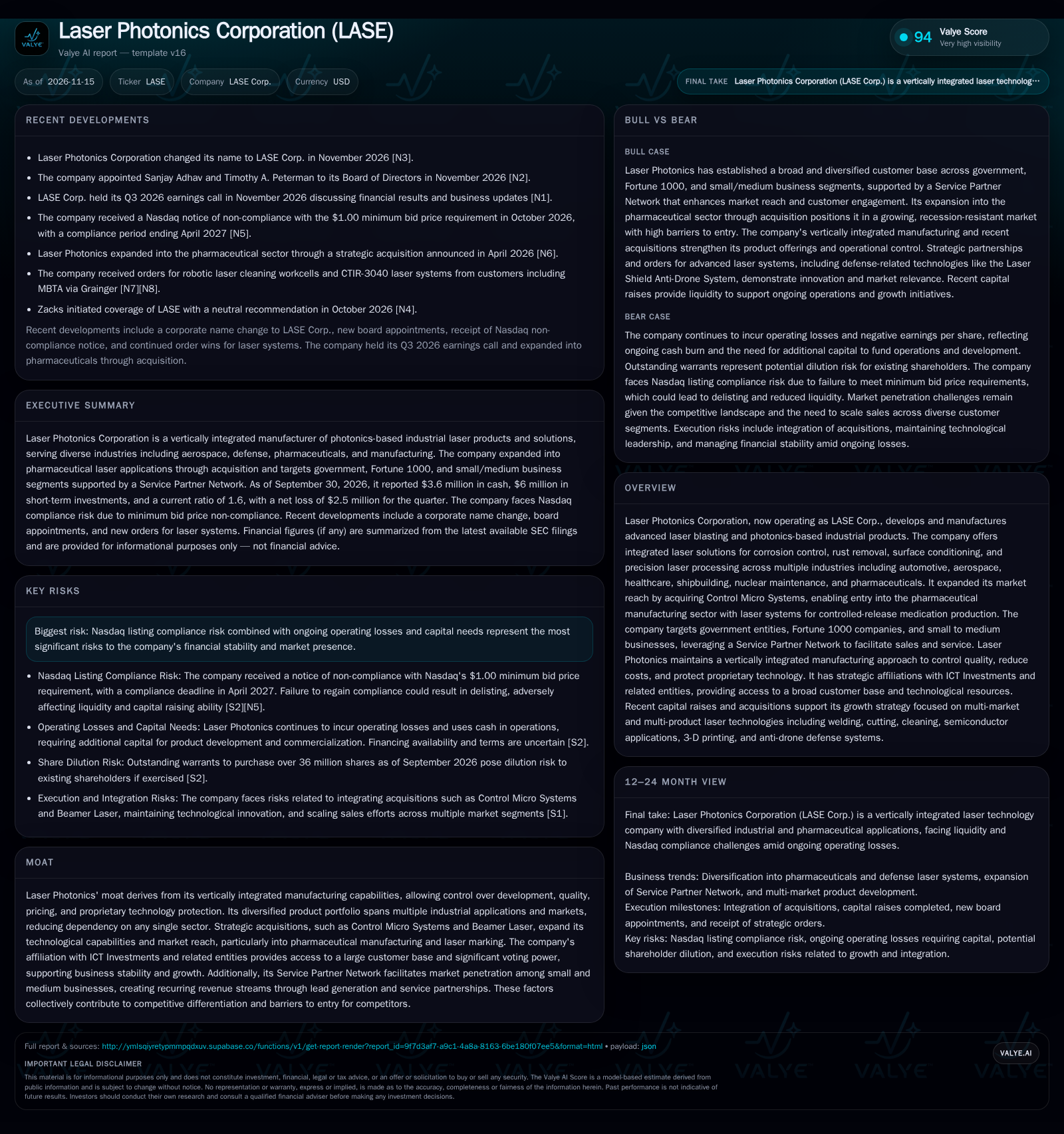
LASE Corp. is expanding across industrial, defense, and pharmaceutical verticals with advanced laser solutions and a vertically integrated model. However, ongoing operating losses, a recent Nasdaq non-compliance notice, and significant outstanding warrants present material risks. The company's ability to integrate acquisitions, sustain innovation, and convert order wins into margin-accretive growth will determine whether its multi-market ambitions translate into durable shareholder value. [S1] [S2] [N5]
Laser Photonics Corporation, now operating as LASE Corp., is staking its future on a broad portfolio of laser-driven solutions spanning industrial cleaning, precision manufacturing, and next-generation defense. The company’s expansion into pharmaceutical manufacturing and anti-drone defense systems, underpinned by recent acquisitions and a vertically integrated strategy, signals ambition to capture value across sectors where automation, quality, and regulatory compliance are critical. Yet, persistent operating losses, potential shareholder dilution from a large pool of outstanding warrants, and the looming threat of Nasdaq delisting due to minimum bid price non-compliance collectively amplify the stakes of business execution. The next 12-18 months will test whether LASE can translate innovation and customer wins into sustainable economics—or remain constrained by capital needs and market skepticism. [S1] [S2] [N5]
Recent Performance and Strategic Moves Shape LASE Corp.’s Immediate Outlook
LASE Corp. reported a net loss of approximately $2.5 million for the quarter ended September 30, 2026, with basic and diluted EPS of -$0.05 per share. As of that date, the company held $3.6 million in cash, $6 million in short-term investments, and recorded current assets of about $10 million against current liabilities of $6.3 million (current ratio 1.6, cash ratio 1.54). The company reported cash and liquidity metrics for the period; these figures do not by themselves establish operating runway, investment capacity, financial flexibility, or financing capacity. [S2]
Strategically, the company has pursued acquisitions—most notably Control Micro Systems for pharmaceutical laser manufacturing and assets of Beamer Laser for IR fiber marking systems—broadening its addressable markets and technical capabilities. Recent orders, including for a robotic laser cleaning workcell and CTIR-3040 system for customers like MBTA via Grainger, signal some commercial traction, though the revenue and margin contributions from these wins have not been disclosed. [S1] [N7] [N8]
Externally, LASE faces a Nasdaq notice of non-compliance with the $1.00 minimum bid price requirement, with a compliance deadline of April 19, 2027. Should the share price remain below this threshold, the company risks delisting, which could reduce trading liquidity and increase financing difficulty. Additionally, with over 36 million common share warrants outstanding, shareholder dilution is a material overhang. [S2] [N5]
How LASE Corp. May Convert Industrial Laser Innovation into Profitable Growth
LASE Corp. operates a vertically integrated manufacturing model, controlling hardware design, assembly, and (potentially) software for its photonics products. This structure theoretically supports better margin capture, quality assurance, and IP protection compared to OEM assemblers or commodity hardware competitors. The company’s product suite spans high-ticket capital equipment (laser cleaning, marking, and processing systems) and, through its Service Partner Network, ongoing service and support contracts—offering possible recurring revenue streams if adoption is sticky.
Pricing in the industrial laser market typically reflects value delivered through automation, labor savings, reduced chemical use, and regulatory compliance—especially in sectors like shipbuilding, aerospace, and pharmaceuticals. However, high upfront costs and lengthy sales cycles are common, often requiring customization and integration. For pharmaceutical manufacturing, regulatory validation and precision manufacturing demands can support premium pricing, but customer acquisition is slower and post-sale support is intensive.
Operating leverage in this model depends on scaling sales faster than fixed costs (R&D, manufacturing overhead, and SG&A). If LASE can ramp order volume through its Service Partner Network and strategic affiliations (such as ICT Investments), manufacturing utilization and gross margins could improve. Conversely, if order flow is lumpy or integration of acquisitions stalls, fixed costs may continue to outpace revenue, extending the company’s history of operating losses.
The need for ongoing capital—in light of negative earnings and cash burn—remains a central constraint. The company’s recent $5 million public offering supplies near-term funding, but the risk of further dilution or unfavorable financing terms persists unless LASE achieves margin-accretive growth. [S1] [S2]
Assessing LASE Corp.’s Edge in a Crowded Industrial Laser Landscape
LASE Corp. claims competitive differentiation from its vertically integrated model, broad product portfolio, and ability to serve diverse industries—from automotive and aerospace to pharmaceuticals and defense. The recent acquisitions of Control Micro Systems and Beamer Laser extend its reach into regulated markets and high-precision applications, potentially raising switching costs for customers who require validated, specialized solutions.
However, the industrial laser ecosystem is marked by established global competitors—ranging from large diversified industrials to specialized photonics firms—many of whom possess deeper resources, more extensive sales channels, and established customer relationships. Price competition is fierce, especially in commoditized segments like basic laser cleaning or marking. LASE’s success may hinge on its ability to deliver demonstrable performance, superior support, or unique features (such as the anti-drone defense system) that address urgent customer pain points.
The Service Partner Network and affiliations with ICT Investments offer a plausible route to expanding reach and building recurring revenue through service contracts. Yet, LASE’s ability to convert these relationships into high-retention, high-margin business remains unproven at scale. The risk is that without clear technology advantages, established trust, or regulatory validation (especially in pharma and defense), the company could face slow adoption and pressure on both volume and pricing.
If Integration and Market Expansion Succeed, Revenue Scale and Margin Expansion Could Follow
A favorable trajectory for LASE would see the company successfully integrating acquired capabilities, translating technical breadth into cross-sell opportunities, and leveraging its Service Partner Network to accelerate adoption among government, Fortune 1000, and SME customers. If the company’s laser cleaning, marking, and pharmaceutical systems can command premium pricing due to regulatory or performance advantages, gross margins should improve as manufacturing utilization rises.
The anti-drone defense initiative—if validated through defense contracts—could open a high-value, defensible niche with limited competition and long-term supply potential. Similarly, if the pharmaceutical vertical delivers repeat orders and establishes LASE as a trusted partner for precision manufacturing, the company could shift its revenue mix toward higher-margin, less cyclical markets.
Confirmation of this scenario would come from sequential growth in order backlog (if disclosed), improved gross margin trends, and evidence of customer retention or multi-year contracts—particularly in pharma and defense. A sustained return to positive operating cash flow and a narrowing net loss would further support the upside case.
Progress Tempered by Execution Hurdles and Dilution: The Most Likely Outcome
The most plausible outcome is that LASE makes incremental progress in integrating acquisitions and expanding its order base, but continues to incur operating losses and relies on periodic capital raises to bridge funding gaps. Order wins from high-profile customers (e.g., MBTA via Grainger) may provide proof points, but unless these translate into sustained, margin-accretive business, the company’s financial profile will remain challenged.
Dilution from outstanding warrants and the risk of Nasdaq delisting could weigh on investor sentiment and limit the company’s access to low-cost capital. The underlying value proposition—diversified industrial and pharmaceutical laser solutions—remains attractive in theory, but market penetration is likely to be gradual given entrenched competitors, long sales cycles, and the need for regulatory validation in new verticals.
This scenario would be confirmed by continued net losses, modest sequential revenue growth, and additional equity financings. Evidence to the contrary—such as a rapid ramp in high-margin recurring revenue, or a successful Nasdaq compliance remediation—would be required to shift the base thesis.
Delayed Adoption and Funding Stress Could Trigger Value Erosion and Strategic Setbacks
In a negative scenario, LASE’s multi-vertical approach could stretch management and financial resources too thin, leading to integration setbacks, delayed product launches, or loss of technical edge. If order flow stalls or large customers delay adoption, fixed costs would remain high relative to revenue, extending cash burn and forcing more dilutive or distressed capital raises.
Failure to regain Nasdaq compliance could result in delisting, materially reducing trading liquidity and raising the cost of capital. In this case, the company might have to consider strategic alternatives—such as asset sales, business restructuring, or abandoning less profitable verticals—to preserve core business value.
Downside confirmation would come from widening net losses, declining cash balances, evidence of acquisition integration issues, or announcements of strategic reviews. Accelerated warrant exercises at depressed prices would amplify dilution, while any regulatory or customer pushback in pharma or defense verticals could further erode the growth thesis.
Milestones That Will Determine Whether LASE Corp. Can Deliver on Its Laser Technology Promise
Order backlog growth and composition, if disclosed, especially the proportion attributable to pharmaceutical and defense applications.
Gross margin trends by product category—improving margins would signal manufacturing leverage and pricing power.
Integration milestones for recent acquisitions (Control Micro Systems, Beamer Laser), including cross-selling activity and cost synergies.
Nasdaq compliance status updates and any actions taken to address the minimum bid price requirement.
Dilution impact from warrant exercises and any further equity or debt financings.
Customer retention rates or renewal/expansion activity within the Service Partner Network, if disclosed.
Progress and validation milestones for the Laser Shield Anti-Drone System, including any awarded contracts or regulatory clearances.
Disclaimer: This is research-only, informational analysis and not investment advice. It may include AI-generated interpretation and general industry context. Always verify important details using primary sources.

Comments