
NIQ Global Intelligence: Subscription Economics, AI Leverage, and the Stakes of Expansion Beyond Core FMCG Analytics
NIQ Global Intelligence operates a high-retention, subscription-driven analytics platform for global consumer brands and retailers. Recent AI-powered product innovation, strategic acquisitions, and strong net dollar retention anchor its thesis, but future value hinges on the company’s ability to expand wallet share, successfully cross-sell, and withstand intensifying competition in consumer intelligence and analytics.
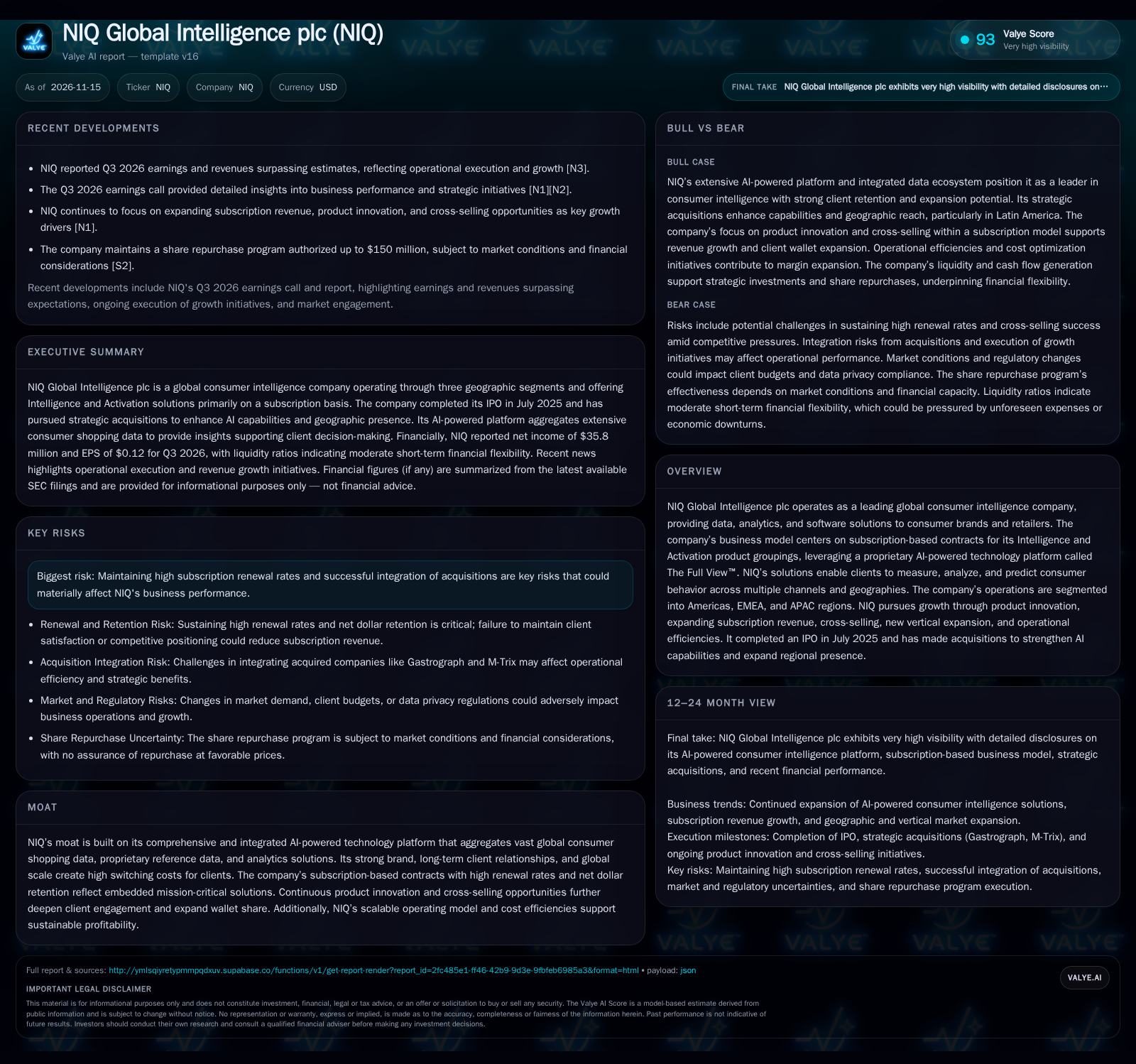
NIQ Global Intelligence delivers global consumer analytics via a predominantly subscription-based model, achieving 105% net dollar retention and 81% revenue concentration in its Intelligence segment. Recent acquisitions and AI-powered product launches target expansion, but sustaining high renewal rates and successful cross-selling remain critical levers—and risks—for future growth. Margin improvement, fueled by scalable tech and cost optimization, supports the investment case, but integration and execution challenges could temper upside if not managed carefully. [S1] [S2]
NIQ Global Intelligence plc’s value proposition rests on a sticky, data-rich subscription model serving global consumer brands and retailers. With its Intelligence segment generating 81% of revenue and a net dollar retention of 105%, NIQ has built a foundation of recurring, expanding client relationships. The company’s recent AI-centric acquisitions and product launches aim to deepen its analytics moat and open new verticals, but the path forward will require sustained execution on up-selling, cross-selling, and operational integration in a market where switching costs and client loyalty are significant—but not unassailable.
Recent Results Highlight Subscription Strength and Margin Progress
For the quarter ended September 30, 2026, NIQ Global Intelligence reported net income of $35.8 million and diluted EPS of $0.12, reflecting operational profitability alongside growth investments. The company reported cash and liquidity metrics for the period; these figures do not by themselves establish operating runway, investment capacity, financial flexibility, or financing capacity. [S2]
Subscription-based Intelligence solutions accounted for 81% of total revenue, and approximately 84% of Intelligence revenue came from multi-year or annual contracts. Critically, net dollar retention in the Intelligence segment reached 105% for the nine months ending September 2026, indicating that existing clients are expanding their spend, more than offsetting churn. [S1]
NIQ completed significant strategic moves in the past year: raising $985.1 million in its July 2025 IPO (used to repay borrowings), acquiring Gastrograph to bolster AI capabilities, and acquiring M-Trix to expand its Latin American footprint. [S1]
The company’s authorized $150 million share repurchase program remains subject to market and financial conditions, reflecting a degree of capital allocation flexibility but no guaranteed return to shareholders. [S2]
How NIQ’s Subscription Model and AI Platform Drive Profitability
NIQ’s primary economic engine is its subscription-based Intelligence segment, where multi-year or annual contracts generate predictable, recurring revenue. High net dollar retention (105%) suggests that upselling and cross-selling are effective, with clients increasing their spend over time. The model’s stickiness is rooted in the mission-critical nature of NIQ’s data and analytics for large consumer brands and retailers, who rely on these insights for product, pricing, and marketing decisions.
Pricing power in this market is typically a function of data breadth, integration with client workflows, and demonstrable ROI from analytics. NIQ’s unified AI platform, The Full View™, aggregates and harmonizes global consumer data, enabling the company to command premium pricing—especially as clients seek omnichannel and predictive insights. However, pricing pressure could arise if alternative data sources or analytics platforms achieve parity in data quality or integration.
On the cost side, NIQ has demonstrated operating leverage through technology and geographic talent sourcing. Cash data costs have fallen from 22% to 15% of revenue since 2021, a result of AI-enabled efficiencies and scale. This margin improvement provides room to reinvest in product development and sales expansion, but future gains may be incrementally harder as the low-hanging cost optimizations are exhausted.
Capital needs are modest in a software/data platform business, with growth investments focused on product innovation, AI development, and selective M&A. The IPO proceeds were primarily used to deleverage, reducing financial risk, but ongoing investments in new verticals and international expansion could require incremental capital if organic cash generation proves insufficient.
Competitive Moats, Switching Costs, and the Battle for Data Supremacy
NIQ’s competitive position is anchored in the scale and integration of its data ecosystem, the depth of its client relationships, and the proprietary nature of its analytics platform. The company’s global reach and ability to aggregate diverse retail and consumer data create high switching costs for large enterprise clients, who often embed NIQ’s insights into core strategic processes.
However, the broader consumer analytics market is intensely competitive, with established players in syndicated data, emerging AI-driven analytics startups, and large technology companies offering alternative solutions. Competitive threats include data commoditization, vertical disintermediation (e.g., retailers developing in-house analytics), and price-based competition from new entrants targeting specific geographies or verticals.
Recent acquisitions (Gastrograph, M-Trix) suggest a strategic focus on both deepening AI capabilities and expanding into fast-growing or under-penetrated regions. The ability to cross-sell Activation analytics to Intelligence clients, and to move into new verticals (pet, beauty, financial services, etc.), will test the company’s product integration and sales execution.
Enduring differentiation depends on continuous product innovation, the breadth and accuracy of data, and NIQ’s ability to embed itself deeper into client workflows—outpacing both legacy and insurgent competitors.
AI-Driven Cross-Selling and International Expansion Unlock Accelerated Growth
A favorable scenario for NIQ sees its AI-powered platform enabling meaningful product innovation—such as advanced eCommerce measurement, omnichannel shopper analytics, and digital shelf solutions—driving both wallet share expansion among existing clients and penetration into new verticals. If the company can maintain or improve net dollar retention above 105%, this would indicate successful cross-selling and upselling, particularly as clients adopt higher-value Activation solutions.
International growth, especially in under-penetrated markets like Latin America (bolstered by the M-Trix acquisition), could further accelerate revenue as consumer analytics adoption increases outside North America and Western Europe.
Margin expansion may continue if AI-driven efficiencies reduce data acquisition and processing costs, and if operating leverage holds as revenue scales.
Evidence confirming this scenario would include: sustained net dollar retention above 105%, rising proportion of revenue from new verticals or geographies, continued decline in data costs as a percent of revenue, and above-market revenue growth rates in quarterly results.
Sustained Recurring Revenue Growth, with Execution and Integration as Key Variables
The most plausible middle path for NIQ is continued steady growth in subscription revenue from its core Intelligence segment, with incremental gains from Activation cross-sell and international expansion. Net dollar retention remains at or slightly above 100%, reflecting ongoing wallet share growth but moderated by competitive pressures and some client churn.
Integration of recent acquisitions delivers moderate synergies but also absorbs management attention and operational resources. Product innovation keeps pace with evolving client needs but does not produce a step-change in demand or pricing power.
Margins improve gradually as technology and cost optimization efforts persist, but the pace of efficiency gains slows.
Evidence for this scenario would be stable or slightly improving net dollar retention, gradual revenue growth in line with industry benchmarks, and steady margin improvement in financial disclosures.
Renewal Slippage and Integration Risks Threaten Growth Trajectory
The adverse scenario for NIQ involves a material decline in subscription renewal rates or net dollar retention, potentially triggered by increased competition, pricing pressure, or client dissatisfaction with new product offerings. If key clients reduce spend or switch to alternative providers, the high-visibility revenue base could erode faster than new wins can offset.
Integration challenges with Gastrograph or M-Trix—ranging from cultural misalignment to technical platform incompatibility—could result in operational disruption, lost sales momentum, or cost overruns. Regulatory changes, particularly around data privacy, could also increase compliance costs or restrict data flows, impacting product value.
Margin pressure may intensify if data acquisition or processing costs rise, or if the company is forced to discount to retain clients. Liquidity, while currently adequate, could become a concern if profitability stalls and investment needs persist.
Confirmation of this scenario would include reported declines in net dollar retention, missed revenue or margin targets, negative commentary on acquisition integration, or increased client churn disclosed in filings or earnings calls.
Milestones That Will Test NIQ’s Analytics Moat and Growth Ambitions
Quarterly net dollar retention rates in the Intelligence segment—if disclosed—will be the clearest indicator of wallet share expansion or erosion.
Revenue contribution from new verticals (e.g., pet, beauty, financial services) would help test the success of NIQ’s expansion strategy.
Progress on cross-selling Activation solutions to existing Intelligence clients, measured by attach rates or Activation revenue growth, if disclosed, would be a key proof point.
Integration updates and synergy realization from Gastrograph and M-Trix acquisitions—watch for management commentary or cost/revenue impact.
Trends in data acquisition and processing costs as a percentage of revenue will indicate whether AI-enabled efficiencies are continuing to deliver margin gains.
Client churn or renewal rates, particularly among top 20 customers, would help surface competitive pressure or satisfaction risks.
Geographic revenue growth, especially in Latin America and APAC, will signal whether regional expansion is translating into material financial impact.
Any regulatory disclosures or commentary on data privacy compliance costs, which could affect the scalability of NIQ’s data-driven model.
Disclaimer: This is research-only, informational analysis and not investment advice. It may include AI-generated interpretation and general industry context. Always verify important details using primary sources.

Comments