
Rockwell Medical’s Vantive Acquisition: Scale Ambitions, Margin Pressures, and the Stakes of Dialysis Market Evolution
Rockwell Medical’s pending acquisition of Vantive’s in-center hemodialysis business marks a strategic leap in scale and complexity, but introduces heightened financial leverage, operational risks, and exposure to shifting dialysis treatment paradigms. The company’s reliance on a concentrated customer base, inability to fully offset rising costs, and dependence on continued in-center dialysis utilization define both its immediate upside and its existential vulnerabilities.
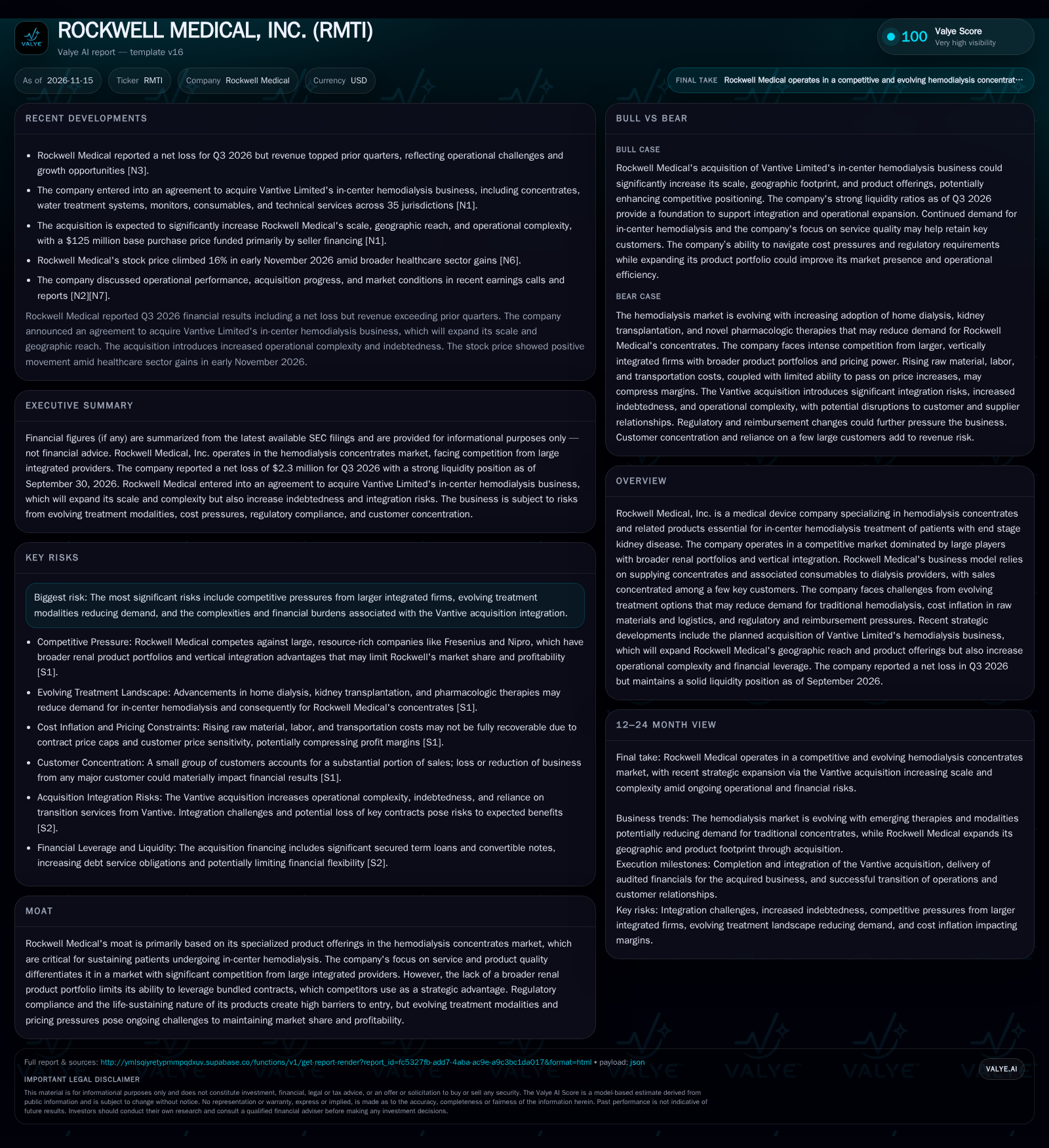
Rockwell Medical is set to significantly expand its scale and product reach through the acquisition of Vantive’s hemodialysis business, but faces margin compression, integration risks, and long-term demand uncertainty as the dialysis treatment landscape evolves and customer concentration remains acute. The outcome of this acquisition and the company’s ability to manage rising costs and regulatory headwinds will be critical to its future trajectory. [S2] [N1]
Rockwell Medical’s bold move to acquire Vantive Limited’s in-center hemodialysis business signals a decisive bet on scale in a market facing both entrenched competition and structural change. While the deal could broaden Rockwell’s geographic and product footprint overnight, it also magnifies operational and financial risks—including a sharply higher debt burden and the formidable task of integrating a business spanning 35 jurisdictions. With persistent margin pressure, heavy customer concentration, and the dialysis industry itself in flux, Rockwell’s future will hinge on its ability to navigate integration, defend its core revenue base, and adapt to the shifting landscape of kidney disease treatment. [S2] [N1]
Vantive Acquisition Transforms Scale—and Raises the Stakes
Rockwell Medical has signed an agreement to acquire Vantive Limited’s in-center hemodialysis business—including concentrates, water treatment systems, monitors, consumables, and technical services spanning 35 jurisdictions—for a base purchase price of $125 million, funded primarily by seller financing. This acquisition, announced November 2, 2026, will dramatically increase Rockwell’s operational scale and global reach, but also introduces substantial new indebtedness and integration complexity. [N1] [S2]
As of September 30, 2026, Rockwell reported cash and equivalents of $10.6 million, current assets of $37.2 million, current liabilities of $15.1 million, and a current ratio of 2.47. However, the company reported a net loss of $2.3 million and basic EPS of -$0.59 for Q3 2026, highlighting ongoing profitability challenges. [S2]
The company’s sales remain heavily concentrated among a small number of customers, with a historical reliance on one major account whose purchases have declined since 2025. This customer concentration amplifies the revenue impact of any contract loss or renegotiation. [S1]
Rockwell’s stock price climbed 16% in early November 2026, likely reflecting market optimism around the Vantive deal and broader healthcare sector momentum. [N6]
How Economics of Scale and Cost Pressures Shape Rockwell’s Model
Rockwell Medical’s core business is supplying hemodialysis concentrates and related consumables to in-center dialysis providers. Revenue is driven by the volume of treatments performed in dialysis clinics, making the business sensitive to trends in patient census and the prevalence of in-center versus home-based modalities. Pricing power is limited: most customer contracts have price caps or fixed terms, and dialysis providers are highly cost-sensitive, limiting Rockwell’s ability to offset rising input costs.
The company’s fixed cost base is significant, with manufacturing, quality assurance, and regulatory compliance costs largely insensitive to short-term volume fluctuations. Variable costs—including raw materials, logistics, and labor—have risen due to inflation and supply chain pressures, but Rockwell has limited contractual flexibility to pass these increases through to customers. As a result, margin compression is a persistent risk, and operating leverage can cut both ways: higher volumes from the Vantive acquisition could improve margins if integration is smooth and cost synergies are realized, but any operational disruption or contract loss could exacerbate losses.
The $125 million Vantive deal is funded primarily by seller financing, immediately increasing Rockwell’s financial leverage and debt service obligations. The company’s ability to access additional capital may be constrained until audited financials for the acquired business are delivered and filed, potentially limiting flexibility to respond to unforeseen shocks during integration. [S2]
Competing Against Vertical Integration and the Shift Toward Home Dialysis
Rockwell Medical operates in a market dominated by large, vertically integrated players such as Fresenius and Nipro, which bundle concentrates with a broader suite of renal products and services. These competitors can leverage purchasing power, integrated supply chains, and bundled contracts to offer more comprehensive solutions to dialysis providers—often at lower effective prices. Rockwell, lacking a full-spectrum renal portfolio, competes primarily on product quality, reliability, and service, but this leaves it exposed to price-based competition and contract churn.
Additionally, the threat of substitution is rising. Advances in home dialysis technology, greater adoption of peritoneal dialysis, kidney transplantation, and emerging pharmacologic therapies may reduce the total addressable market for in-center hemodialysis—and thus for Rockwell’s concentrates. While the Vantive acquisition may help diversify Rockwell’s product and geographic base, it does not fundamentally insulate the company from the risk of market contraction due to changing treatment paradigms.
Customer concentration further weakens bargaining power; the loss or renegotiation of a single large contract can have outsized revenue and margin impact. Regulatory barriers and the life-sustaining nature of dialysis concentrates do create high switching costs and entry barriers, but these alone may not be enough to ensure durable profitability in the face of shifting industry dynamics. [S1]
If Integration Succeeds and In-Center Dialysis Demand Holds Steady
A favorable outcome for Rockwell Medical would see the Vantive acquisition successfully integrated, with minimal customer or supplier attrition and realization of operational synergies. The enlarged company could benefit from procurement scale, a broader product suite, and improved geographic reach, potentially enhancing its negotiating position with both suppliers and customers. If in-center hemodialysis remains the dominant modality despite emerging alternatives, Rockwell could see a meaningful uplift in revenue and, with careful cost management, margin improvement.
Confirmation of this scenario would include smooth transition of Vantive operations, rapid delivery of audited financials, stable or growing volumes from legacy and acquired customers, and early evidence of cost savings or cross-selling opportunities. Watch for sustained revenue growth, improving gross margins, and a reduction in customer concentration risk as signs the company is capturing the intended benefits of scale.
Scale Brings Growth—but Margin Pressures and Market Risks Persist
The most plausible middle path is that Rockwell Medical completes the Vantive acquisition, expands its revenue base, and diversifies its product and geographic exposure, but continues to face significant margin pressure from cost inflation and limited pricing power. Integration challenges may cause some operational hiccups and customer attrition, but not enough to fundamentally derail the deal’s growth thesis. The core market for in-center hemodialysis is likely to remain stable in the near term, but may gradually erode as alternative therapies gain traction.
This scenario would be confirmed by moderate revenue growth post-acquisition, choppy but gradually improving margins as integration progresses, and ongoing dependence on a handful of major customers. Evidence that would challenge this scenario includes either a sharp drop in acquired business volumes or a major contract loss, or conversely, unexpectedly rapid adoption of home or alternative dialysis modalities that significantly shrink the addressable market.
Integration Missteps and Industry Shifts Threaten Revenue and Solvency
The most adverse scenario would see Rockwell Medical struggle to integrate the Vantive business, resulting in operational disruptions, loss of key customers, or supplier renegotiations on unfavorable terms. Meanwhile, accelerated adoption of home dialysis, kidney transplantation, or novel therapies could reduce in-center treatment volumes faster than expected, shrinking the core market and stranding recently acquired assets.
Confirmation of this scenario would include missed integration milestones, delayed or qualified delivery of audited financials, negative working capital trends, declining volumes or contract losses, and downward revisions to revenue or margin guidance. A liquidity event or need for emergency capital—especially if access is constrained by deal covenants—would further validate a severe downside.
Milestones and Industry Shifts That Will Determine Rockwell’s Trajectory
Successful and timely completion of the Vantive acquisition, including delivery and filing of audited financial statements for the acquired business.
Retention rates and volume trends for major legacy and acquired customer contracts—especially any updates to customer concentration metrics, if disclosed.
Gross margin evolution post-acquisition, particularly whether cost synergies or procurement scale offset inflationary pressures.
Integration progress: on-time achievement of operational and system transitions, and any disclosed disruptions in supply, logistics, or customer service.
Changes in the mix of in-center versus home dialysis and transplantation rates in core markets, as reported by industry sources.
Any regulatory or reimbursement policy shifts affecting dialysis provider funding or concentrate reimbursement rates.
Trends in raw material, labor, and transportation costs and the company’s ability (if disclosed) to renegotiate contract pricing or secure input cost relief.
Debt service coverage and liquidity metrics, particularly if integration or market headwinds require additional capital or trigger covenant concerns.
Disclaimer: This is research-only, informational analysis and not investment advice. It may include AI-generated interpretation and general industry context. Always verify important details using primary sources.

Comments