
BCP Investment Corp: Navigating Middle Market Debt, Merger Dynamics, and the Realities of Below-Investment-Grade Risk
BCP Investment Corp’s model as an externally managed BDC targets income generation from a diversified, largely speculative debt portfolio in the U.S. middle market. Recent merger activity, persistent net losses, and a reliance on below-investment-grade instruments shape both its opportunity and risk profile.
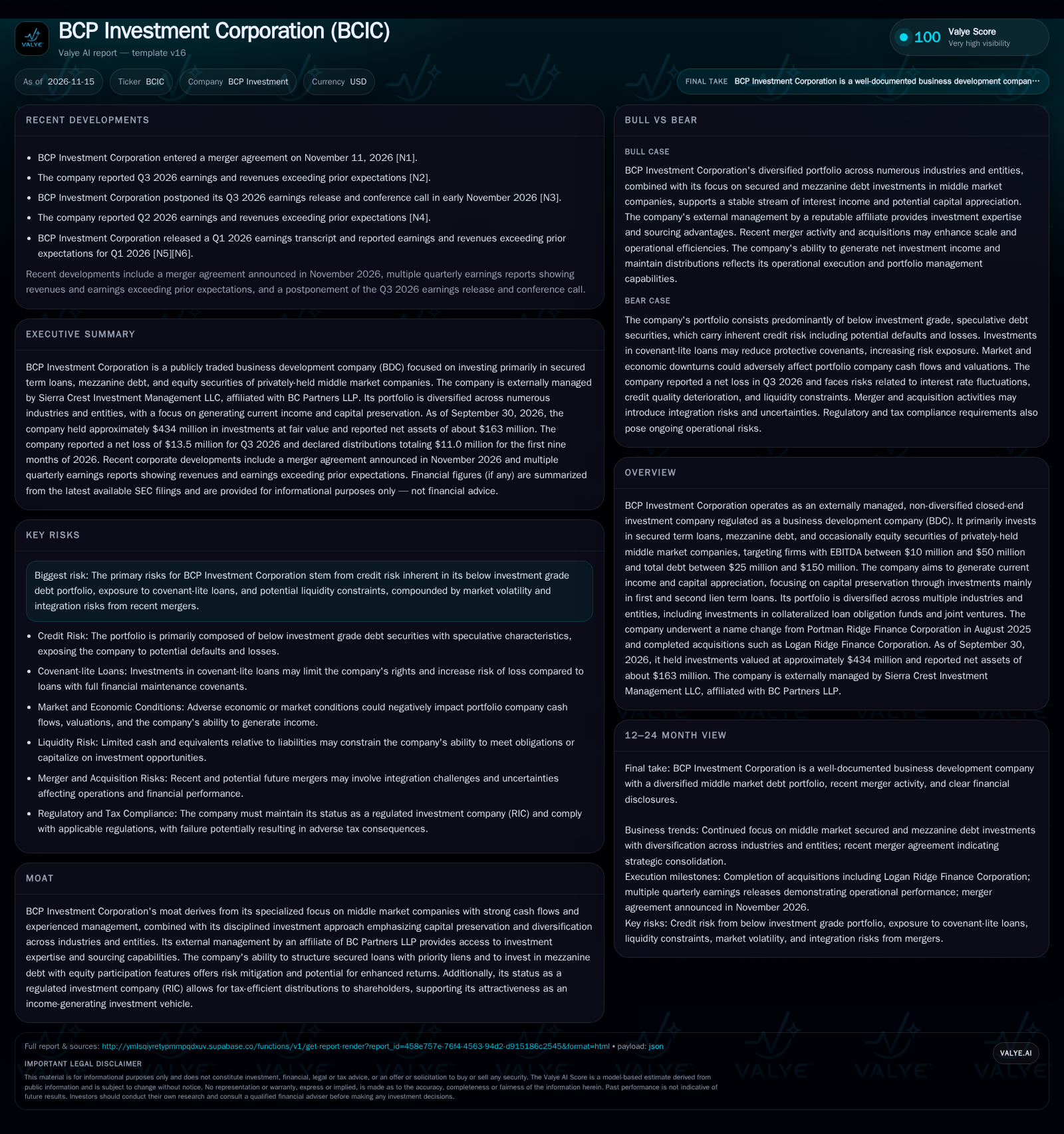
BCP Investment Corp (BCIC) is a business development company focused on secured and mezzanine debt investments in privately-held middle market firms, primarily below investment grade. A newly announced merger could reshape scale and portfolio construction, but also introduces integration and strategic uncertainties. The company’s ability to generate stable income depends on credit discipline, capital market access, and effective risk management in a volatile environment. [S1] [S2] [N1]
BCP Investment Corp occupies a distinctive niche as a business development company (BDC) focused on generating current income from a diversified portfolio of largely below-investment-grade debt in the U.S. middle market. The recently announced merger agreement and persistent net losses highlight both the potential for structural change and the ongoing fragility of the business. Understanding BCIC’s economics, risk levers, and strategic direction is essential for assessing its future resilience and return prospects. [S1] [S2] [N1]
Merger Agreement, Net Losses, and Portfolio Scale: What’s Changing Now?
BCP Investment Corp entered a merger agreement on November 11, 2026, marking a potentially transformative event for its scale, cost structure, and portfolio composition. The specifics of the merger—including counterparty, terms, and strategic rationale—are not detailed in the available sources, but the move signals a response to either competitive, operational, or portfolio challenges. [N1]
As of September 30, 2026, BCIC reported $434 million in investments at fair value, diversified across 108 entities and 41 industries, with net assets of $163 million. However, the company posted a net loss of $13.5 million in Q3 2026, with a net loss per share of $1.09, despite exceeding earnings and revenue estimates in earlier quarters. This suggests volatility in portfolio performance, possibly due to credit events, valuation marks, or integration costs from recent acquisitions. [S2] [N2] [N4]
The portfolio remains heavily concentrated in first- and second-lien loans and mezzanine debt to private middle market companies, a segment traditionally exposed to higher credit risk and lower liquidity. The company’s continued distribution of $11 million over nine months underscores its focus on income generation, but the sustainability of these payouts is challenged by recurring net losses. [S1] [S2]
How BCIC’s Business Model Generates—and Risks—Income
BCIC’s revenue engine is built on interest and fee income from secured term loans, mezzanine debt, and occasional equity positions in privately held middle market companies. These loans typically command higher yields than investment-grade debt due to their speculative risk profile, offering the potential for outsized current income. However, this risk premium is a double-edged sword: any uptick in borrower defaults, downgrades, or restructurings can quickly erode both income and capital.
The company’s cost structure reflects both operating expenses and the external management fee paid to Sierra Crest Investment Management (affiliated with BC Partners LLP). This model provides professional sourcing and portfolio oversight, but also introduces a layer of fixed costs that can drag on net investment income, especially if asset values decline or credit losses mount.
Operating leverage in the BDC model is amplified by the use of debt financing—total liabilities reached $287 million as of September 2026. While leverage can enhance returns in benign environments, it increases vulnerability to adverse credit cycles and refinancing risk. The company’s low cash and equivalents ($2.35 million) relative to liabilities may also constrain flexibility to support the portfolio or capitalize on new opportunities if market conditions deteriorate. [S2]
Distributions to shareholders are an important feature for BDCs, often funded from net investment income. Persistent net losses, however, raise questions about the sustainability of these payouts and the risk of return-of-capital distributions if operating results do not improve.
Specialization in Middle Market Credit: Differentiation or Commodity Risk?
BCIC’s focus on lending to privately held middle market firms with EBITDA between $10 million and $50 million differentiates it from BDCs targeting either smaller, riskier credits or large, syndicated loans. This segment is characterized by less competition from banks (due to regulatory constraints) and the potential for bespoke deal structures, which can command premium yields and investor protections.
However, the competitive landscape is crowded with other BDCs, private credit funds, and institutional lenders chasing similar deals. Access to proprietary deal flow via its external manager can be an advantage, but the prevalence of covenant-lite loans in the market erodes lender protections and makes credit discipline critical. When competition intensifies, pricing power diminishes and underwriting standards can slip, increasing the risk of portfolio impairments.
The portfolio’s diversification across 41 industries and 108 entities helps mitigate idiosyncratic risk, but the overall exposure to below-investment-grade borrowers means BCIC’s fortunes remain highly correlated with the health of the U.S. middle market and the broader credit environment.
If Credit Quality Holds and Merger Synergies Materialize, Income and Valuation Could Recover
A bullish scenario for BCIC hinges on stabilizing credit conditions across its portfolio and successful integration of the announced merger. If defaults remain low, underlying borrowers maintain cash flow coverage, and interest rates remain favorable, BCIC could continue to generate strong net investment income, supporting both distributions and gradual NAV recovery.
Merger synergies—such as cost savings, improved sourcing, or expanded access to proprietary deals—could enhance operating margins and portfolio returns. If the combined entity achieves greater scale, it may also unlock better financing terms or reduce fee drag. Evidence confirming this scenario would include a return to net profitability, improved net asset value per share, and stable or growing distributions without return-of-capital. Additional signs would be successful integration disclosures, absence of major credit impairments, and positive commentary from management regarding merger benefits.
Falsification would come from negative credit migration, realized losses, or failure to achieve promised merger efficiencies, leading to shrinking net investment income or further NAV erosion.
Portfolio Income Remains Volatile Amid Ongoing Credit and Integration Uncertainties
The most plausible outcome is a continuation of BCIC’s current pattern: generating meaningful investment income from a diversified but speculative middle market credit portfolio, while facing recurring bouts of volatility tied to credit events, borrower stress, and fair value marks.
Net investment income may remain positive, but periodic net losses are likely as credit impairments, market-driven valuation swings, and integration costs from recent and pending mergers flow through the income statement. The ability to maintain distributions without eroding net asset value will depend on disciplined underwriting, effective risk management, and measured leverage.
Evidence supporting this scenario would include continued portfolio diversification, stable or slightly declining NAV, and periodic—but not escalating—realized losses. Confirmation would also come from the company maintaining its BDC regulatory status and avoiding major liquidity crunches.
A move away from this scenario would be signaled by a sharp rise in defaults, persistent negative net investment income, or unsuccessful merger execution resulting in cost overruns or lost deal flow.
Credit Deterioration and Liquidity Strain Could Force Asset Sales or Distribution Cuts
In an adverse scenario, a deteriorating credit environment could lead to rising borrower defaults, lower recovery values on impaired loans, and increased non-accruals. Given BCIC’s concentration in below-investment-grade debt, even modest macroeconomic stress could trigger outsized losses relative to capital.
If net investment income turns negative and realized losses mount, the company could be forced to cut or suspend shareholder distributions to preserve capital. Integration missteps with merger counterparties could further exacerbate operational disruptions or erode fee income.
Confirmation of this scenario would include a spike in non-performing assets, negative net investment income for multiple quarters, NAV declines exceeding realized distributions, and management guidance signaling reduced payouts or asset sales.
Signals That Will Shape the Future of BCIC’s Middle Market Credit Strategy
The reported net investment income versus net losses each quarter—if disclosed—will clarify whether the company is maintaining its income engine or eroding capital.
Net asset value (NAV) per share trends, especially after the merger closes, will reveal whether value is being created, preserved, or lost.
Non-accrual rates and realized credit losses in the loan portfolio—if disclosed—will serve as a barometer for credit discipline and the health of underlying borrowers.
Leverage ratios and refinancing activity, including any amendments to credit facilities, will indicate potential financial flexibility or looming liquidity pressure.
Distributions paid relative to net investment income (and any return-of-capital components) will show the sustainability of payouts.
Progress reports and integration metrics on the announced merger—such as cost savings, changes in portfolio composition, or management commentary—will be critical to assessing the strategic direction.
Any changes in portfolio concentration by industry or borrower, if disclosed, would help test whether risk is being diversified or inadvertently increased.
Updates on regulatory compliance and maintenance of BDC and RIC status will be important to monitor for potential tax or operational headwinds.
Disclaimer: This is research-only, informational analysis and not investment advice. It may include AI-generated interpretation and general industry context. Always verify important details using primary sources.

Comments