
Kiora Pharmaceuticals: Orphan Drug Ambitions, Partnership Leverage, and the Unfolding Clinical Risk Cycle
With late-stage clinical assets targeting retinal diseases of high unmet need and strategic collaborations that offload development costs, Kiora Pharmaceuticals stands at a critical juncture. Its future will be shaped by pivotal 2027 trial readouts, execution under complex licensing deals, and the delicate balance between capital sufficiency and clinical progress.
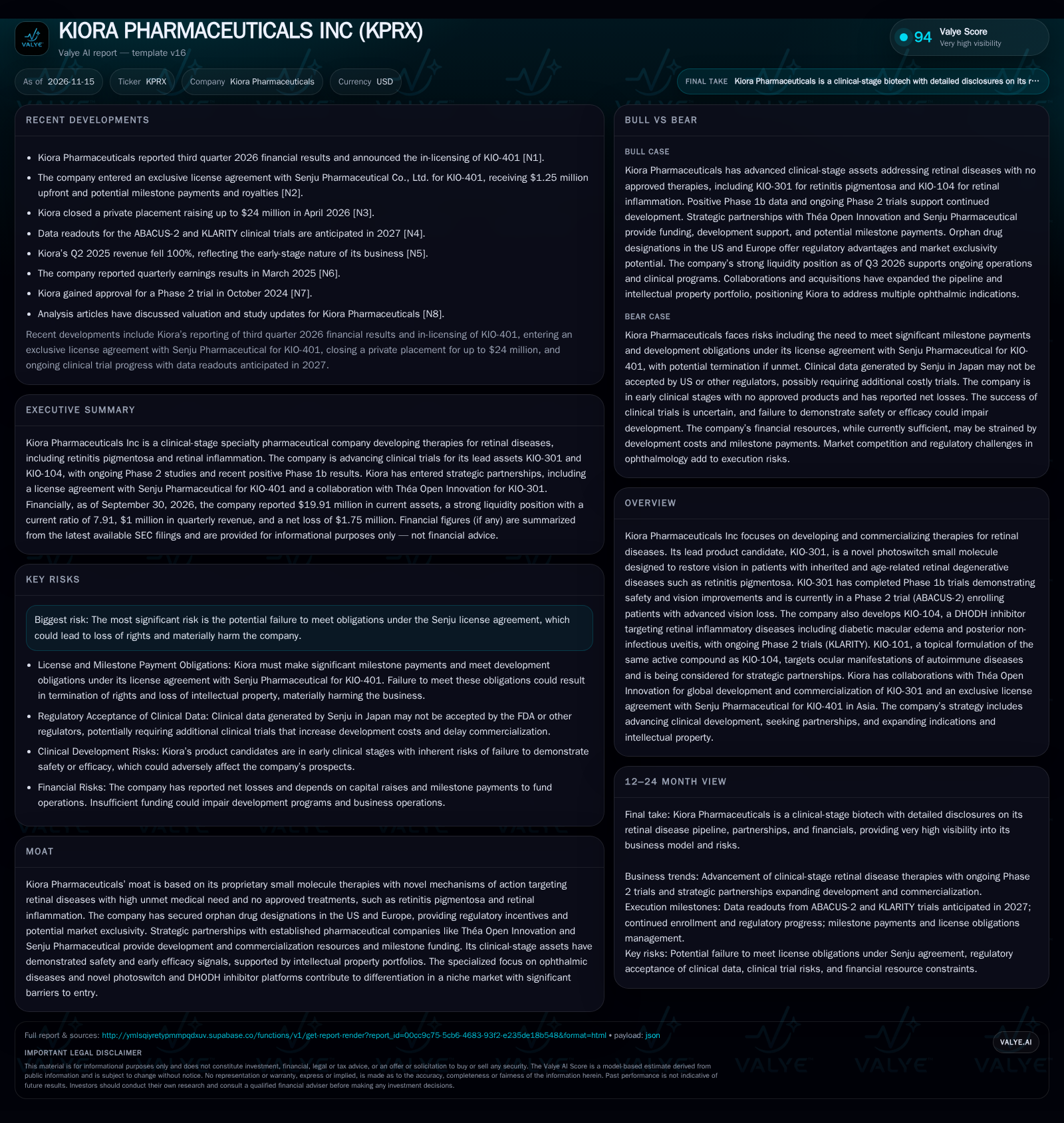
Kiora Pharmaceuticals is advancing novel therapies for retinal diseases, with its lead asset KIO-301 in Phase 2 and supported by a global partnership that funds development. Recent milestones include a $24 million private placement and multi-million-dollar licensing deals. The company's near-term outlook hinges on successful clinical execution, regulatory acceptance of ex-US data, and fulfillment of licensing obligations, with 2027 trial readouts as a major inflection point. Financial resources appear sufficient for ongoing operations, but dependency on milestones and the early-stage nature of the pipeline amplify risk [S1] [S2] [N3] [N4].
Kiora Pharmaceuticals has positioned itself as a high-leverage player in the retinal disease space, targeting rare and underserved ophthalmic conditions with no approved therapies. The company’s lead asset, KIO-301, is backed by both Orphan Drug status and a global development partnership, while a second program, KIO-104, pushes into inflammatory retinal disease. Recent capital raises and licensing deals provide operational runway and external validation, but the company’s fortunes remain tied to the success of ongoing Phase 2 trials and the management of complex partner obligations. With major clinical readouts on the horizon in 2027, Kiora exemplifies the opportunity—and risk—profile of a late-clinical-stage biotech at an inflection point.
Recent Licensing Activity and Clinical Progress Set the Stage for 2027 Inflection
The most material present facts for Kiora Pharmaceuticals are its advancement of KIO-301 into a 36-patient Phase 2 trial (ABACUS-2) for retinitis pigmentosa, the in-licensing and monetization of KIO-401 via a deal with Senju Pharmaceutical, and a recent $24 million private placement to bolster capital reserves. KIO-301’s Orphan Drug Designation in both the US and EU, plus its global co-development with Théa Open Innovation (which funds all R&D), reduces financial risk for this lead asset [S1]. The Senju deal brought $1.25 million upfront and promises up to $109.5 million in milestones, but carries the risk of termination if development obligations are not met [N2]. Financially, as of September 30, 2026, Kiora had $5.57 million in cash and $10.72 million in short-term investments, with current assets of $19.91 million and a current ratio of 7.91, reflecting a reported liquidity position snapshot [S2]. The critical near-term catalyst is the anticipated 2027 readouts from the ABACUS-2 and KLARITY Phase 2 trials [N4].
How Kiora Could Monetize Innovation in Retinal Disease
Kiora’s business model is typical of late-stage specialty biotech: up-front capital is deployed into R&D for high-value, niche indications (retinal diseases) with the intent to secure regulatory approval and command premium pricing. KIO-301’s Orphan Drug Designation in the US and Europe could confer seven to ten years of market exclusivity, allowing for significant pricing power if successful. The company’s economics are heavily milestone- and partnership-dependent: Théa Open Innovation funds all R&D for KIO-301, shifting fixed development costs off Kiora’s balance sheet and reducing dilution risk, while licensing deals like Senju for KIO-401 offer staged non-dilutive funding tied to performance milestones [S1] [N2].
Revenue visibility is low until product approval, and the $1 million in recent quarterly revenue likely reflects upfront or milestone payments rather than recurring product sales [S2]. Fixed costs are dominated by R&D and G&A, and the company is still reporting net losses as expected at this stage. If KIO-301 or KIO-104 succeed in late-stage trials and are approved, gross margins could be high due to premium orphan pricing and modest COGS, but commercial ramp will depend on market access and specialist adoption. The company’s capital needs will remain substantial until at least one asset achieves approval or a lucrative out-licensing/partnership exit.
Barriers, Differentiation, and the Competitive Landscape in Ophthalmic Drug Development
Kiora’s competitive position is defined by its focus on rare retinal diseases with high unmet need, where few or no approved therapies exist. This creates an opportunity for first-mover advantage—especially in retinitis pigmentosa, where KIO-301’s photoswitch mechanism is novel and could provide functional vision restoration where gene therapies or implants are impractical. The company’s moat is strengthened by Orphan Drug exclusivity, specialized intellectual property, and the support of established partners (Théa Open Innovation and Senju) that can provide commercial and regulatory leverage [S1].
However, the competitive landscape is evolving: gene therapy players, device-based approaches, and other small-molecule developers are all targeting retinal degeneration and inflammation. Large pharma has shown periodic interest in rare ophthalmic indications, which could result in future competition or acquisition interest. Kiora’s differentiation hinges on the clinical efficacy, safety, and usability of its assets, as well as on the successful navigation of regulatory and reimbursement hurdles. Given the small patient populations, winning even a modest share of the market could be economically meaningful, but payer scrutiny and the emergence of alternative modalities remain ongoing risks.
If 2027 Clinical Data Are Transformative, Commercialization Could Accelerate and Partnerships Deepen
In a favorable scenario, KIO-301’s ABACUS-2 Phase 2 trial delivers clear and durable improvements in vision for patients with ultra-low or no light perception, confirming the safety and efficacy signals from Phase 1b. Simultaneously, KLARITY shows that KIO-104 provides meaningful visual acuity and inflammation improvements in DME or uveitis. These results would validate the platform, unlock significant milestone payments from existing partners, and likely attract additional licensing or co-development deals for broader indications or geographies [S1] [N4].
Commercialization could then be accelerated by Théa Open Innovation’s global reach, minimizing Kiora’s own infrastructure buildout needs. Orphan pricing, expedited regulatory review, and rapid specialist adoption could combine to yield early revenue inflection points. Confirmation of this upside would include positive headline trial results, regulatory filings, expanded or deepened partnerships, and visible commercial launch activity.
Clinical Progress Continues, But Execution, Regulatory, and Funding Hurdles Persist
The most plausible pathway for Kiora is continued advancement of KIO-301 and KIO-104 through Phase 2, with mixed or incremental results that support further development but do not immediately transform the company’s prospects. Partnerships continue to provide milestone and R&D funding, but additional capital raises may be needed to bridge to pivotal trials or commercialization. Regulatory acceptance of ex-US clinical data (notably from Senju in Japan for KIO-401) remains a hurdle, potentially requiring additional studies to satisfy FDA or EMA requirements [S1].
Revenue remains milestone-driven and lumpy, with no near-term product sales. The company manages its cash burn through disciplined R&D prioritization and partnership activity, but the risk of net losses and future dilution persists. Confirmation of the base scenario would include continued enrollment and trial progress, additional (but not transformative) partnership activity, and stable but not rapidly improving financials.
Clinical or Regulatory Setbacks Could Trigger Funding Stress and Partner Retrenchment
The principal risk is clinical failure—if KIO-301 or KIO-104 fail to show safety or efficacy in 2027 readouts, the value of the pipeline could be sharply impaired. Similarly, if regulatory authorities reject clinical data from Senju or demand additional costly trials, timelines and budgets could be stretched beyond current resources [S1]. Failure to meet development or milestone obligations could lead to termination of the Senju license, resulting in loss of rights and intellectual property, with a material adverse impact on the business [S1] [N2].
In this scenario, Kiora could face significant funding stress, forced to raise dilutive capital on unfavorable terms or scale back operations. Partnership support could weaken, further diminishing non-dilutive funding sources. Evidence of the downside would include negative trial results, regulatory refusal to accept ex-US data, termination of license agreements, and a sharp increase in capital-raising activity or cost-cutting announcements.
Milestones That Will Determine Whether Kiora’s Retinal Disease Bet Pays Off
ABACUS-2 (KIO-301) Phase 2 enrollment progress and the timing/quality of 2027 clinical data readout.
KLARITY (KIO-104) Phase 2 trial updates, including rate of enrollment, safety, and preliminary efficacy signals.
Disclosure of milestone payment receipts or partnership expansions with Théa Open Innovation or Senju.
Regulatory feedback on ex-US clinical data (especially from Japan for KIO-401) and any requirement for additional trials.
Cash burn rate and quarterly net loss trends, particularly if disclosed in future filings.
Any changes to license or development obligations that could trigger termination risk or impact intellectual property rights.
Progress or setbacks in out-licensing or partnering KIO-101 for ocular autoimmune indications.
Clinical or commercial pipeline updates—such as new indications, patent filings, or early market access programs—that could expand addressable markets or extend exclusivity.
Disclaimer: This is research-only, informational analysis and not investment advice. It may include AI-generated interpretation and general industry context. Always verify important details using primary sources.

Comments