
Bit Digital, Inc.: Profitability and Expansion Ambitions Confront the Realities of Power, Policy, and Geopolitics
Bit Digital’s Q3 2026 results show net income, a reported liquidity position, and operational momentum, but the company’s growth trajectory is increasingly dictated by externalities—namely, energy market volatility, regulatory headwinds, and global instability. The core question: Can Bit Digital translate financial strength into sustainable scale given mounting constraints on power and infrastructure?
The sustainability of its profitability and growth ambitions will be tested by factors largely beyond its immediate operational control. [S2]
Yet, the company’s long-term prospects are increasingly exposed to external risks: geopolitical upheaval, volatile energy markets, and tightening regulatory scrutiny over data center development and power allocation. While Bit Digital’s current financial strength provides flexibility, the company’s ability to scale operations and sustain profitability will depend on navigating an environment where access to energy and regulatory approvals are as critical as mining or hosting capabilities themselves. [S2]
Profitability and Liquidity Stand Out, But Expansion Is Contingent
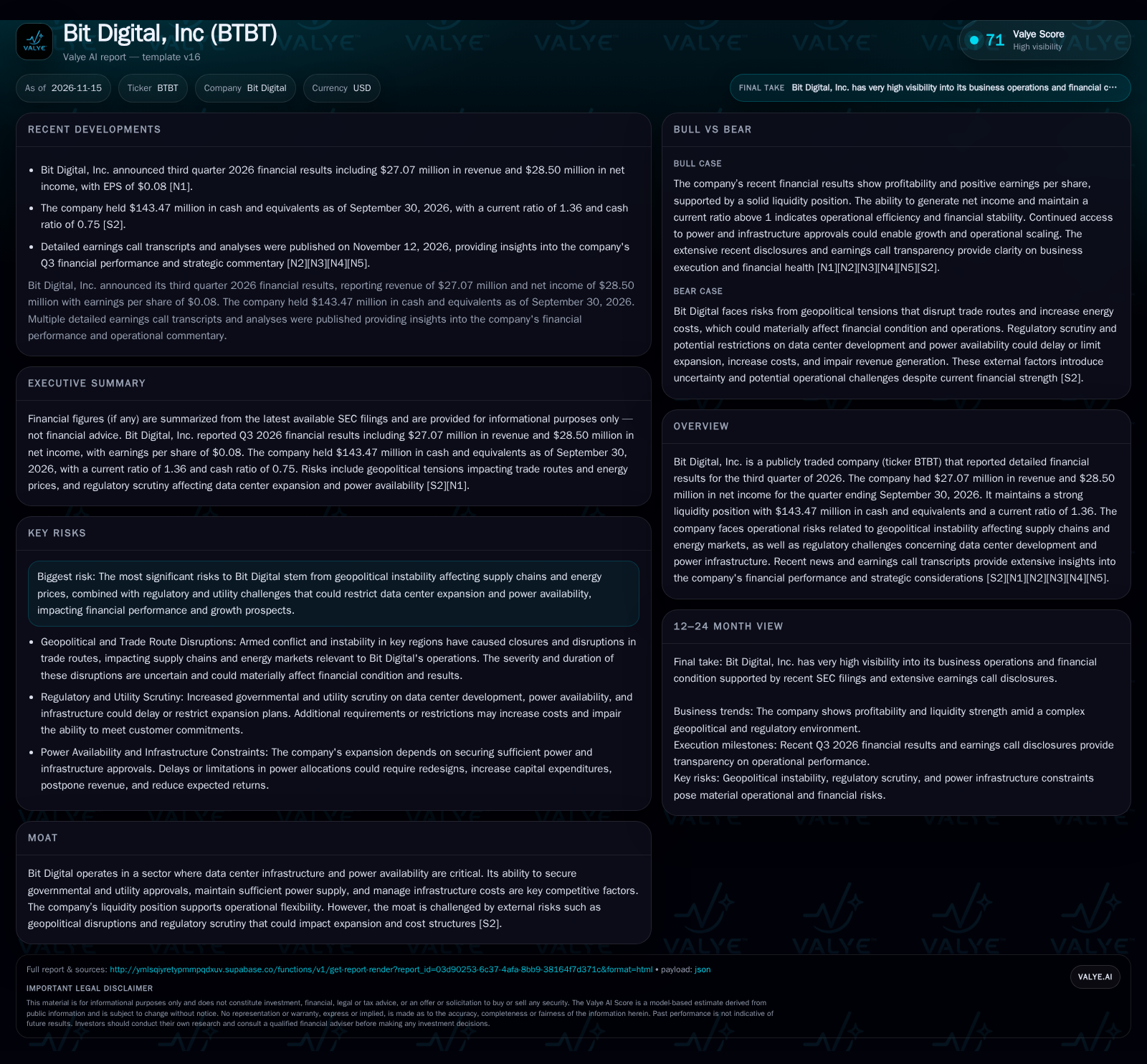
For the third quarter of 2026, Bit Digital reported $27.07 million in revenue and $28.50 million in net income, translating to basic and diluted EPS of $0.08. As of September 30, 2026, it held $143.47 million in cash and equivalents, with total current assets of $261.39 million versus current liabilities of $192.43 million, resulting in a current ratio of 1.36 and a cash ratio of 0.75. [S2]
These financials indicate not just ongoing operations but outright profitability in the latest period, a notable outcome in a sector often characterized by volatile margins. However, the company’s own disclosures—and recent news coverage—underscore that future expansion is highly dependent on factors outside its direct control: namely, the availability and cost of energy, as well as the ability to secure necessary regulatory and utility approvals for new or expanded data center infrastructure. [S2] [N1] [N2] [N3] [N4] [N5]
How Bit Digital’s Revenue Model Interacts with Energy and Capital Constraints
Bit Digital’s core business revolves around digital asset mining and/or hosting, both of which are fundamentally driven by the interplay of cryptocurrency prices, mining difficulty, energy costs, and infrastructure capacity. The economics here are heavily volume- and margin-sensitive: higher crypto prices or lower mining difficulty can expand gross margins, while sustained increases in energy costs or regulatory-driven downtime can rapidly erode profitability.
Fixed costs are substantial—data center buildout, hardware procurement, and securing long-term power contracts—making operating leverage high in both directions. When network conditions are favorable and power is available at predictable rates, each incremental hash can deliver attractive margins. Conversely, if energy prices spike or power allocation is capped, the model can become cash-intensive and far less profitable.
If capital is tied up in stranded or underutilized assets due to external constraints, return on investment could deteriorate quickly.
Competing for Power, Policy, and Scale in a Crowded Mining Ecosystem
Bit Digital operates in an environment where competitive advantage does not derive solely from hardware or mining sophistication, but increasingly from the ability to secure stable, low-cost power and navigate regulatory hurdles. Peer categories include large-scale North American and international crypto miners, as well as infrastructure-focused hosting providers that cater to third-party mining clients.
The company’s liquidity may allow it to move quickly on new infrastructure opportunities, but these are often subject to intense competition for limited power allocations, especially in regions with favorable energy profiles. Regulatory scrutiny—whether tied to environmental impact, grid stability, or local economic priorities—can also act as a gating factor, favoring operators with established local relationships, compliance track records, or the ability to tolerate delays and capital at risk.
Potential substitutes include cloud-based mining, alternative proof-of-stake protocols, or even traditional data center operators pivoting to blockchain workloads if regulatory and economic conditions become favorable. The net result: Bit Digital’s moat is as much about external navigation as it is about internal execution.
If Power and Policy Align, Profitable Scaling Could Accelerate
The most favorable outcome for Bit Digital would be a confluence of manageable energy costs, supportive regulatory environments, and continued access to new infrastructure approvals.
Evidence that would confirm this scenario includes: announcements of new data center or power agreements, regulatory approvals for expansion, and sustained or improving gross margins in subsequent quarters. Additional support would come from disclosures of increased operational uptime, higher hash rates, or greater capacity utilization rates.
Falsification would come from delays or denials in infrastructure approvals, material increases in energy costs that compress margins, or the need to idle capacity due to geopolitical or regulatory disruptions.
Sustained Profitability Depends on Managing Volatility and Incremental Growth
The most plausible trajectory is a company that continues to demonstrate periodic profitability and maintains a reported liquidity position buffer, but whose growth is episodic and sensitive to externalities. In this scenario, Bit Digital incrementally expands operations as and when power and regulatory conditions permit, but faces periodic headwinds—such as energy price spikes or approval delays—that limit full-scale expansion.
Supporting evidence would include stable or gradually increasing revenues and margins, periodic announcements of new capacity coming online, and continued net income or at least operating cash flow positive quarters. Watchpoints would be any signs of capital being tied up in delayed or underutilized projects, or disclosures of increasing regulatory costs.
Falsification would occur if the company is unable to deploy cash into productive assets, or if persistent external constraints force a reduction in scale or materially compress margins.
External Shocks Could Rapidly Erode Margins and Stall Expansion
The most adverse outcome involves a scenario where geopolitical instability drives sustained energy price increases or disrupts critical supply chains, while regulatory and utility scrutiny leads to project delays, denials, or costly retrofits. In this situation, Bit Digital’s ability to deploy capital is blunted, margins compress, and idle assets accumulate, resulting in diminished profitability and, potentially, negative cash flow.
Confirmation would come from sequential declines in revenue and net income, disclosures of extended project delays or denied permits, and statements about rising compliance or energy costs. If the company is forced to curtail operations or write down stranded assets, the thesis would be clearly at risk.
What Will Determine Whether Bit Digital Converts Strength Into Sustainable Growth?
The pace and terms of new power agreements or infrastructure expansion announcements—these will indicate Bit Digital’s ability to convert cash into productive, revenue-generating assets.
Monitoring sequential changes in gross margin and net income, especially in relation to energy market moves, will reveal how well the company is managing core input cost volatility.
Disclosures related to regulatory approvals, delays, or costs for new or existing sites would help test whether external constraints are tightening or easing.
Evidence of increasing operational downtime, curtailments, or underutilized capacity would suggest risk of stranded assets or declining ROI.
If disclosed, hash rate growth, capacity utilization rates, or hosting client additions would provide insight into organic volume expansion.
Tracking any large capital expenditures and their subsequent returns will show whether the company can maintain or improve asset efficiency.
Updates on the competitive landscape, such as new entrants or changes in local power policy, could signal shifts in Bit Digital’s relative positioning.
Management commentary or filings that address contingency planning for geopolitical or energy market shocks would offer clues about operational resilience.
Disclaimer: This is research-only, informational analysis and not investment advice. It may include AI-generated interpretation and general industry context. Always verify important details using primary sources.

Comments