
Grace Therapeutics Bets on Injectable Nimodipine: A Focused Orphan Drug Strategy Confronts Regulatory and Pipeline Concentration Risks
With GTx-104 delivering positive Phase 3 results but facing an FDA Complete Response Letter, Grace Therapeutics channels all resources into a single lead candidate for aneurysmal subarachnoid hemorrhage, wagering on clinical need, hospital adoption, and orphan drug incentives to carve a path to commercial relevance.
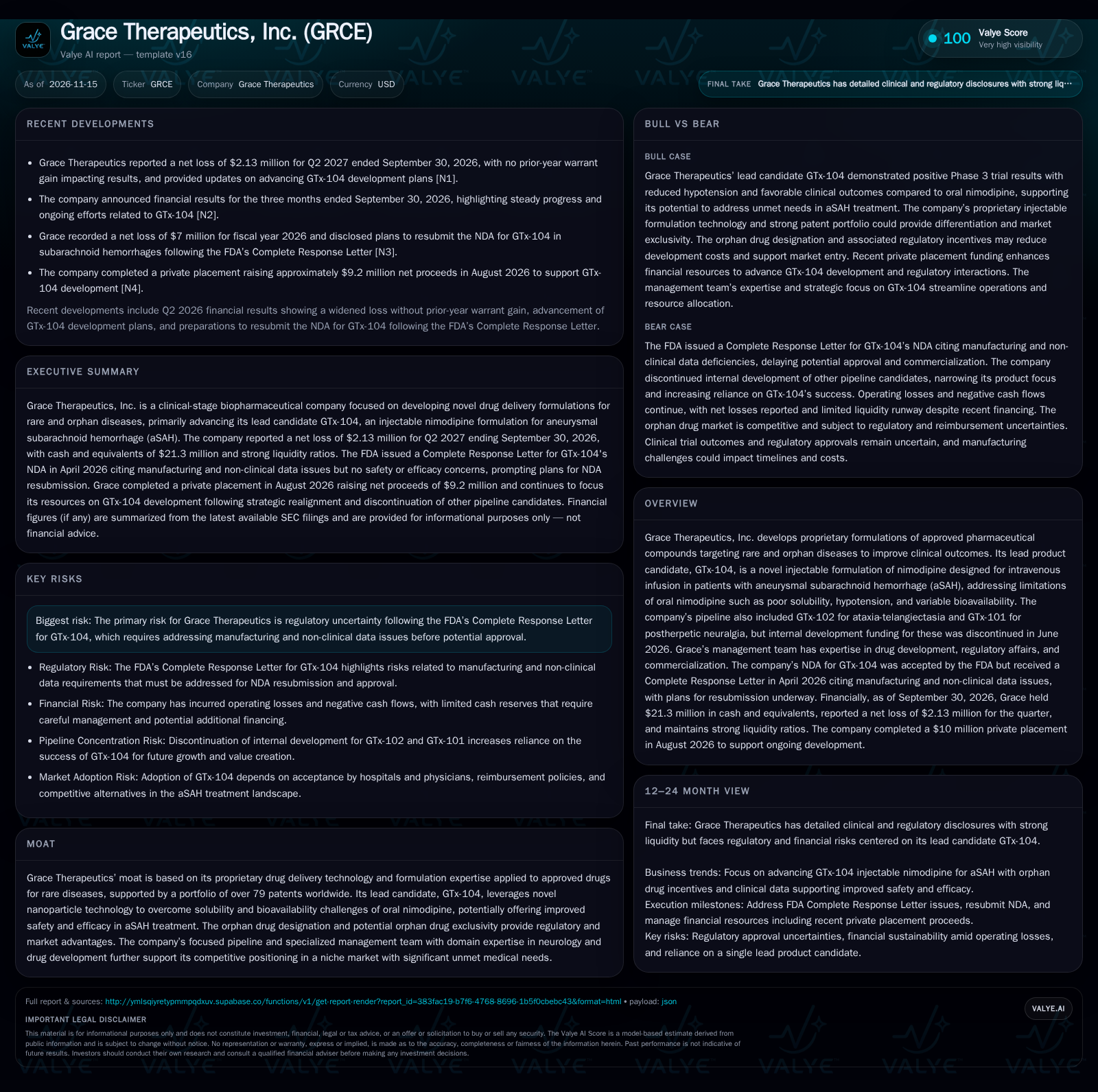
Grace Therapeutics, Inc. is now singularly focused on GTx-104, its novel IV nimodipine for aneurysmal subarachnoid hemorrhage (aSAH), after discontinuing internal funding for other pipeline assets. GTx-104 met its Phase 3 primary endpoint and offers a differentiated delivery solution, but its NDA received an FDA CRL citing CMC and non-clinical issues. The company maintains reported liquidity position after a recent $9.2M raise, but faces high dependency on GTx-104's regulatory and commercial trajectory. Key questions center on remediation of CRL points, hospital adoption, and the durability of clinical and economic advantages versus entrenched oral nimodipine.
Grace Therapeutics, Inc. now stands as a quintessential single-asset orphan drug play, having shifted all internal resources to GTx-104—an IV formulation of nimodipine targeting aneurysmal subarachnoid hemorrhage (aSAH). After discontinuing its other pipeline projects in mid-2026, Grace is wagering on positive Phase 3 data and a clear unmet clinical need to drive adoption and reimbursement. However, an FDA Complete Response Letter citing chemistry, manufacturing, and non-clinical issues, but not safety or efficacy, has delayed commercial progress.
Regulatory Setbacks and Strategic Refocus Define Current Position
The most consequential recent development for Grace Therapeutics is the FDA's issuance of a Complete Response Letter (CRL) for GTx-104 in April 2026, which cited chemistry, manufacturing, and non-clinical deficiencies but did not question the drug's safety or efficacy [S1] [N6] [N3]. This regulatory setback delays potential market entry and requires additional investment and validation work before resubmission.
In parallel, Grace discontinued internal funding for its two other clinical assets, GTx-102 and GTx-101, as of June 2026, crystallizing its strategic focus exclusively on GTx-104 [S1] [S2]. This decision underscores a high-conviction, high-risk posture: success now depends almost entirely on the regulatory and commercial fate of this single program.
Financially, Grace reported $21.3 million in cash and equivalents as of September 30, 2026, and completed a $9.2 million private placement in August 2026, giving it a reported current ratio of 13.61 and a cash ratio of 19.27 [S2] [N4]. While these metrics indicate short-term liquidity, the ongoing net losses and pipeline narrowing raise questions about long-term funding needs if regulatory or commercial milestones are delayed.
How GTx-104 Could Reshape Economics in a Niche but High-Value Market
Grace’s business model now centers entirely on the commercial success of GTx-104, which targets approximately 42,500 U.S. aSAH patients annually, with additional opportunity in Europe and China [S1]. The economics of orphan drugs typically benefit from premium pricing, limited sales infrastructure needs, and regulatory incentives such as market exclusivity. If GTx-104 is approved, the company could capture a meaningful share of the aSAH treatment market, especially if clinical and economic advantages over oral nimodipine are validated in real-world hospital settings.
GTx-104’s value proposition is rooted in its novel IV formulation, which addresses oral nimodipine’s limitations—namely, poor solubility, variable bioavailability, and high rates of hypotension. The Phase 3 STRIVE-ON trial reported a 19% reduction in clinically significant hypotension episodes compared to the oral formulation [S1]. If this translates into better outcomes and lower hospital resource utilization, GTx-104 could command premium pricing and rapid uptake in critical care settings.
Fixed costs in this model are relatively high due to ongoing regulatory, manufacturing, and commercialization expenses, while variable costs may be moderate given the specialized nature of the product and sales channels. The orphan drug focus means that operating leverage could materialize quickly if adoption is strong, but the company is exposed to significant negative leverage should uptake or approval be delayed. Capital needs will remain elevated until GTx-104 is on the market and generating revenue, especially given the need to address CMC and non-clinical issues before resubmission.
Differentiation, Patent Position, and Hospital Adoption: Barriers and Counterforces
Grace’s competitive edge rests on three pillars: proprietary nanoparticle drug delivery technology, a portfolio of over 79 granted and pending patents, and the clinical differentiation of GTx-104 as an IV alternative to oral nimodipine [S1]. In the aSAH segment, oral nimodipine is entrenched as standard of care due to decades of clinical experience, low cost, and generic availability. However, the clinical drawbacks of oral administration—especially in critically ill, intubated, or unconscious patients—create a structural opportunity for IV delivery if efficacy and safety advantages are proven.
Hospital adoption is likely to hinge on robust pharmacoeconomic data, ease of administration, and demonstrated reduction in adverse events or resource use. Market research suggests an 80% likelihood of hospital adoption for a viable IV nimodipine product [S1]. However, competitive risk remains from both incumbent oral formulations and other potential IV or alternative delivery solutions, including those from larger pharmaceutical players with established hospital sales forces.
Orphan drug designation provides a regulatory buffer in the form of potential market exclusivity, but this advantage is time-limited and contingent on successful approval. The main counterforce is the potential for generics or alternative delivery technologies to erode pricing power or limit the duration of exclusivity-driven margins.
What Success Looks Like: Regulatory Clearance Triggers Rapid Uptake and Margin Expansion
The most favorable scenario for Grace would involve rapid remediation of the FDA’s CMC and non-clinical concerns, successful NDA resubmission, and timely approval of GTx-104. With positive Phase 3 results already in hand and no safety or efficacy concerns flagged by regulators, the pathway to approval appears technically feasible if operational execution is strong [S1] [N3].
Upon approval, strong hospital adoption could occur if the clinical data translate into tangible improvements in outcomes and resource utilization. The orphan drug status could support premium pricing and rapid formulary inclusion, particularly if GTx-104 is able to secure reimbursement at favorable rates. Early uptake would drive operating leverage and could allow the company to invest in pipeline expansion or lifecycle management.
Evidence that would confirm this scenario includes: FDA acceptance of the resubmitted NDA, positive feedback from hospital pharmacy and therapeutics committees, initial sales traction post-launch, and payer coverage aligned with orphan drug pricing expectations.
Most Likely Trajectory: Protracted Resolution of Regulatory Issues and Moderate Uptake
The most plausible path forward involves a multi-quarter process to address the FDA’s CMC and non-clinical findings, delaying market entry for GTx-104 into late 2027 or beyond. While the absence of safety or efficacy concerns is encouraging, manufacturing and non-clinical remediation often require new studies, process validation, and potentially additional capital outlays.
Hospital adoption, while supported by market research, may be gradual rather than immediate, with institutions requiring further real-world data and budget impact analyses before broad formulary inclusion. Uptake may be strongest in large academic medical centers and stroke centers initially, with diffusion to smaller hospitals over time.
This scenario would be confirmed by staged regulatory updates, incremental hospital wins, and steady but not explosive revenue recognition. Conversely, unexpected regulatory rejections, persistent CMC issues, or slower-than-expected formulary adoption would falsify the base case.
Where It Could Go Wrong: Regulatory Delays, Adoption Hurdles, and Funding Pressures
The primary downside risk is that remediation of CMC and non-clinical issues takes longer than expected, or that new regulatory concerns emerge in the process, leading to further delays or even outright rejection of GTx-104’s NDA. This would extend Grace's pre-revenue period and increase cash burn, forcing the company to seek additional dilutive financing or strategic alternatives.
Even if regulatory hurdles are cleared, commercial uptake could disappoint if hospitals perceive insufficient incremental benefit over oral nimodipine, if pricing is challenged by payers, or if operational complexities (such as IV preparation or administration) limit routine use. Competitive threats from larger players or new entrants with alternative delivery approaches could further erode market opportunity.
Confirmation of the downside scenario would come from repeated regulatory setbacks, negative formulary or payer decisions, weak initial sales, or evidence of cash runway compression leading to urgency around new capital raises.
Milestones That Will Determine If Grace’s Bet on GTx-104 Pays Off
FDA acceptance of the resubmitted NDA for GTx-104 and clarity on any additional data requirements.
Timeline and completeness of remediation for CMC and non-clinical issues cited in the April 2026 CRL.
Hospital formulary adoption rates, especially among large academic stroke centers and regional hospitals, if disclosed.
Trends in payer reimbursement decisions and pricing achieved for GTx-104 versus generic oral nimodipine.
Evidence of real-world clinical outcomes and resource utilization improvements post-launch, if disclosed.
Cash burn rate and any new capital raises or strategic partnerships needed before or after commercial launch.
Updates on patent challenges, exclusivity duration, or competitive IV nimodipine developments.
Management’s ability to articulate and execute on a pipeline expansion or lifecycle management strategy beyond GTx-104.
Disclaimer: This is research-only, informational analysis and not investment advice. It may include AI-generated interpretation and general industry context. Always verify important details using primary sources.

Comments