
Lumexa Imaging: Outpatient Volume Inflection, Expansion Ambitions, and the Realities of Imaging Center Economics
Lumexa Imaging Holdings, fresh off a profitable quarter, aims to extend its outpatient imaging footprint by opening three new centers. While recent growth in patient volume and positive earnings signal operational momentum, the company's long-term trajectory will hinge on its ability to scale efficiently, manage typical industry risks, and demonstrate durable margins in a competitive, capital-intensive sector.
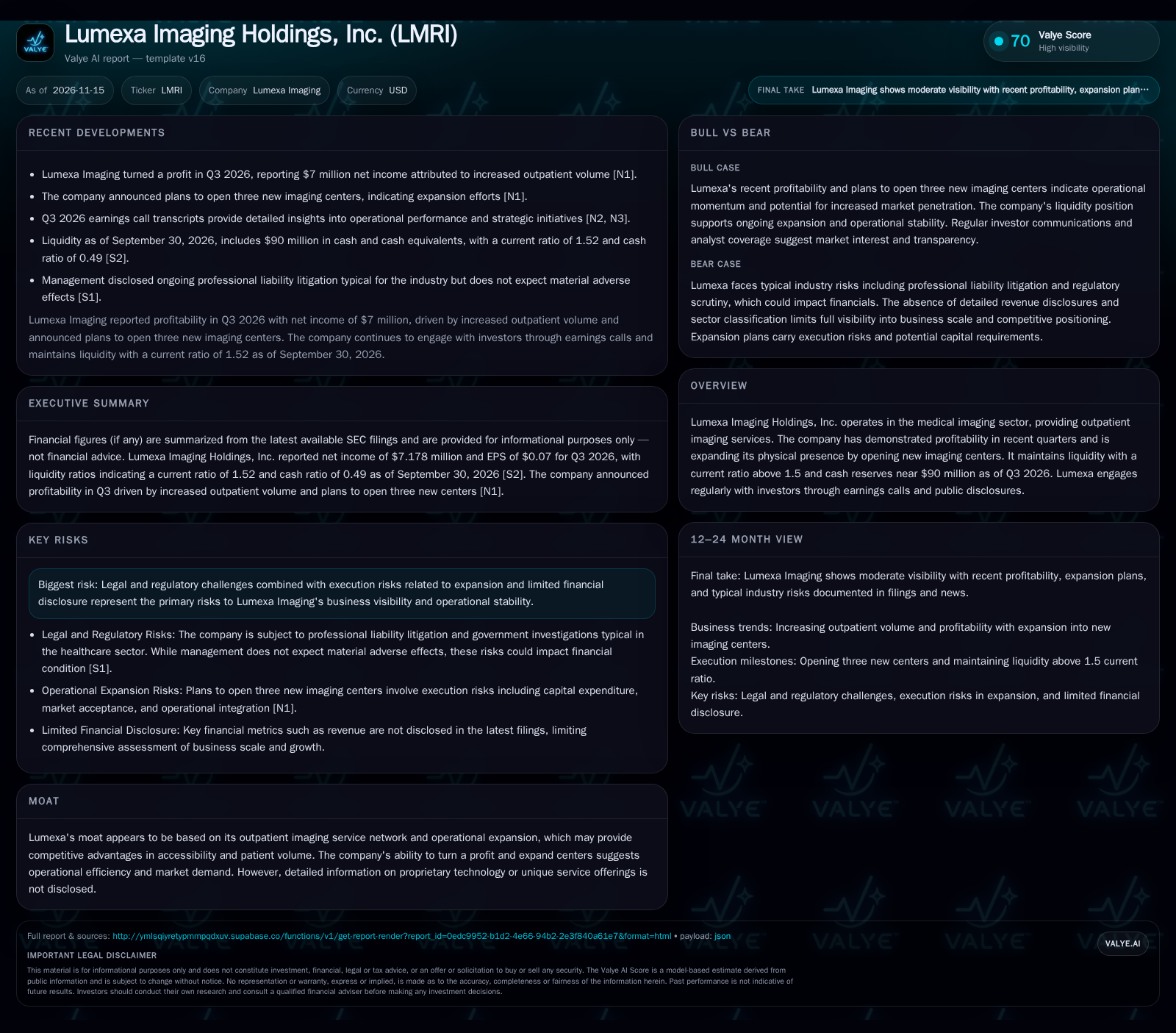
Lumexa Imaging Holdings reported Q3 2026 net income of $7.2 million, reflecting increased outpatient volumes and plans for geographic expansion with three new centers. The company’s outlook depends on execution, patient demand, and how it navigates legal and competitive pressures in the imaging market. [S2] [N1]
Lumexa Imaging Holdings, Inc. has reached a pivotal juncture, transitioning from a phase of operational stabilization to renewed growth ambitions. Reporting a $7.2 million profit for Q3 2026 and planning to open three additional outpatient imaging centers, Lumexa is signaling both financial momentum and geographic expansion. Yet, the company operates in a highly competitive, regulated, and capital-intensive sector where profit sustainability, execution on new sites, and risk management will ultimately determine its valuation and strategic trajectory. The coming quarters will test whether recent volume gains and margin improvements are repeatable or transient.
Recent Profitability and Expansion Plans Define the Current Landscape
Lumexa Imaging Holdings reported net income of $7.178 million for the third quarter of 2026, translating to basic and diluted EPS of $0.07 per share [S2]. This profitability was attributed to increased outpatient imaging volumes, highlighting a near-term inflection in operational performance [N1]. The company also announced plans to open three new imaging centers, marking a tangible commitment to expand its footprint [N1]. [S2] Management disclosed ongoing professional liability litigation, but does not expect material adverse effects from these matters [S1]. These facts collectively frame Lumexa as a company with short-term operational momentum and a willingness to invest in growth.
Imaging Center Economics: Fixed Costs, Volume Leverage, and Expansion Dynamics
The economics of outpatient imaging centers are shaped by high fixed costs—facility leases or ownership, expensive imaging equipment (MRI, CT, PET, etc.), and staffing requirements—against which patient volume drives incremental margin. Once a center is operational, incremental scans typically have high gross margins, as variable costs per procedure are modest compared to the overhead. This creates strong operating leverage: rising patient volumes can rapidly improve profitability, while underutilization can quickly erode margins.
Lumexa’s Q3 profit suggests that existing centers have reached or surpassed break-even patient throughput, at least temporarily. However, expansion into new centers carries upfront capital outlays for equipment, buildout, and initial staffing. These investments must be justified by local demand, payer mix, and competitive intensity. If new centers ramp up volumes efficiently, Lumexa could enjoy further margin gains; slow ramp or market misjudgment, by contrast, would dilute overall profitability. [S2] [N1]
Pricing power is typically constrained by third-party payers (Medicare, Medicaid, commercial insurers), meaning Lumexa’s revenue growth will likely depend more on volume and service mix than price increases. Cross-selling advanced modalities, offering specialized radiology services, or securing preferred provider status with local networks could improve mix and margin, but these levers are not detailed in available disclosures.
Market Positioning Amidst Scale Players and Local Fragmentation
Outpatient imaging is a fragmented but competitive field, with large national and regional operators, hospital-affiliated centers, and independent providers all vying for patient referrals and payer contracts. Lumexa’s ability to grow profitably will depend on how it differentiates itself in local markets—through speed of service, breadth of modalities, quality of radiology interpretation, referring physician relationships, and patient experience.
National imaging chains and hospital systems often benefit from negotiating leverage with payers, economies of scale in procurement, and broader referral networks. Smaller or regional players can sometimes outperform by being nimbler, offering better patient access, or cultivating deep local relationships. Lumexa’s expansion plan suggests it is seeking to reach a scale that improves its negotiating power and operational efficiency, but the absence of detailed information on its technology stack, proprietary protocols, or unique service offerings makes it difficult to assess whether it possesses a durable competitive edge beyond footprint growth.
Additionally, competitive threats include substitution by hospital-based imaging (especially for complex or acute cases), potential commoditization of basic imaging modalities, and the risk of reimbursement pressure from both public and private payers.
Volume Growth and Operational Leverage Unlock Sustainable Margin Expansion
In a favorable scenario, Lumexa’s recent outpatient volume gains prove durable, and the three new imaging centers ramp efficiently to high utilization. This would allow fixed costs to be spread over a larger volume base, reinforcing operating leverage and supporting further earnings growth. If the company can maintain or improve its payer mix—by attracting more commercially insured patients or specialty referrals—average revenue per scan could also rise, boosting margins.
Additional upside could come from expanding into higher-value imaging modalities or specialized diagnostic services, or by leveraging technology to improve scheduling, reduce downtime, and enhance referring physician engagement. Regular earnings call disclosures and analyst coverage suggest that investor interest could increase if Lumexa demonstrates consistent profit growth and successful center launches [N2] [N4].
Evidence confirming this scenario would include sustained or accelerating net income in subsequent quarters, rapid ramp-up to target utilization at new centers, and commentary on favorable payer or modality mix.
Expansion Delivers Mixed Results, with Margins Sensitive to Utilization Fluctuations
The most plausible trajectory is that Lumexa delivers steady, but not linear, growth as it opens new centers. Some sites may reach targeted throughput quickly, while others lag or face local competition. Margins remain positive but fluctuate with patient volume, and the company must continually invest to refresh equipment and maintain service quality.
Profitability could be sustained at recent levels if outpatient imaging demand remains robust and Lumexa avoids significant negative surprises in reimbursement or litigation. However, any slippage in referral relationships, adverse payer mix shifts, or regulatory headwinds could quickly compress margins.
Confirmation of this scenario would come from stable, modestly positive net income and commentary indicating both successes and challenges in new center ramp-up. Falsification would be signaled by either rapid, across-the-board margin expansion (suggesting upside) or consecutive quarters of operating losses (indicating downside stress).
Underutilization, Cost Overruns, and Reimbursement Pressure Undermine Profitability
In a negative outcome, Lumexa’s new centers fail to attract sufficient patient volume, leading to underutilized assets and margin compression. Fixed overhead—leases, equipment depreciation, and staffing—would weigh heavily, and the company could swing back to operating losses. Cost overruns in new site development or integration issues could exacerbate cash burn.
Additional downside risk comes from reimbursement cuts by government or commercial payers, which would directly pressure revenue per scan. If professional liability claims result in material settlements or insurance cost increases, financial strain could intensify. Persistent negative free cash flow would force management to reconsider growth plans or seek external capital, potentially on unfavorable terms.
This scenario would be confirmed by declining or negative net income, rising cash burn, and management commentary highlighting competitive or regulatory headwinds. Warnings about underperforming centers, delays in ramping new locations, or legal settlements would also be red flags.
Milestones and Metrics to Evaluate Lumexa’s Expansion and Margin Durability
Quarterly net income and operating cash flow trends: Sustained profitability would support the case for operating leverage; a useful metric would be center-level contribution margin, if disclosed.
Utilization rates and patient volumes at new imaging centers: Rapid ramp-up to targeted throughput would validate expansion strategy; a slowdown or underutilization would signal execution risk.
Average revenue per scan and modality mix: Improvements here would suggest pricing power or successful up-sell to advanced imaging services; a useful metric would be payer mix evolution, if disclosed.
Updates on litigation or regulatory changes: Material adverse developments could impact financials or strategic flexibility.
Competitive developments in key markets: New entrant activity or hospital chain expansion could signal intensifying local competition.
Management commentary on referral networks and physician engagement: Strong relationships drive volume; deterioration would be a warning sign.
Disclosure of same-center sales or comparable center growth: This would provide insight into organic demand trends and operational efficiency.
Disclaimer: This is research-only, informational analysis and not investment advice. It may include AI-generated interpretation and general industry context. Always verify important details using primary sources.

Comments