
Century Therapeutics: Engineering Immune-Evasive Allogeneic Cell Therapies for Autoimmune Disease and Oncology
Century Therapeutics advances an iPSC-derived, off-the-shelf cell therapy platform with proprietary immune-evasion technology, targeting the limitations of autologous approaches in type 1 diabetes and B-cell-mediated diseases.
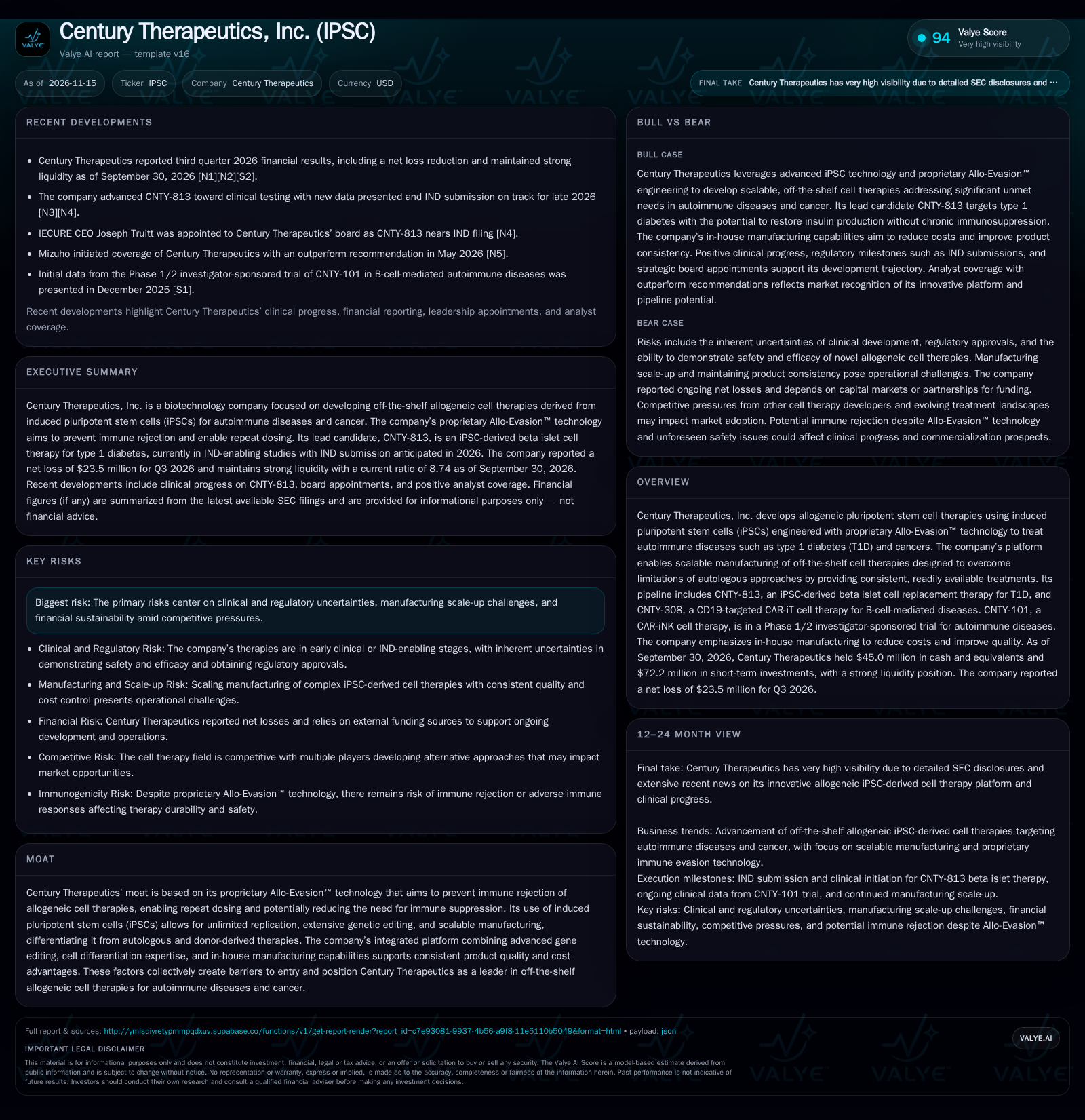
Century Therapeutics is progressing its pipeline of allogeneic iPSC-derived cell therapies, with lead candidate CNTY-813 approaching IND submission for type 1 diabetes and a Phase 1/2 trial underway for CNTY-101 in autoimmune diseases. The company's Allo-Evasion™ technology aims to enable repeat dosing by minimizing immune rejection. As of September 2026, Century held $45M in cash and $72M in short-term investments, reporting a net loss of $23.5M for Q3. The near-term thesis hinges on successful clinical transition and demonstration of scalable manufacturing, set against a backdrop of continued operating losses and intensifying sector competition. [S1] [S2] [N1] [N2] [N3] [N4]
Century Therapeutics is at a pivotal moment as it seeks to redefine cell therapy for autoimmune diseases and cancer using a scalable, off-the-shelf platform based on induced pluripotent stem cells (iPSCs) and proprietary immune-evasion engineering. With its lead candidate CNTY-813 nearing IND submission for type 1 diabetes and a CAR-iNK candidate (CNTY-101) in early clinical testing, the company’s near-term value hinges on transitioning from preclinical promise to clinical proof. [S1] [S2] [N1] [N2] [N3] [N4]
Key Developments: IND Milestones, Pipeline Progress, and Financial Position
Century Therapeutics’ most material recent developments include: (1) advancing CNTY-813, its iPSC-derived beta islet cell replacement therapy for type 1 diabetes, toward an IND submission planned for 2026; (2) presenting initial data from the Phase 1/2 trial of CNTY-101, a CAR-iNK cell therapy for autoimmune diseases; and (3) maintaining a liquidity cushion with $45.0 million in cash, $72.2 million in short-term investments, and a current ratio of 8.74 as of September 30, 2026. The company reported a net loss of $23.5 million for Q3 2026. These facts matter because they frame both Century’s timeline for clinical inflection points and its capacity to fund operations through the next phase of development—critical in a capital-intensive sector where delays or setbacks can rapidly erode optionality. [S1] [S2] [N1] [N2] [N3] [N4]
How Allogeneic iPSC Therapies Could Unlock Scalable Economics
Century’s business model is predicated on the promise of off-the-shelf, allogeneic cell therapies derived from iPSCs, which—unlike autologous approaches—allow for batch manufacturing, standardized quality, and theoretically lower variable costs as scale increases. The in-house manufacturing strategy aims to capture more margin by reducing reliance on third parties, controlling quality, and optimizing cost structure over time. However, the company remains pre-commercial: near-term revenue is unlikely until clinical candidates clear Phase 2 and receive regulatory approval, which historically takes years and substantial capital.
Pricing for cell-based therapies, if approved, tends to be high due to the curative intent and the complexity of manufacturing, but payer adoption depends on demonstration of durable efficacy and safety. The economics hinge on proving that Allo-Evasion™ technology meaningfully reduces immune rejection (and thus the need for costly immunosuppression), enables repeat dosing, and delivers superior outcomes versus alternatives. High fixed costs (R&D, manufacturing infrastructure) are offset by potential operating leverage if therapies transition to commercial scale, but the risk of high upfront investment with uncertain downstream revenues remains acute until clinical validation is achieved.
A critical factor influencing the scalability of Century’s allogeneic iPSC therapies is the balance between fixed and variable costs in manufacturing. While batch production can reduce per-unit costs as volume increases, the initial capital expenditure for building and validating GMP-compliant facilities is substantial, often requiring multi-year amortization. This means that the company’s path to profitability is highly sensitive to achieving sufficient market penetration and patient uptake. Moreover, the complexity of cell therapy logistics—including cold chain management and distribution—introduces additional operational costs that must be optimized to maintain competitive pricing. If Century can streamline these processes, it could enhance its margin profile significantly over time.
Another layer of economic consideration is the reimbursement landscape for novel cell therapies, which remains evolving and uncertain. Payers increasingly demand robust health economic data demonstrating not only clinical efficacy but also cost-effectiveness relative to existing standards of care. Century’s ability to generate long-term outcome data showing durable remission or disease modification without chronic immunosuppression could justify premium pricing and favorable reimbursement. Conversely, if repeat dosing is necessary but immunogenicity is not adequately controlled, the cumulative cost burden may challenge payer acceptance. Therefore, the interplay between clinical durability, dosing frequency, and payer policies will be pivotal in shaping the ultimate commercial viability of Century’s platform.
Differentiation Through Immune Evasion and Manufacturing Scale—But Barriers Remain
Century’s competitive edge rests on three pillars: (1) its proprietary Allo-Evasion™ technology to reduce immune rejection, (2) use of iPSCs for theoretically unlimited supply and genetic engineering flexibility, and (3) in-house manufacturing for quality and cost control. These factors could create barriers to entry relative to autologous or donor-derived cell therapies, which suffer from variability, limited scalability, and logistical complexity.
However, the field of cell therapy is crowded, with numerous public and private biotech companies—spanning iPSC, CAR-T, CAR-NK, and other modalities—pursuing similar indications. Larger incumbents and venture-backed startups are also investing in immune-evasive engineering, manufacturing automation, and next-generation cell constructs. The ultimate competitive test will be clinical: demonstrating that Century’s platform delivers superior efficacy, safety, and cost-effectiveness in real-world indications like type 1 diabetes and B-cell-mediated diseases. If competitors achieve similar immune evasion or scale-up breakthroughs, Century’s differentiation could erode.
The strategic choice to develop an in-house manufacturing capability is a double-edged sword. While it offers potential advantages in quality control, intellectual property protection, and cost containment, it also exposes Century to operational risks uncommon in purely R&D-focused biotech firms. Manufacturing scale-up for iPSC-derived therapies involves complex cell culture, differentiation, and purification steps, each susceptible to variability and failure. Any delays or quality issues could disrupt clinical timelines and increase costs. Competitors opting for outsourced or hybrid manufacturing models may benefit from established infrastructure and risk-sharing, potentially accelerating their path to market. Thus, Century’s competitive moat partly depends on its ability to execute manufacturing scale-up flawlessly.
Furthermore, the competitive landscape is shaped not only by technological innovation but also by strategic partnerships and ecosystem development. Companies that can integrate their cell therapy platforms with complementary technologies—such as gene editing, biomaterials for cell delivery, or advanced diagnostics—may create more compelling therapeutic propositions. Century’s proprietary Allo-Evasion™ technology is a key differentiator, but its value may be enhanced or diminished depending on how well it interfaces with emerging modalities and whether it can be licensed or combined with other platforms. The ability to build a robust pipeline beyond initial indications will also influence long-term competitive positioning.
What If Immune-Evasive iPSC Therapies Become the New Standard?
In a favorable scenario, Century successfully submits its IND for CNTY-813 in 2026, rapidly enrolls and demonstrates compelling clinical efficacy and safety in type 1 diabetes, and validates its Allo-Evasion™ technology as both durable and broadly applicable. This unlocks accelerated regulatory pathways (e.g., breakthrough designation), early payer engagement, and potential pharma partnerships or licensing deals. The in-house manufacturing platform scales efficiently, reducing per-dose costs and supporting rapid commercial ramp post-approval.
Confirming evidence for this scenario would include: positive, durable clinical data in T1D patients showing insulin independence without chronic immunosuppression; regulatory progress (fast track, orphan, or breakthrough status); and public disclosure of scalable, cost-efficient manufacturing runs. Early partnership announcements or non-dilutive funding would further support the thesis. Falsification would occur if immune rejection rates remain high, clinical efficacy is inconsistent, or if operational bottlenecks prevent manufacturing scale-up.
Clinical and Operational Progress—But Commercial Uncertainty Persists
The most plausible middle path is that Century advances CNTY-813 through IND submission and initiates first-in-human trials in 2027, while CNTY-101 generates additional early-stage data. Manufacturing continues to scale in-house, but real-world cost savings and operational efficiency are only partially realized. The company continues to report net losses, requiring additional funding rounds to reach pivotal trials or commercialization.
Evidence supporting this scenario would include: steady but incremental clinical progress (e.g., dose-escalation safety data, immune-evasion markers, early efficacy signals), regular updates on manufacturing yields, and periodic capital raises. Falsification would involve substantial clinical setbacks (e.g., unexpected toxicity, immune rejection), manufacturing failures, or inability to secure necessary funding, leading to program delays or pipeline reprioritization.
If Immune Evasion Falls Short or Funding Gaps Emerge
A bearish scenario unfolds if Allo-Evasion™ technology proves insufficient to prevent immune rejection in humans, resulting in either limited efficacy or safety concerns that stall or halt clinical programs. Manufacturing scale-up may encounter unforeseen technical or quality-control issues, leading to high per-unit costs or batch failures. With persistent operating losses and limited near-term revenue, Century could face intensified dilution or strategic retrenchment if capital markets tighten or data disappoint.
Downside evidence would include: negative clinical readouts (e.g., high rates of immune-mediated adverse events, lack of durable insulin production), delays in IND filings or trial initiations, manufacturing setbacks, or public disclosures of cash runway concerns. A lack of external validation (e.g., partnership inactivity, withdrawal of analyst support) would further undermine the investment case.
Milestones and External Factors That Will Shape Century’s Trajectory
IND submission and subsequent acceptance for CNTY-813 in type 1 diabetes will be a pivotal inflection point. Timely regulatory progress would validate both the platform and execution capability.
Clinical data readouts from the ongoing Phase 1/2 trial of CNTY-101 in B-cell-mediated autoimmune diseases—particularly any evidence of durable efficacy and immune evasion—will be crucial for platform credibility.
If disclosed, manufacturing yield, batch consistency, and cost-per-dose data would help test Century’s claims around scalable, in-house economics.
Updates on partnership activity, licensing deals, or non-dilutive funding would signal external confidence and could provide developmental or commercial leverage.
Emergence of competing immune-evasive or iPSC-derived therapies in similar indications will affect Century’s competitive positioning and perceived moat.
Regulatory developments in cell therapy (e.g., changes in FDA guidance, reimbursement frameworks) could accelerate or hinder commercial adoption.
Disclaimer: This is research-only, informational analysis and not investment advice. It may include AI-generated interpretation and general industry context. Always verify important details using primary sources.

Comments