
Generate Biomedicines: AI-Driven Drug Discovery at a Clinical and Financial Crossroads
Yet, declining sales and sustained losses highlight the tension between technological promise and the realities of late-stage biotech execution.
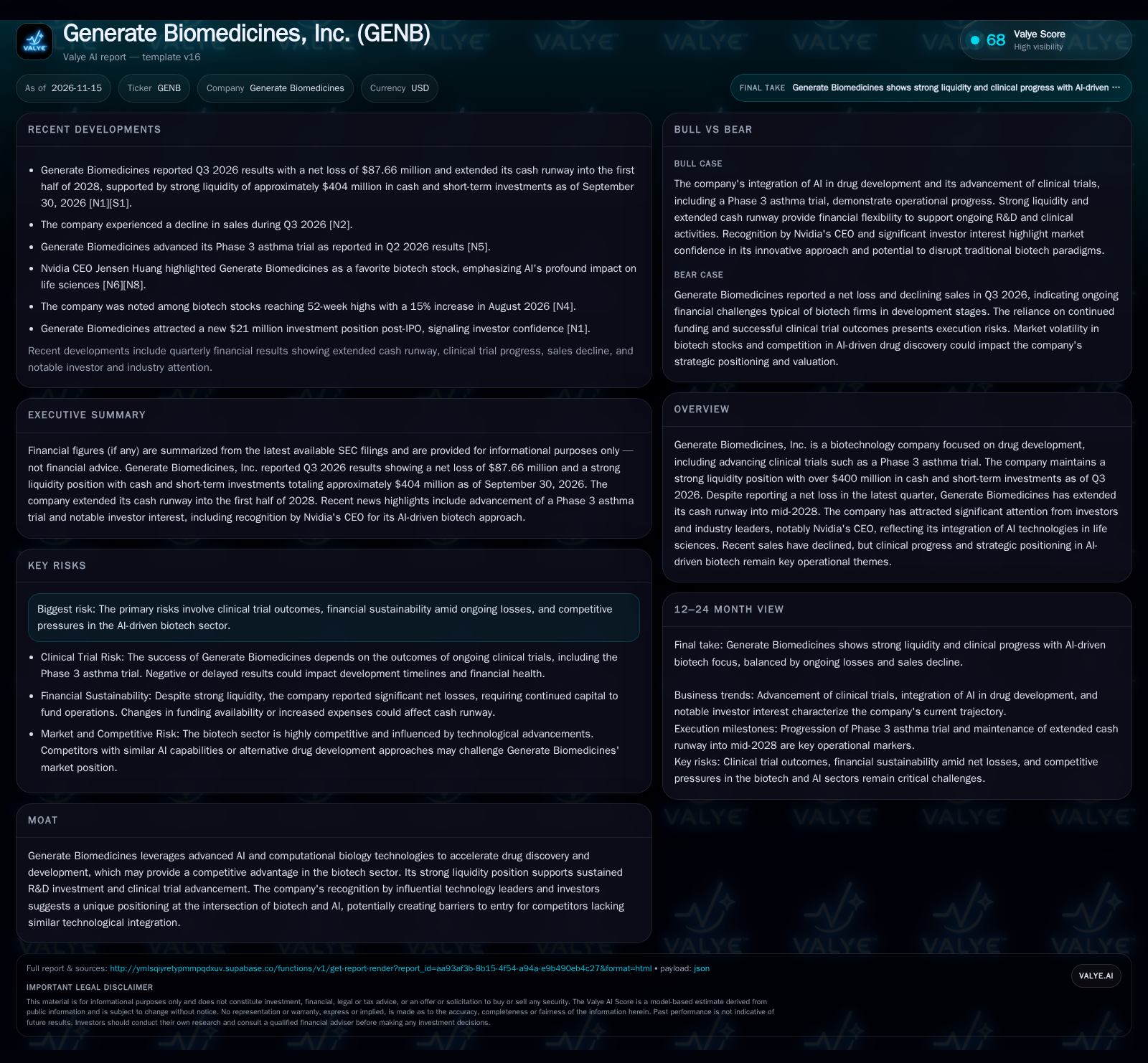
Generate Biomedicines combines reported liquidity position and a high-profile AI drug discovery platform with a pivotal Phase 3 program in asthma. However, recent sales declines and ongoing net losses mean the company’s long-term value hinges on clinical outcomes and the ability to translate AI-powered R&D into commercially viable therapies. Execution risk remains high despite investor interest and strategic positioning at the intersection of biotech and AI. [S1] [N1] [N2] [N5]
Generate Biomedicines stands at a pivotal intersection of artificial intelligence and drug development, with its Phase 3 asthma program and AI-driven platform drawing investor and industry attention. However, Q3 2026 brought a net loss of $87.66 million and a decline in sales, highlighting the execution and funding risks inherent to clinical-stage biotechs. As the field of AI-enabled drug discovery grows more crowded, Generate’s future hinges on clinical outcomes and the translation of computational advances into real-world therapies. [S1] [N1] [N2] [N5]
Liquidity, Clinical Progress, and the Reality of Declining Sales
As of September 30, 2026, Generate Biomedicines reported $140.35 million in cash and cash equivalents and $263.86 million in short-term investments, totaling approximately $404.21 million in liquid assets. Despite this financial strength, Q3 2026 results revealed a net loss of $87.66 million and a decline in sales, underscoring the ongoing costs of clinical development and the absence of significant recurring revenue. The company’s Phase 3 asthma trial advanced during the period, representing a major potential value driver. Investor and industry attention—including recognition from Nvidia’s CEO—highlights Generate’s perceived leadership in AI-driven drug discovery, but the critical challenge remains translating technical progress into commercial outcomes. [S1] [N1] [N2] [N5]
How AI-Enabled Drug Discovery Could (and Might Not) Shift the Biotech Cost Curve
Generate Biomedicines’ business model is built around leveraging artificial intelligence and computational biology to accelerate and improve the efficiency of drug discovery and development. In theory, this approach could reduce the time and cost required to identify viable drug candidates, increase the probability of clinical success, and enable a broader pipeline through parallelized R&D. However, in the current operational phase, the company’s economics are dominated by R&D expenses, clinical trial costs, and ongoing net losses typical of pre-commercial-stage biotech. The absence of significant product sales means that fixed costs—such as platform development, personnel, and trial execution—are not offset by revenue, and operating leverage will only emerge if and when late-stage assets achieve regulatory approval and commercial launch.
Capital needs remain substantial. Even with over $400 million in liquidity, the company’s net loss profile suggests a finite window to achieve meaningful clinical and regulatory milestones. If its Phase 3 candidate succeeds, the economics could pivot rapidly: high-margin specialty drug revenues (if pricing and market access are favorable) could transform the P&L, but commercialization also brings new fixed and variable costs, including manufacturing, marketing, and post-market surveillance. AI may enable more efficient pipeline expansion and out-licensing or partnership opportunities, but the magnitude and timing of these economic benefits remain unproven at scale.
Positioning at the Intersection of AI and Biotech: Differentiation and Imitation Risk
Generate Biomedicines aims to distinguish itself through proprietary AI-driven drug discovery platforms, targeting both speed and precision in candidate identification. This positioning has attracted the attention of technology leaders and investors, including Nvidia’s CEO, reflecting confidence in the company’s technical approach and sector leadership. However, the competitive landscape is intense and rapidly evolving: numerous early-stage and established biotechs are pursuing AI-enabled R&D, and large pharmaceutical companies are investing heavily in in-house or partnered computational capabilities.
Barriers to entry such as proprietary data, algorithms, and integrated wet-lab capabilities may provide temporary differentiation, but the pace of technological diffusion and the potential for platform imitation are high. Market adoption of AI-designed drugs will also depend on regulatory acceptance, payer willingness, and clinical validation. If Generate’s AI-derived candidates demonstrate superior efficacy or speed to market, the company could secure a defensible niche, but absent clear clinical and commercial wins, competitive and technological substitution risk remains elevated.
If Phase 3 Success Catalyzes Commercialization and AI Credibility
A favorable scenario sees Generate Biomedicines’ Phase 3 asthma candidate achieving positive pivotal results, leading to regulatory approval and commercial launch. This would validate not only the asset but the broader AI-driven approach, potentially unlocking revenue streams from product sales, licensing, and partnerships. Successful commercialization could yield high-margin specialty drug economics and establish Generate as a leader in computational drug development, attracting further investment and enabling pipeline expansion.
Confirmation of this scenario would come from positive Phase 3 readouts, regulatory filings and acceptance, and evidence of commercial uptake post-launch. Additional indicators would include new partnerships, licensing deals with large pharma, and expansion of the pipeline into additional late-stage assets. A falsification would be a failed or inconclusive Phase 3 result, regulatory setbacks, or inability to convert clinical success into commercial traction.
Progress Amid Uncertainty: Clinical Execution and Funding the Next Phase
The most plausible path for Generate Biomedicines involves continued advancement of its lead clinical assets, ongoing investment in AI platform capabilities, and periodic partnership or licensing transactions to defray R&D costs. Incremental progress—such as successful completion of Phase 3 enrollment, interim data releases, and partnership announcements—would support valuation and provide optionality for further funding or strategic transactions.
This scenario would be confirmed by steady clinical trial progress, maintenance of a multi-year cash runway, and selective expansion of the pipeline or external collaborations. It would be falsified by material clinical delays, unexpected cost escalation eroding runway, or failure to secure new sources of non-dilutive capital before the next financing need.
When Clinical or Commercial Setbacks Expose Structural Risks
The adverse scenario involves a material setback in the Phase 3 asthma program—such as negative efficacy or safety data—or regulatory delays that push commercialization further into the future. In this case, the company would continue to burn cash with no offsetting revenue, increasing the risk of dilutive equity raises or strategic retrenchment. If AI-driven discovery fails to produce differentiated clinical assets, the narrative advantage may dissipate, and Generate could be outpaced by larger, better-resourced competitors.
Evidence of this scenario would include trial discontinuation, failed regulatory filings, sharp increases in quarterly net losses, or a need to restructure operations to conserve cash. Additional warning signs would be the inability to secure new partnerships or financing on favorable terms, or broader market skepticism about the commercial viability of AI-designed therapeutics.
Milestones That Will Clarify the Value of AI-Driven Drug Discovery at Generate
Progress and outcomes of the Phase 3 asthma trial, including interim and final data releases, will be the single most important near-term catalyst.
Updates on pipeline expansion—especially movement of additional assets into mid- or late-stage clinical trials—would indicate platform scalability.
Quarterly cash burn and updated runway projections will help assess financial resilience and the timeline for additional capital needs.
Any new partnership, licensing, or collaboration agreements, particularly with major pharmaceutical companies, would validate commercial interest and platform credibility.
Disclosure of revenue contributions from out-licensing, milestone payments, or early commercial sales (if any) would clarify the business model’s transition from R&D to revenue.
Regulatory feedback or acceptance of AI-derived candidates would serve as critical external validation.
R&D expense trends and allocation, if disclosed, would provide insight into the balance between platform investment and clinical development.
Disclaimer: This is research-only, informational analysis and not investment advice. It may include AI-generated interpretation and general industry context. Always verify important details using primary sources.

Comments