
TScan Therapeutics: Strategic Realignment, Capital Constraints, and the Stakes of In Vivo Solid Tumor TCR-T Development
TScan Therapeutics’ pivot to in vivo-engineered TCR-T therapies for solid tumors comes with significant operational downsizing, early-stage intellectual property, and a cash runway into late 2027—but with material uncertainty about long-term viability and the challenges of clinical, commercial, and capital execution.
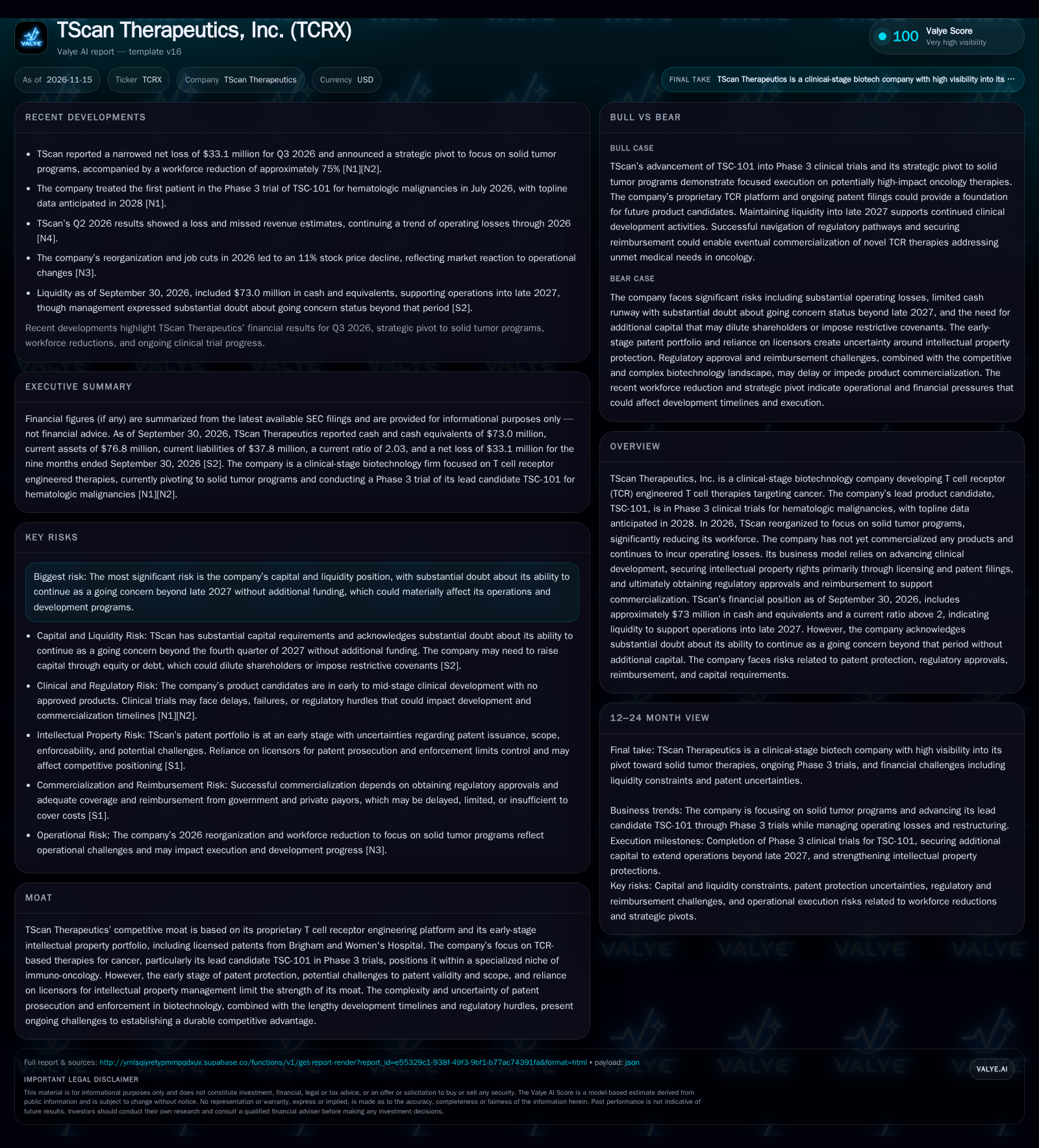
TScan Therapeutics is refocusing on in vivo TCR-T therapies for solid tumors, implementing a 75% workforce reduction and aiming for $55 million in cost savings through 2027. With $73 million in cash as of September 2026, the company has liquidity into late 2027 but faces substantial doubt about its ability to continue as a going concern beyond that point. The path forward depends on successful clinical progress, capital access, and validation of its proprietary platform in a competitive, high-risk cell therapy landscape. [S2] [N1] [N2] [N3]
TScan Therapeutics is at a pivotal crossroads after a dramatic 2026 restructuring that reduced its workforce by 75% and concentrated resources on in vivo T cell receptor (TCR)-engineered therapies for solid tumors. While the company’s proprietary technology and narrowed focus may address key limitations in cancer cell therapy, TScan faces a short cash runway, ongoing operating losses, and significant risks around intellectual property, regulatory approval, and reimbursement. The next two years will be critical for demonstrating clinical progress and accessing additional capital—without which the company’s long-term future remains uncertain.
Strategic Refocus and Cost Actions Define TScan’s 2026 Inflection Point
TScan Therapeutics undertook a major strategic reorganization in 2026, reducing its workforce by approximately 75% and reallocating resources to prioritize in vivo-engineered TCR-T therapies for solid tumors. This pivot is expected to generate $55 million in cumulative cost savings through the end of 2027 and reflects a move away from broader cell therapy ambitions toward a more focused, capital-efficient approach. As of September 30, 2026, TScan reported $73 million in cash and equivalents, a current ratio of 2.03, and a narrowed net loss of $33.1 million for the first nine months of the year. Management projects that these resources will fund operations into late 2027, but has formally acknowledged substantial doubt about the company’s ability to continue as a going concern beyond that point without additional capital. The company has not yet commercialized any products and remains pre-revenue. [S2] [N1] [N2] [N3]
How the In Vivo TCR-T Model Could Shift Economics—and Its Capital Demands
TScan’s business model is currently entirely investment-driven, with no product revenue and ongoing operating losses. The company’s new focus on in vivo-engineered TCR-T therapies seeks to address some of the capital intensity and logistical challenges of ex vivo autologous cell therapy—namely, high manufacturing costs, individualized production, and patient-specific logistics. If successful, an in vivo approach could enable more scalable, off-the-shelf products, potentially improving gross margins and reducing cost of goods sold relative to traditional cell therapies.
However, the economics remain highly speculative at this stage. Substantial upfront R&D investment is required to demonstrate clinical proof-of-concept and establish a regulatory pathway. Commercial viability will depend on the ability to achieve high response rates, durable efficacy, and a sufficiently broad patient addressable market to justify fixed R&D and infrastructure costs. The capital needs are further amplified by the necessity of running multiple clinical trials, navigating regulatory hurdles, and building commercial and manufacturing capability—none of which are currently in place.
Operating leverage could be realized if a lead candidate achieves approval and scales rapidly, but in the interim, TScan is exposed to the fixed costs of ongoing trials with limited flexibility to cut further. [S2]
Competing in a Crowded and Evolving TCR-T Landscape
TScan’s competitive position is defined by its proprietary TCR engineering platform and a pipeline now focused on solid tumor indications like melanoma, ovarian cancer, non-small cell lung cancer, and head and neck cancer. The company’s emphasis on in vivo engineering may offer differentiation versus traditional ex vivo autologous TCR-T approaches, which are hampered by manufacturing complexity and scalability limits. However, TScan’s intellectual property portfolio is at an early stage, and its reliance on licensors for patent prosecution and enforcement limits its control over critical IP assets. This introduces risk around freedom to operate and long-term exclusivity.
The broader cell therapy space is marked by intense innovation from both established biopharma players and well-funded startups, with alternative modalities such as CAR-T, bispecific antibodies, and non-cell-based immunotherapies all competing for the same patient populations. The speed of clinical progress, ability to demonstrate superior efficacy and safety, and securing payer reimbursement will be decisive. TScan’s lack of commercial infrastructure and its early-stage clinical status leave it vulnerable to larger competitors, fast followers, or disruptive next-generation technologies that could leapfrog TCR-T approaches.
If TScan’s in vivo technology can truly overcome the cost and logistical barriers of ex vivo cell therapy, this could create a competitive edge—but this remains to be demonstrated in clinical trials.
Unlocking Value Through Clinical Proof and Strategic Partnerships
A favorable scenario for TScan hinges on rapid clinical progress in its in vivo TCR-T solid tumor programs. If early-phase trials demonstrate strong safety and efficacy—particularly in indications with high unmet need—this could attract strategic partnerships, non-dilutive capital, or licensing deals that extend the cash runway and validate the platform.
Clinical milestones such as positive Phase 1/2 data, successful patient enrollment, and regulatory feedback would be key confirming signals. The ability to secure breakthrough or fast-track designation from regulators would further de-risk the program and enhance partnering leverage. Additionally, demonstrating the scalability and manufacturability of the in vivo approach—potentially leading to a lower cost of goods than ex vivo competitors—would support a differentiated value proposition.
Evidence that would confirm this scenario includes: the announcement of a major partnership or licensing agreement, successful capital raises on favorable terms, positive clinical readouts, and expanded patent protection for lead assets. Conversely, failure to achieve meaningful clinical differentiation, lack of external validation, or inability to secure capital would falsify this upside trajectory.
Navigating the Precarious Middle: Clinical Progress Amid Persistent Funding Needs
The most plausible near-term outcome is a continuation of gradual clinical progress in TScan’s lead in vivo TCR-T programs, accompanied by periodic capital raises to extend the operational runway. Modest positive signals from early-stage trials could sustain investor and partner interest but may not be sufficient to command premium valuations or secure large-scale non-dilutive funding.
Execution risk remains high: the company will need to balance the pace of development with limited financial resources, carefully sequencing trial expenses and deferring non-core programs. Dilutive equity offerings, possible at a discount to market, are likely, and further cost-cutting may be necessary if clinical timelines slip or capital markets tighten.
This scenario would be confirmed by continued enrollment in lead trials, incremental clinical updates with manageable adverse events, and a series of smaller financing rounds. It would be falsified by failure to enroll patients, negative safety or efficacy signals, or inability to raise sufficient capital in 2027.
Cash Burn, Clinical Setbacks, and the Risk of Forced Restructuring or Asset Sales
In a negative scenario, TScan’s clinical programs fail to produce compelling data, or development timelines are delayed, exhausting the company’s cash runway before a value-inflecting milestone is reached. The inability to raise additional capital—whether due to unfavorable market conditions, lack of clinical progress, or increased competition—could force the company into further restructuring, asset sales, or even wind-down.
The early-stage and externally managed nature of TScan’s IP portfolio could complicate efforts to monetize assets, as potential buyers may question the strength and exclusivity of the company’s technology. Existing debt covenants and restrictive loan agreements may further limit operating flexibility in distress scenarios.
This scenario would be confirmed by negative or inconclusive clinical data, missed trial milestones, failed or punitive capital raises, and management communications around strategic alternatives or going concern risk. A sudden increase in workforce reductions, halted programs, or asset divestitures would further validate the downside case.
What Will Determine TScan’s Trajectory in the Next 18 Months?
Clinical trial enrollment rates and on-time completion of key milestones for lead in vivo TCR-T programs; any delays or enrollment challenges would be an early warning signal.
Initial safety and efficacy data from Phase 1/2 studies—positive readouts would support platform validation, while negative outcomes would signal heightened risk.
Announcements of partnerships, licensing deals, or non-dilutive funding arrangements, which would extend the cash runway and validate external interest.
Updates on the strength, issuance, and scope of TScan’s patent portfolio, including any new granted patents or material IP challenges.
Changes in cash burn and expense discipline post-restructuring; a useful metric would be quarterly operating cash flow if disclosed.
Ability to raise additional capital on favorable or at least non-punitive terms; watch for equity or debt financings, including terms and dilution.
Regulatory feedback or designation (e.g., fast-track status) that could accelerate development or de-risk the path to approval.
If disclosed, progress toward establishing commercial manufacturing capability for in vivo TCR-T products—a critical bottleneck for future scaling.
Disclaimer: This is research-only, informational analysis and not investment advice. It may include AI-generated interpretation and general industry context. Always verify important details using primary sources.

Comments