
Octave Intelligence: Profitable Operations, Share Repurchases, and the Strategic Implications of Dual-Jurisdiction Governance
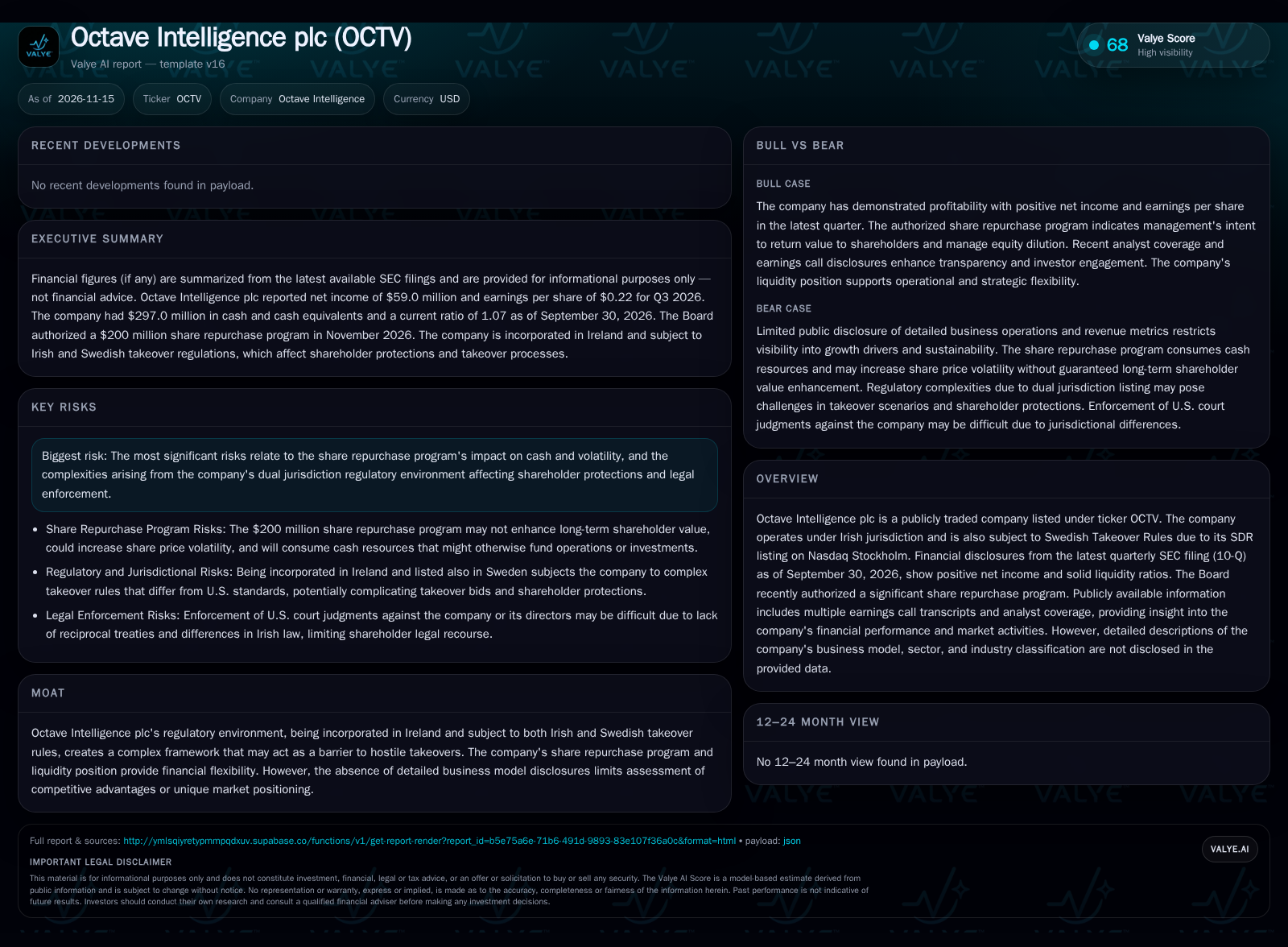
Octave Intelligence posted a profitable Q3 2026, initiated a $200 million share buyback, and operates under complex Irish and Swedish takeover frameworks. With nearly $300 million in cash and a history of targeted acquisitions and divestitures, the company’s business model remains opaque, leaving investors to weigh capital allocation, regulatory friction, and the sustainability of earnings as core uncertainties.
Octave Intelligence reported $59 million in net income for Q3 2026, maintains $297 million in cash, and authorized a $200 million share repurchase. Its business model and sector specifics are undisclosed, but recent M&A activity and dual-jurisdiction rules create unique strategic and governance dynamics. The sustainability of current profitability and the effectiveness of capital deployment are key variables for future performance. [S1]
However, the absence of clear business model disclosures and the overlay of Irish and Swedish regulatory frameworks mean investors face an unusual mix of financial clarity and operational opacity. Recent acquisitions and divestitures indicate an active approach to portfolio management, but the strategic rationale and earnings sustainability remain open questions. In this context, the durability of recent earnings, the impact of capital allocation decisions, and the company’s ability to navigate complex governance environments are central to the investment case. [S1]
Profitability, Buybacks, and Regulatory Layers: What Defines Octave Now?
Octave Intelligence reported net income of $59.0 million and $0.22 earnings per share for Q3 2026, with $297.0 million in cash and a current ratio of 1.07 as of September 30, 2026. These results place the company in a position of operational profitability and liquidity, at least as measured by conventional financial metrics. In November 2026, the Board authorized a $200 million share repurchase program targeting Class B Ordinary Shares and SDRs listed on Nasdaq Stockholm, a move that could support the share price or mitigate dilution, depending on execution. The company operates under both Irish and Swedish takeover laws, which add another layer of complexity to board and shareholder actions during potential M&A events or hostile bids. Meanwhile, recent M&A activity—two acquisitions in 2026 totaling $11.1 million, focused on customer relationships and technology—points to ongoing portfolio reconfiguration, though the magnitude suggests bolt-on rather than transformative deals. [S1]
Unpacking the Economics: Profit Signals Amid Commercial Ambiguity
The company’s profitability and cash generation suggest it is operating a business with either high gross margins, disciplined cost control, or both. However, the absence of any disclosed sector, main products, or revenue streams leaves the economic engine fundamentally unclear. If Octave is tied to AI, analytics, or technology services—as suggested by analyst coverage and sector-relevant news—it could be benefiting from recurring software contracts, data analytics subscriptions, or managed services models, each with different margin and cash flow dynamics.
The authorized share buyback signals that management believes the shares are undervalued or that there are limited reinvestment opportunities with higher risk-adjusted returns. However, the buyback, if executed, will reduce cash available for organic growth, R&D, or larger strategic acquisitions. The company's recent acquisitions were small ($11.1 million total in 2026), primarily allocated to intangible assets such as customer relationships and technology, hinting at a strategy of incremental capability expansion rather than major market entry. Such acquisitions can be immediately accretive if they bring in sticky revenue or high-margin services, but can also dilute focus if integration is poor or synergies are overestimated.
Operating leverage could be present if the company is scaling a software- or platform-centric business, but without disclosure on fixed versus variable costs, it is not possible to confirm the degree of margin expansion potential. The company reported cash and liquidity metrics for the period; these figures do not by themselves establish operating runway, investment capacity, financial flexibility, or financing capacity. [S1]
Competitive Edge or Commodity Player? Assessing Octave’s Strategic Posture
Without a clear public description of Octave’s business model, its sustainable competitive advantages are speculative. If the company operates in technology, analytics, or AI-driven software, competitive dynamics are likely shaped by speed of innovation, integration depth, customer lock-in, and ecosystem effects. The fact that recent acquisitions emphasized customer relationships and developed technology suggests a focus on proprietary solutions or relationship-driven sales, which could provide some switching friction if implemented well.
However, the absence of product or customer concentration disclosures raises the possibility that Octave is competing in a fragmented or commoditized market where pricing power is limited and customer churn could be high. The regulatory environment—being subject to Irish and Swedish takeover rules—may deter hostile bids, acting as a defensive moat, but does not substitute for a true product or platform moat. Peer comparisons are further complicated by the lack of a disclosed industry, though the presence of analyst coverage and inclusion in technology- and AI-related news cycles suggest that Octave is not a pure-play legacy industrial or commodity business. [S1] [N3]
How a Virtuous Cycle of Earnings and Capital Allocation Could Take Hold
If Octave’s core business is indeed software- or data-driven, and recent profitability reflects scalable recurring revenue, sustained earnings growth could be achieved with relatively modest incremental investment. A successful buyback could further enhance per-share metrics, especially if shares are repurchased below intrinsic value and organic growth continues. Small, targeted acquisitions may allow the company to bolt on specialized technology or customer bases, increasing average contract value or reducing churn if well integrated.
Confirmation of this scenario would require future disclosures showing stable or expanding margins, recurring revenue growth, and evidence that acquisitions deliver promised synergies. Analyst upgrades, expanded share repurchase execution, or new product launches would also support the upside case. Falsification would occur if subsequent quarters reveal margin erosion, stalled revenue, or if buybacks fail to move the needle on per-share performance. [S1] [N3]
Incremental Value Creation Amid Governance and Disclosure Constraints
The most plausible scenario is that Octave continues to operate profitably, pursuing incremental growth through small acquisitions and modest internal investment, with the share buyback providing a floor for the share price but not fundamentally altering the growth trajectory. The dual-jurisdiction regulatory regime will likely continue to shape strategic decisions, especially around M&A or capital structure changes, but is unlikely to be a day-to-day operational barrier.
This scenario would be confirmed by steady net income, stable cash balances (even after buyback execution), and continued small-scale M&A with limited integration or impairment charges. Falsification would come from a sharp deterioration in operating metrics, unexpected regulatory friction in a takeover or capital return event, or signs that the company is unable to source attractive bolt-on deals to sustain growth. [S1]
Risks of Overcapitalized Stagnation and Regulatory Friction
The main adverse scenario is that Octave’s recent profitability proves unsustainable, either due to end-market weakness, loss of a major customer, or increased competition. If the business is less sticky than assumed, or if recent acquisitions do not generate expected returns, cash flows could contract. The share repurchase could then appear mistimed, reducing strategic flexibility just as additional investment or restructuring becomes necessary.
Regulatory complexity may compound downside risk by delaying or complicating necessary strategic responses—such as asset sales, mergers, or capital raises—especially if hostile bids or activist involvement increases. Confirmation of this scenario would come from sudden margin compression, a material decline in cash balances, or regulatory delays in major corporate actions. Falsification would be evidenced by resilience in earnings and cash flow even as buybacks proceed and regulatory hurdles are navigated without incident. [S1]
What Will Shape Octave’s Next Chapter? Milestones That Could Shift the Thesis
Disclosure of the company’s primary business lines, end markets, or revenue composition—if provided—would clarify the sustainability and drivers of earnings.
Execution details and pace of the $200 million share repurchase: actual repurchase volume, average price paid, and impact on share count and EPS.
Future acquisition announcements, including size, structure, target description, and integration commentary, to test whether the bolt-on strategy adds value.
Trends in net income and margins over the next several quarters, especially after the buyback and any new M&A activity.
Any regulatory or legal developments related to the Irish and Swedish takeover regimes, particularly if the company becomes the subject of a bid or activist campaign.
Management commentary on capital allocation priorities—whether further buybacks, dividends, or a pivot to organic investment are emphasized.
Analyst rating changes or new coverage initiation, which may signal shifting market perceptions or improved disclosure.
Disclaimer: This is research-only, informational analysis and not investment advice. It may include AI-generated interpretation and general industry context. Always verify important details using primary sources.

Comments