
Kardigan, Inc.: Clinical-Stage Ambition, Extended Timelines, and the Realities of Pre-Revenue Biotech
With a recent IPO and a reported liquidity position, Kardigan, Inc. is advancing its Phase 2 Ataciguat trial but faces a long pathway to potential commercialization. The company’s valuation now hinges on clinical milestones, disciplined capital deployment, and the ability to navigate the inherent volatility of early-stage drug development.
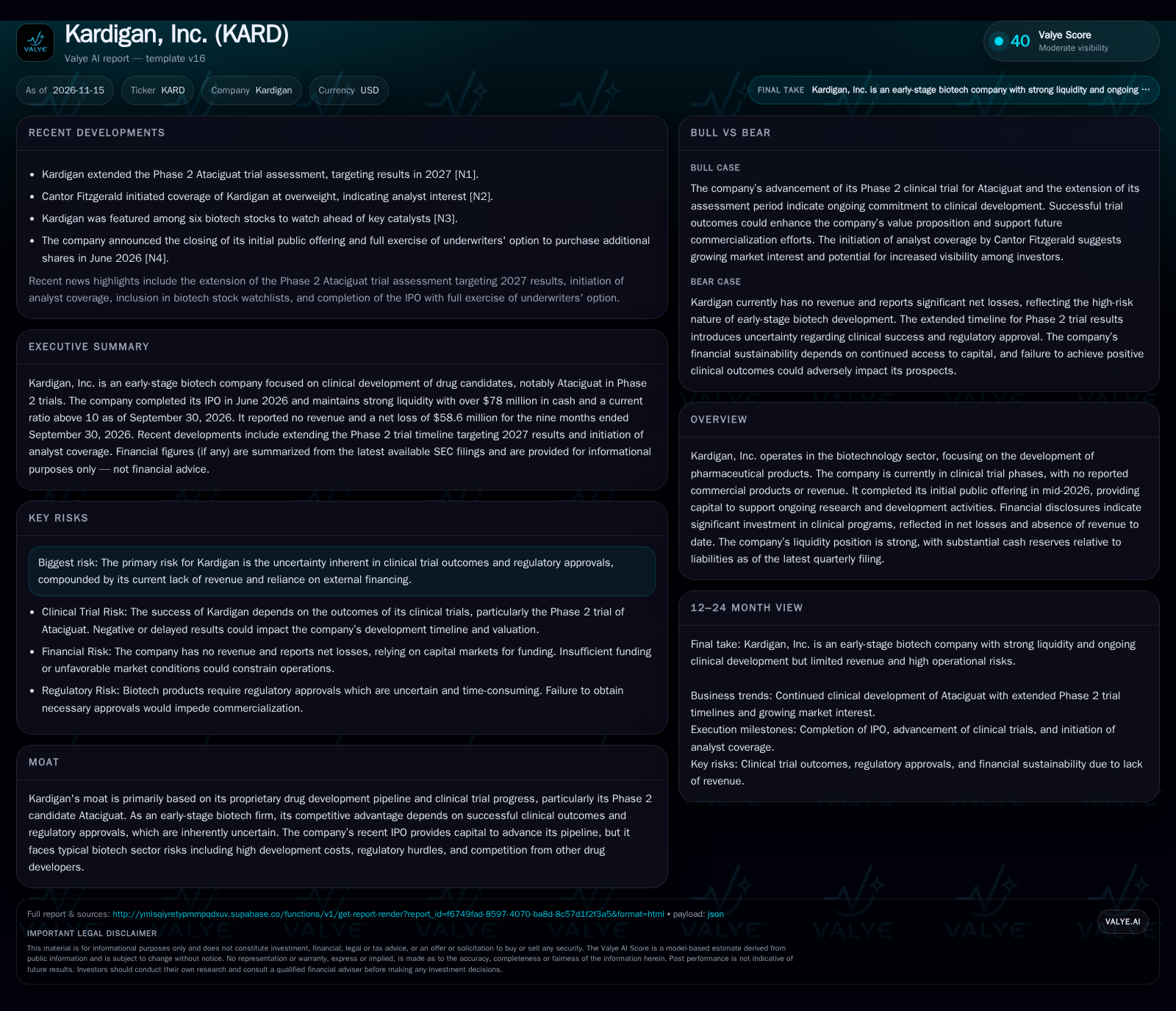
Kardigan, Inc. is a newly public biotech focused on cardiovascular therapeutics, currently running a Phase 2 trial for Ataciguat.While the company boasts reported liquidity position from its June 2026 IPO and a reported current ratio, it remains pre-revenue with substantial net losses and an extended timeline for clinical readouts. The key thesis levers are clinical trial progress, capital efficiency, and the uncertain journey toward regulatory approval and eventual commercialization. Near-term upside depends on clinical progress and external validation; downside risks stem from trial delays, negative data, or capital market disruptions.
Kardigan, Inc. represents the quintessential high-risk, high-reward profile of a newly public biotech: flush with capital following its IPO, zero revenue, and a lead asset—Ataciguat—still in mid-stage clinical development. The company’s future will be determined by its ability to generate compelling clinical data, manage cash burn over an extended trial timeline, and ultimately convert scientific promise into regulatory and commercial success. As the Ataciguat Phase 2 trial targets results in 2027, investors face a multi-year wait for pivotal catalysts, with significant binary risk at each clinical and regulatory juncture.
Recent IPO Proceeds and Extended Clinical Timelines Shape Near-Term Reality
Kardigan, Inc. completed its initial public offering in June 2026, raising $422.5 million in net proceeds following the full exercise of the underwriters’ overallotment option [S1] [N4]. As of September 30, 2026, the company reported $78.9 million in cash and cash equivalents and $484.5 million in current assets, with a current ratio of 10.62 [S1]. These figures underscore Kardigan’s strong near-term liquidity but do not address the longer-term capital requirements typical of clinical-stage biotech firms. Kardigan reported no revenue and a net loss of $58.6 million for the first nine months of 2026 [S1], reflecting the company’s ongoing investment in research and development. The Phase 2 clinical trial for Ataciguat, the company’s lead asset, has had its assessment period extended, with topline results now targeted for 2027 [N1]. This extension pushes out the timeline for value-defining data and increases the importance of capital efficiency and interim milestones.
Economics of Pre-Revenue Drug Development: Burn Rate, Leverage, and the Path to Value Inflection
Kardigan’s financial structure is characteristic of early-stage biotech: no product revenue, high R&D spend, and operating losses funded by equity capital. The company’s cost base is dominated by clinical trial and development expenses, which are largely fixed in the short term but may scale with additional programs or trial sites. The company reported cash and liquidity metrics for the period; these figures do not by themselves establish operating runway, investment capacity, financial flexibility, or financing capacity. [S1]
Operating leverage is negative at this stage: increased spending is required to progress the pipeline, but there is no meaningful offset from commercial inflows. Only if Ataciguat demonstrates positive clinical results and advances toward approval does the business model shift toward potential revenue generation and margin leverage. Until then, the company’s economics are defined by its ability to manage cash burn and raise capital at acceptable terms. Should Ataciguat eventually reach commercialization, the biotech business model could offer high gross margins and strong operating leverage, but this scenario remains several years away and is highly contingent on clinical success.
Pipeline Differentiation and the Realities of Biotech Competition
Kardigan’s competitive position is defined by the novelty and clinical potential of its pipeline, particularly Ataciguat, which targets cardiovascular diseases with significant unmet need [S1]. In the pre-commercial phase, competitive differentiation hinges on intellectual property protection, the ability to generate compelling clinical data, and progress relative to peer-stage companies developing similar assets. The cardiovascular space is crowded with both large pharmaceutical incumbents and other clinical-stage biotechs, many of whom are targeting adjacent or overlapping indications.
Switching costs and customer lock-in are not relevant at this stage, as Kardigan has no commercial products or prescriber relationships. Instead, value is derived from the perceived probability of clinical and regulatory success, the strength of the underlying science, and the company’s ability to secure future partnerships or licensing deals. Should Ataciguat or other pipeline assets demonstrate clear differentiation in safety, efficacy, or mechanism of action, Kardigan could attract external interest from larger biopharma partners or acquirers—an important potential exit pathway in the biotech sector. Conversely, undifferentiated results or crowding by more advanced competitors could erode the company’s strategic value.
Pivotal Data and External Validation Could Transform the Valuation Paradigm
The most favorable scenario for Kardigan is that the extended Phase 2 trial of Ataciguat yields positive, statistically significant efficacy and safety data in 2027. This would position the company to advance into pivotal Phase 3 studies or attract lucrative licensing or partnership deals with larger pharmaceutical players. External validation—such as additional analyst coverage, inclusion in high-profile biotech indices, or strategic investments—could further enhance market confidence and valuation.
Upside confirmation would require clear disclosures of robust clinical data, regulatory engagement (such as Fast Track or Breakthrough Therapy designation), and evidence of disciplined cash management to extend runway through key inflection points. Announcements of new pipeline programs or non-dilutive funding sources (e.g., grants, partnerships) would also be supportive.
Managing Through the Long Interim: Capital Discipline and Incremental Progress
The most plausible near-term scenario is a continuation of current trends: Kardigan advances the Ataciguat Phase 2 trial through 2027, with no major clinical or regulatory readouts in the next 12-18 months. Periodic news flow—such as patient enrollment updates, trial protocol amendments, or interim safety reviews—provides limited catalysts but does not fundamentally alter the risk/reward calculus.
Absence of major negative developments (e.g., clinical holds, adverse safety signals, or material trial delays) would support the base scenario. However, the long wait for value-defining data and the persistent need for capital carry ongoing dilution and execution risks. The scenario would be falsified by unexpected trial setbacks, a rapid acceleration of cash burn, or adverse capital market conditions that constrain future fundraising.
Clinical Setbacks or Capital Market Disruption Could Imperil the Development Path
The principal downside risks for Kardigan are negative or inconclusive Phase 2 results for Ataciguat, leading to a collapse in the asset’s development value and sharply reduced investor confidence. Clinical setbacks—such as safety signals, lack of efficacy, or difficulties in patient recruitment—would not only delay the timeline but could also force the company to pivot or downsize, rapidly depleting cash reserves.
In the absence of revenue and with ongoing operating losses, Kardigan’s ability to fund continued operations is dependent on its access to equity markets or partnerships. A downturn in biotech capital markets, unfavorable financing terms, or dilution fatigue among investors could further constrain the company’s options. Confirmation of the downside scenario would include trial discontinuation, severe delays, or a need for emergency capital raises at depressed valuations. Mitigating the downside would require clear contingency planning, cost control, and the identification of secondary pipeline assets or alternative value creation strategies.
Milestones and Metrics That Will Determine Kardigan’s Trajectory
Progress and enrollment rates in the Phase 2 Ataciguat trial, including updates on protocol amendments, patient recruitment, and interim safety reviews, if disclosed.
Quarterly cash burn and updated guidance on runway duration relative to planned trial milestones.
Announcements of additional pipeline programs, partnerships, or licensing deals that could diversify risk or provide non-dilutive funding.
Disclosures of regulatory interactions, such as meeting minutes, special designations, or feedback from agencies, if available.
Evidence of analyst coverage expansion, institutional investor participation, or strategic investments that signal external validation.
Material trial setbacks, clinical holds, or adverse safety/efficacy disclosures that could impact the viability of Ataciguat.
Updates on capital market conditions, financing capacity, or equity dilution risk as the company approaches future funding needs.
If disclosed, any changes in management or board composition that may signal shifts in strategic direction or risk appetite.
Disclaimer: This is research-only, informational analysis and not investment advice. It may include AI-generated interpretation and general industry context. Always verify important details using primary sources.

Comments