
Cardinal Infrastructure: Acquisition-Driven Expansion Meets the Realities of Operating Losses and Asset Risk
Cardinal Infrastructure Group Inc.
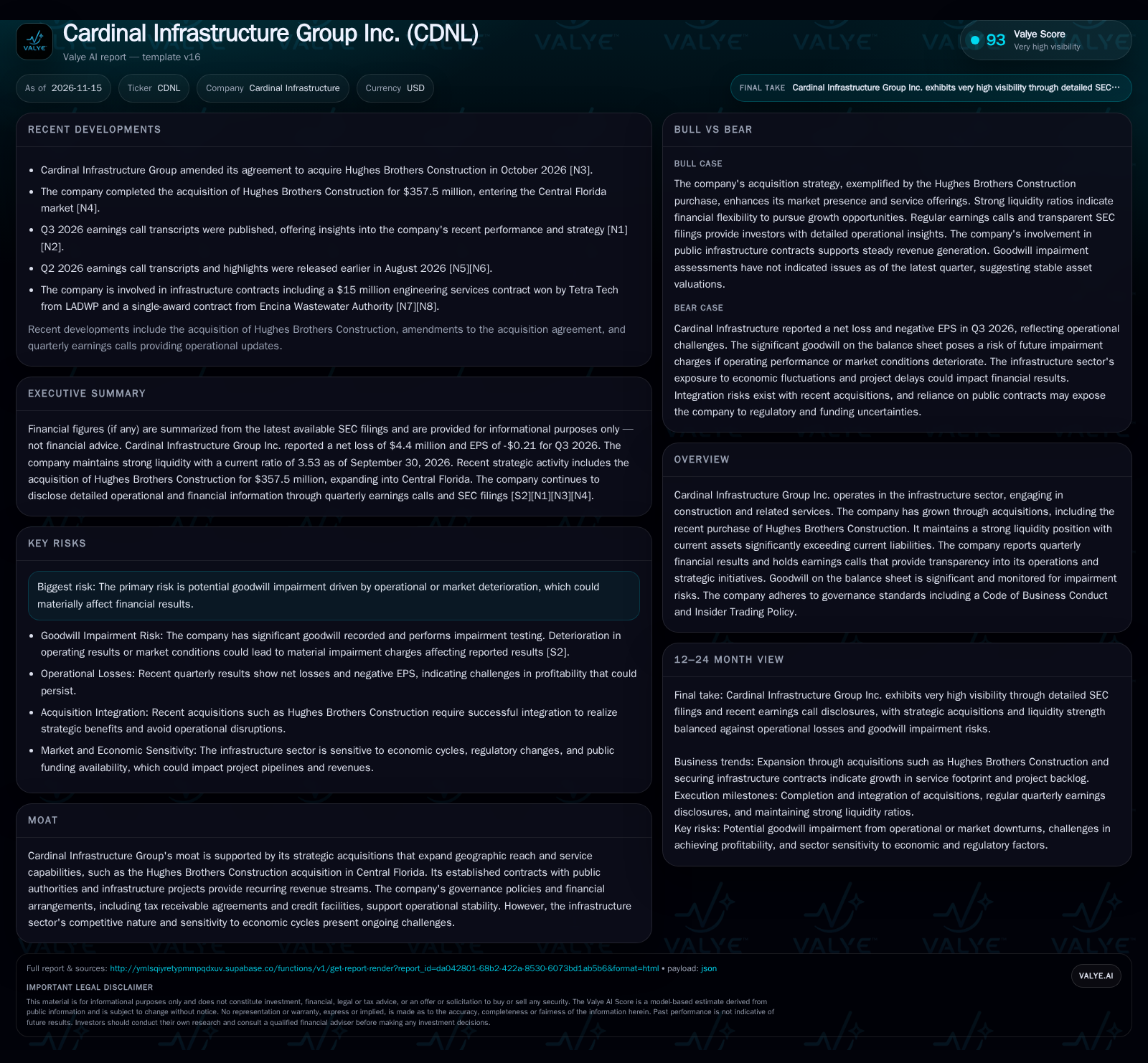
Cardinal Infrastructure Group Inc. (CDNL) reported a Q3 2026 net loss of $4.4 million despite maintaining a current ratio of 3.53. The company amended and closed its acquisition of Hughes Brothers Construction, signaling a continued strategy of growth via M&A. However, substantial goodwill and the risk of future impairment loom if integration or operating momentum falter. The company's future hinges on converting acquisitions into profitable operations and navigating the infrastructure sector’s cyclical uncertainties. [S2] [N3] [N4]
Cardinal Infrastructure Group Inc. is navigating a critical juncture as it pursues growth through acquisitions while contending with persistent operating losses and asset risks. The company’s Q3 2026 results highlight both the promise and the pitfalls of its strategy: a widened geographic footprint and project pipeline following the Hughes Brothers Construction acquisition, offset by a net loss and a growing goodwill balance that could become a liability if integration or market conditions worsen.
Recent Losses, Liquidity, and Acquisition Moves: What’s Changed for Cardinal?
Cardinal Infrastructure reported a net loss of $4.4 million for Q3 2026, translating to basic and diluted EPS of -$0.21. Despite this operational setback, the company’s reported liquidity position, with current assets of $549.7 million against current liabilities of $155.8 million—a current ratio of 3.53 as of September 30, 2026 [S2]. This balance-sheet strength is timely, as Cardinal completed and amended its acquisition of Hughes Brothers Construction in October 2026, a move that extends its presence into Central Florida and potentially increases its project backlog [N3] [N4]. Notably, the company continues to carry substantial goodwill on its balance sheet, with annual and interim impairment assessments indicating no current charge but highlighting the risk that underperformance or market downturns could force future write-downs [S2]. These developments collectively raise the stakes for how well Cardinal can convert its acquisitive strategy into bottom-line improvement.
How Cardinal’s Business Model Converts Projects into Earnings—And Where It Stumbles
Cardinal Infrastructure operates in the construction and infrastructure services sector, where revenue is typically generated through a mix of long-term public contracts and private project work. Margins in this space are often pressured by competitive bidding, rising input costs, and project execution risks. The company’s recent acquisition of Hughes Brothers Construction suggests a deliberate strategy to drive scale and expand project mix—potentially enabling Cardinal to bid on larger, more complex contracts and diversify by geography. If managed efficiently, this could unlock operating leverage, as fixed costs are spread over a larger revenue base and procurement power improves.
However, integration costs, inefficiencies in combining operations, and the risk of project delays or cost overruns can erode these potential benefits. The reported net loss in Q3 2026 signals that Cardinal’s current revenue mix and cost structure have not yet delivered sustainable profitability [S2]. The large goodwill balance further amplifies the stakes: unless acquired businesses generate sufficient incremental earnings and cash flows, Cardinal faces the risk of impairment charges that could further depress reported results. The company reported cash and liquidity metrics for the period; these figures do not by themselves establish operating runway, investment capacity, financial flexibility, or financing capacity.
Competitive Landscape: Can Scale and Public Contracts Defend Margins?
Cardinal’s core competitive assets are its established relationships with public authorities and its ability to secure infrastructure contracts, which can offer recurring revenue streams and project visibility. The recent acquisition of Hughes Brothers Construction adds geographic reach and may improve Cardinal’s access to new contract opportunities in Central Florida [N4]. In the U.S. infrastructure sector, competition is intense, with both large national firms and regional players vying for contracts. Scale can provide cost advantages and credibility for larger projects, while deep local relationships can be critical for winning bids and navigating regulatory nuances.
However, competitive bidding often compresses margins, and public-contract exposure means that Cardinal’s revenue pipeline is sensitive to government budget cycles and policy shifts. Substitution risk from new construction technologies or delivery models (such as design-build, PPPs, or modular construction) may pressure traditional players unless they adapt. Integration of acquired businesses is another battleground: failure to harmonize systems, cultures, and project delivery standards can result in inefficiencies that offset scale benefits. In sum, Cardinal’s competitive position hinges on its ability to leverage scale, maintain high win rates, and execute projects profitably while managing integration and sectoral risks.
Unlocking Value: When Integration and Market Tailwinds Align
If Cardinal successfully integrates Hughes Brothers Construction—achieving cost synergies, operational alignment, and project delivery improvements—the company could see margin expansion and improved earnings quality. A favorable scenario would also require a robust infrastructure spending environment, with stable or increasing public-sector budgets and strong demand for both new construction and maintenance projects. This would support higher volumes and potentially improved pricing, especially if Cardinal leverages its expanded geographic footprint to win larger or more specialized contracts.
Confirmation of this scenario would come from a return to positive net income, sustained improvement in gross and operating margins, and evidence of backlog growth driven by new contract wins in previously underpenetrated markets. Further, if goodwill remains unimpaired over several reporting periods—implying that acquisition performance meets or exceeds expectations—investors could gain confidence in Cardinal’s acquisitive growth strategy. The absence of major project delays or cost overruns, and management commentary indicating successful integration and pipeline expansion, would also bolster the bull case.
A Realistic Trajectory: Slow Margin Rebuild Amid Integration and Sector Cycles
The most plausible near-term path for Cardinal is a gradual improvement in operating results as the benefits of the Hughes Brothers Construction acquisition are realized, but with continued exposure to sector and integration headwinds. Margins may improve incrementally as cost synergies are captured and as Cardinal’s expanded footprint boosts its ability to win new projects. However, competitive pressures are likely to keep overall margin expansion modest, and periods of project-specific volatility—such as delays, rework, or cost inflation—could continue to weigh on earnings.
Evidence for this scenario would be a narrowing of quarterly net losses, stabilization or modest growth in revenue, and no immediate goodwill impairment. On the other hand, persistent bottom-line losses, rising integration expenses, or signs of project execution issues would challenge this base case. Management transparency during earnings calls regarding pipeline health, integration progress, and cost control will be critical for tracking whether Cardinal is on a sustainable path toward profitability.
When Integration Falters and Market Headwinds Strike
In an adverse scenario, Cardinal struggles to integrate Hughes Brothers Construction, encountering higher-than-expected costs, operational disruptions, or cultural clashes that erode project delivery efficiency. Simultaneously, a downturn in infrastructure spending—driven by public budget tightening, regulatory delays, or macroeconomic contraction—could reduce project volumes and intensify competition, further compressing margins. If these pressures persist, Cardinal may be unable to generate sufficient cash flow from its expanded asset base, raising the risk of a goodwill impairment charge.
Confirmation of this downside would include widening net losses, negative operating cash flow, project cancellations or delays, and a formal goodwill impairment recorded in SEC filings. Additional warning signs would be management commentary highlighting integration difficulties, loss of key contract bids, or increased reliance on credit facilities to fund operations. In this scenario, the company’s reported liquidity position could erode rapidly, and investor confidence in the acquisition-driven growth model would likely deteriorate.
Milestones and Metrics That Will Determine Cardinal’s Value Creation
Quarterly net income and EPS trends: A return to profitability or continued losses will be a primary signal of integration success and operating leverage.
Gross and operating margin progression: Improvements here, if disclosed, would indicate that cost synergies from acquisitions are materializing.
Goodwill balance and any recorded impairments: Watch for signs of asset write-downs in future filings, which would signal acquisition underperformance.
Backlog growth and contract win rates: Disclosure of new project awards, especially in Central Florida, would test whether the Hughes Brothers acquisition is expanding addressable opportunity.
Integration expense disclosures and management commentary: Look for concrete updates on synergy capture, cost control, and cultural alignment.
Project execution metrics: Delays, cost overruns, or client disputes, if disclosed, would be early warning signs of operational or integration risk.
Sector-level indicators: Changes in public infrastructure budgets, regulatory approvals, or macroeconomic outlooks will shape Cardinal’s project pipeline and pricing environment.
Disclaimer: This is research-only, informational analysis and not investment advice. It may include AI-generated interpretation and general industry context. Always verify important details using primary sources.

Comments