
Galata Acquisition Corp. II: The Countdown to a Defining Deal in the SPAC Lifecycle
With its IPO proceeds secured in trust and a broad sector mandate, Galata Acquisition Corp. II now enters the critical phase of sourcing and executing a transformative business combination. The challenge: convert potential financial flexibility and sponsor expertise into a value-creating transaction before the 2027 deadline—while managing dilution risks and market uncertainties.
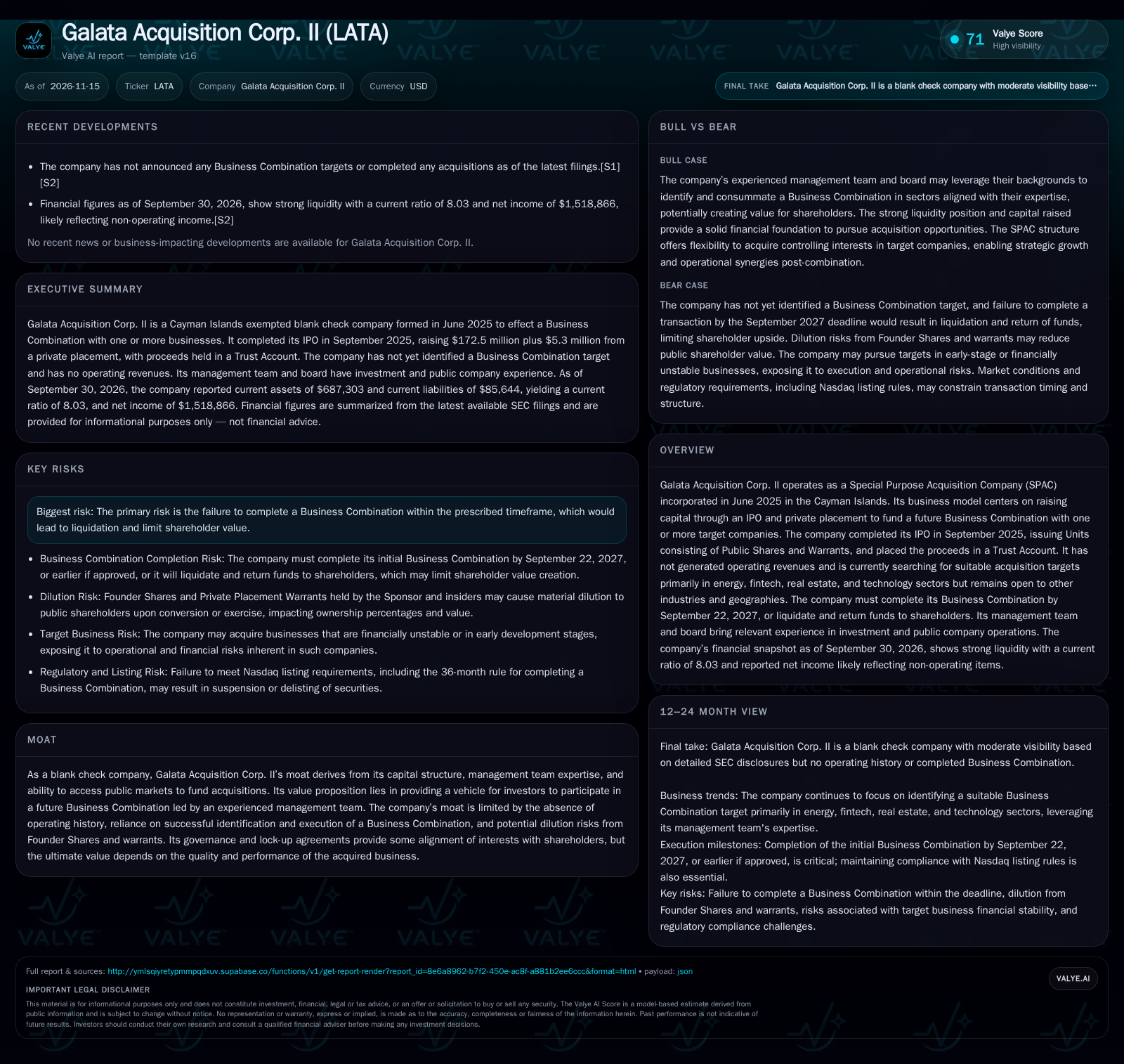
Galata Acquisition Corp. II, a Cayman Islands-based SPAC, has raised $172.5 million through its IPO and an additional $5.3 million via private placement, all held in trust for a future acquisition. The company has yet to announce a target and must complete a business combination by September 22, 2027, or return funds to shareholders. Risks include potential dilution from sponsor warrants and the threat of liquidation if no deal is reached.[S1] [S2]
Galata Acquisition Corp. II, a blank check company formed in June 2025, exemplifies the classic SPAC structure: a pool of public capital, a seasoned sponsor group, and a ticking clock to deliver a value-generating acquisition. With $172.5 million in IPO proceeds and $5.3 million from private placement warrants held in trust, the company’s financial base is secure for now. However, Galata remains pre-deal, with no announced acquisition target, and faces a hard deadline of September 22, 2027, to complete a business combination or liquidate. The coming quarters will test the management team’s ability to balance speed, selectivity, and shareholder alignment in a competitive and evolving deal environment.[S1] [S2]
Where Galata Stands: Pre-Deal Status and the Clock Is Ticking
As of November 2026, Galata Acquisition Corp. II has not identified or announced any business combination target. The company’s $172.5 million in IPO proceeds, supplemented by $5.3 million from private placement warrants, remains secured in a trust account.Its current assets stand at $687,303, with current liabilities of $85,644, resulting in a reported current ratio of 8.03—characteristic of a SPAC awaiting a transaction rather than reflecting operational activity.[S2]
The company faces a firm deadline: it must complete a business combination by September 22, 2027, or liquidate and return trust funds to public shareholders. Meanwhile, reported net income of $1,518,866 likely reflects non-operating gains from trust investments rather than core business earnings. The sponsor’s founder shares and warrants present a potential source of future dilution, especially if a deal is consummated and these instruments convert or are exercised.[S1] [S2]
SPAC Financial Mechanics: Trust Proceeds, Deal Leverage, and Dilution Dynamics
Galata’s core economic model is typical of post-IPO SPACs: proceeds are placed in a trust account, earning minimal interest until a business combination is executed. There are no operating revenues; all expenses (legal, due diligence, and administrative) are funded from a small working capital pool outside the trust. The company’s value creation opportunity arises only if it sources and closes a deal that is accretive for public shareholders—typically by acquiring a growth-stage or undervalued private company and bringing it to public markets.
The economics for public shareholders are shaped by several levers: the quality and pricing of the eventual deal, the degree of sponsor dilution (from founder shares and warrants), and post-deal company performance. Sponsor economics are designed to incentivize deal completion, but can result in significant dilution—often up to 20% of post-combination equity—if not carefully managed. In the event of liquidation, public shareholders receive their pro-rata share of the trust (minus limited expenses), while sponsor capital is at risk and warrants become worthless.
Capital needs are concentrated at the deal stage. If the target requires additional funds, Galata may pursue PIPE (private investment in public equity) financing, which can further dilute shareholders but may be essential for larger or capital-intensive acquisitions. Operating leverage is not relevant until a business combination is closed and the new entity begins operations as a public company.
Deal Sourcing in a Crowded SPAC Market: Galata’s Edge and Vulnerabilities
Galata operates in an environment with numerous competing SPACs, all seeking attractive targets before their respective deadlines. The company’s broad sector mandate—spanning energy, fintech, real estate, and technology—provides flexibility but also pits it against both sector-focused SPACs and traditional private equity funds. The sponsor team’s investment and public company experience could give Galata an edge in deal sourcing, negotiation, and post-merger governance, especially if they have deep networks or prior success in their target industries.
However, the competitive landscape is not static. The surge of SPAC IPOs in the 2021-2022 cycle has left a crowded field, with many sponsors chasing a finite pool of high-quality targets. Target companies are increasingly able to command favorable terms or shop for the best sponsor, raising the risk of overpaying for deals or settling for less-attractive assets. Additionally, traditional IPO and direct listing alternatives have become more viable for some private companies, reducing the relative appeal of a SPAC merger.
Regulatory scrutiny has also increased, with the SEC and Nasdaq imposing stricter disclosure and timing requirements. Galata’s flexibility is balanced by these external constraints and the need for shareholder approval for any business combination.
How a Well-Timed, High-Quality Acquisition Could Unlock Shareholder Value
The most favorable outcome for Galata is a scenario in which the management team leverages its expertise and network to identify a high-growth, scalable target—ideally in a sector where the sponsor has operational insight or industry connections. If the company can negotiate a deal that is both attractively priced and strategically compelling, it could catalyze value appreciation for public shareholders, especially if the merged entity commands a public market premium.
Evidence supporting this scenario would include the announcement of a business combination with a credible, growth-oriented company, accompanied by favorable deal terms (limited dilution, strong PIPE participation, or a post-announcement share price premium to trust value). Additional confirmation would come from the target’s robust financials, clear path to profitability, and positive market reception upon deal close. Early signals might include increased sponsor engagement, news of advanced negotiations, or regulatory filings related to a proposed merger.
Most Likely Trajectory: Extended Search, Modest Deal, and Shareholder Dilution
The most plausible path is that Galata continues its target search into 2027, potentially facing time pressure as the deadline approaches. In this scenario, the company may ultimately consummate a business combination with a mid-tier or late-stage private firm—possibly in fintech or technology—where valuations are more reasonable but the growth profile is less explosive. Sponsor dilution would materialize as founder shares and warrants convert, and public shareholders might see their ownership percentages shrink post-deal.
This outcome would be confirmed by a business combination announcement close to the deadline, with deal terms that include some dilution for public shareholders. PIPE financing may be required if the target has significant capital needs, further diluting existing holders. The post-merger entity could trade near trust value, reflecting market skepticism about the deal’s upside. Falsification would occur if no deal is announced or if the company opts for liquidation instead.
Deal Failure and Liquidation: Risks of a Crowded Market and Sponsor Dilution
The principal risk is that Galata fails to secure a business combination by the September 2027 deadline. This could occur if competition for targets remains intense, valuations become prohibitively high, or regulatory hurdles delay or derail negotiations. In this scenario, the company would be forced to liquidate, returning trust funds to shareholders and rendering sponsor equity and warrants worthless.
Adverse confirmation signals would include repeated extensions of the search process, negative market reaction to potential deal rumors, or the withdrawal of previously announced targets. If the SPAC is unable to secure PIPE financing for a larger target, the risk of deal collapse increases. Shareholders would receive their pro-rata share of the trust, but would forgo any potential upside, and public market value may trade below trust value as the deadline approaches and deal prospects dim.
Milestones That Will Define Galata’s SPAC Outcome
Announcement of a definitive business combination agreement, including target identity, sector, and deal terms.
Level of dilution to public shareholders from the conversion of founder shares and exercise of warrants—if disclosed, this would clarify post-merger ownership dynamics.
Evidence of PIPE financing commitments or additional capital raised alongside the business combination, which could impact both dilution and deal feasibility.
Shareholder reaction to a proposed merger, as measured by share price relative to trust value and redemption rates at the time of the vote.
Regulatory filings and SEC correspondence related to a proposed business combination, which could reveal potential deal risks or timeline extensions.
Sponsor or management team purchase of additional shares or warrants in the open market, if disclosed, as a potential signal of deal confidence.
Any extension of the SPAC’s deadline or amendments to trust terms, which would indicate challenges in sourcing or closing a transaction.
A useful metric would be the percentage of public shares redeemed in connection with a business combination vote, as this impacts post-merger float and market perception.
Disclaimer: This is research-only, informational analysis and not investment advice. It may include AI-generated interpretation and general industry context. Always verify important details using primary sources.

Comments