
Jones Ventures INTL Acquisition1 Corp: SPAC Economics, Execution Stakes, and the Realities of the Blank-Check Model
Jones Ventures INTL Acquisition1 Corp stands at the pre-acquisition stage typical of newly listed SPACs, with reported liquidity position and recent net income driven by interest on IPO proceeds. The company’s future value hinges entirely on its ability to identify and execute a compelling business combination before the SPAC’s window closes.
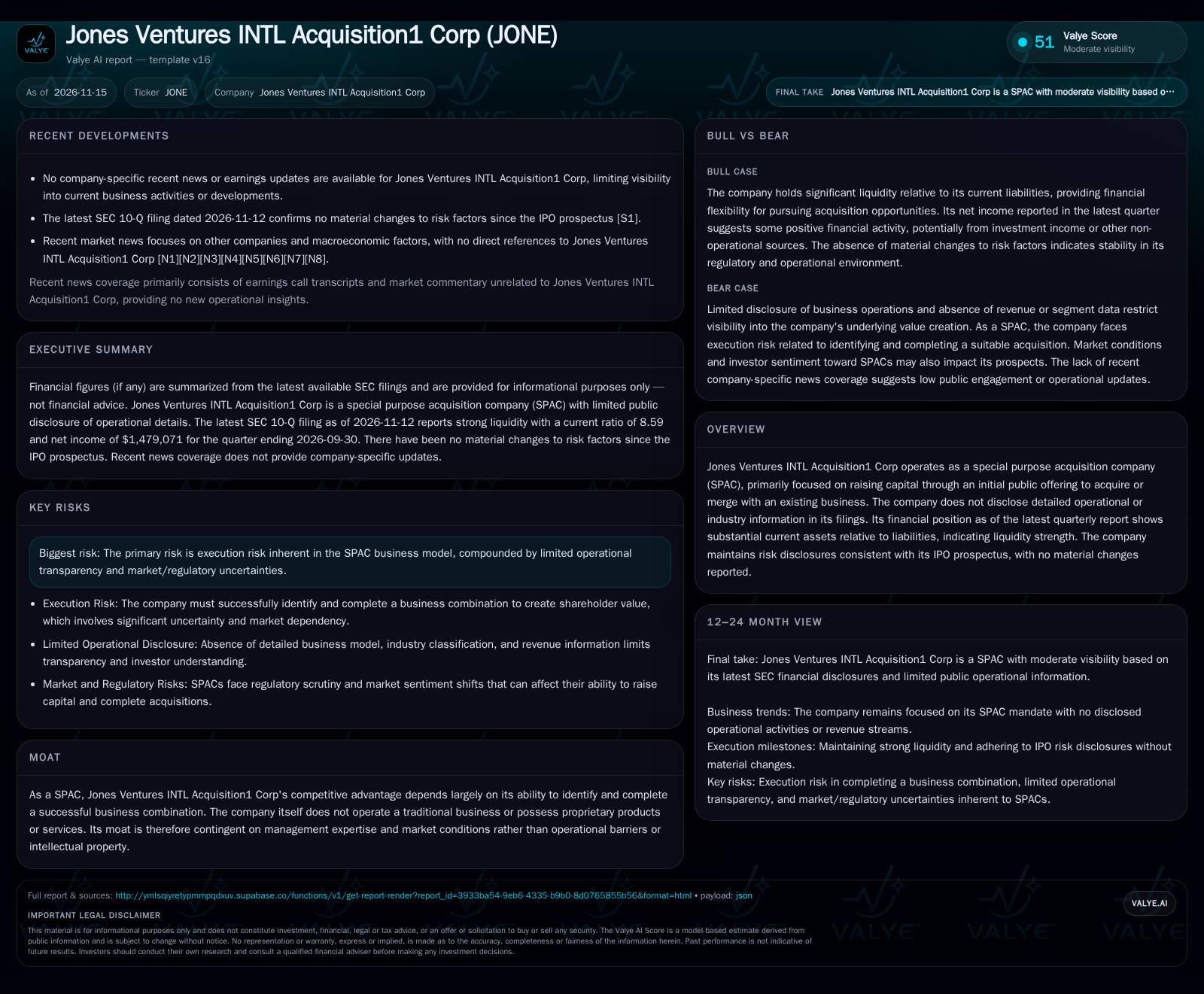
Jones Ventures INTL Acquisition1 Corp is a newly public SPAC with $1.35 million in current assets and a current ratio of 8.59 as of September 2026, reflecting reported liquidity position. Its net income of $1.48 million in the quarter is attributable entirely to interest on IPO proceeds, not operations. The company has not yet identified a business combination target, and its value proposition remains tied to future M&A execution rather than ongoing operations or revenue [S1].
Jones Ventures INTL Acquisition1 Corp exemplifies the early-stage SPAC paradigm: substantial IPO proceeds, minimal operating activity, and a business model built on the pursuit of a transformative acquisition. As of September 2026, the company’s financial disclosures show a healthy current asset base and net income derived exclusively from interest on its trust account, not from actual operations. With no business combination target identified and no operational revenue, investor focus inevitably turns to the company’s ability to source, negotiate, and close a deal that justifies the initial capital raise. The true test of value creation for Jones Ventures INTL Acquisition1 Corp remains entirely in the future, hinging on execution and market timing [S1].
Financial Position and Operating Status: Where Jones Ventures INTL Acquisition1 Corp Stands
As of September 30, 2026, Jones Ventures INTL Acquisition1 Corp reported current assets of $1,348,948 against current liabilities of $157,081, resulting in a current ratio of 8.59 [S1]. The company’s net income for the quarter was $1,479,071, generated entirely by interest income on IPO trust account proceeds and fair value adjustments—not from business operations [S1]. There is no revenue from commercial activity, and the company has not yet identified or initiated negotiations with any business combination target. Risk disclosures remain unchanged from the IPO prospectus, highlighting that the principal risk is the execution of a suitable acquisition within the required timeframe [S1].
SPAC Economics: How Value Could Be Created or Destroyed
The business model of Jones Ventures INTL Acquisition1 Corp is archetypal for SPACs: raise capital via an IPO, park proceeds in a trust account, and seek a private company to merge with or acquire. Until a target is acquired, the company does not generate operating revenues; instead, net income arises from interest earned on cash held in trust. All operating expenses—including legal, due diligence, and compliance—are funded from the IPO proceeds and, potentially, sponsor loans if needed.
The economics hinge on the ability to identify a high-quality target and negotiate favorable terms before the SPAC’s deadline (typically 18-24 months post-IPO). If a deal is consummated, value for shareholders depends on the acquired company’s future growth, profitability, and public-market appeal. If no deal is struck, funds are returned to shareholders and the SPAC is liquidated, with sponsors losing their at-risk capital and out-of-pocket expenses. The fixed costs of being a public company (reporting, legal, audit) persist regardless of deal outcome, eroding the trust account over time. The structure creates operating leverage only after a merger, when the combined entity’s cost base and revenue-generating capabilities come into play.
Where SPACs Compete: Talent, Targets, and Market Timing
Jones Ventures INTL Acquisition1 Corp’s competitive position is defined not by products or intellectual property, but by its ability to source, attract, and successfully close a deal with a desirable target company. The primary competitors are other SPACs seeking similar acquisition candidates, private equity buyers, and traditional IPO routes for private companies. The market for high-quality acquisition targets has become increasingly competitive, with deal multiples and sponsor incentives under scrutiny.
Differentiation for a SPAC typically comes from sponsor reputation, industry networks, and the ability to offer attractive deal terms or post-merger support. However, there is no evidence of a proprietary sourcing advantage or sector specialization for Jones Ventures INTL Acquisition1 Corp in the current disclosures. In the absence of a target, its competitive position is neutral and entirely dependent on the skill and connections of its sponsor group, as well as prevailing market sentiment toward SPAC deals.
Catalyst Chain: How a Successful Acquisition Could Unlock Shareholder Value
The upside scenario for Jones Ventures INTL Acquisition1 Corp requires a sequence of favorable events. First, the management team must identify a private company with strong growth prospects, a compelling story for public investors, and a willingness to merge. Second, the deal must be structured on terms that preserve or enhance the value of the SPAC’s trust account for public shareholders. Third, regulatory approval and shareholder votes must be secured.
If these steps are achieved, the combined company could benefit from public market access, liquidity, and potential valuation uplift. Confirmation of this scenario would include a definitive merger announcement, clear disclosure of target financials and strategic rationale, and positive market or analyst reaction to the proposed deal. Falsification would come from an inability to secure a target, shareholder rejection of the proposed deal, or a transaction that results in significant redemption of public shares, leaving the post-merger entity undercapitalized.
The Most Likely Outcome: Extended Search, Rising Costs, and Uncertain Deal Timing
The most plausible scenario is that Jones Ventures INTL Acquisition1 Corp continues its search for a business combination target over the coming quarters, incurring ongoing legal, compliance, and administrative expenses. Interest income on the trust account may partially offset these costs, but the trust balance will gradually decline due to redemptions or expenses. The company may announce a letter of intent or enter negotiations, but as seen across the SPAC sector, deal execution is not assured and timelines frequently slip.
Supporting evidence would include SEC filings showing continued net interest income, incremental expense accruals, and possibly early-stage deal discussions. Falsification would be an abrupt liquidation announcement, a failure to maintain minimum trust balances, or a material change to risk factors indicating a change in strategy or market conditions.
Deal Drought: What If No Business Combination Materializes?
The adverse scenario is that Jones Ventures INTL Acquisition1 Corp fails to identify or consummate a business combination before its deadline. In this event, the SPAC would be required to liquidate, returning the trust account funds to public shareholders and leaving sponsors with sunk costs. This outcome is increasingly common in a market where regulatory scrutiny, high redemption rates, and a crowded field of SPACs make successful deals less likely.
Confirmation would come in the form of liquidation filings, statements regarding the inability to secure a target, or amendments to the company’s charter to extend the search window. Falsification of this scenario would require concrete evidence of a signed merger agreement and a clear path to deal closure.
What Will Determine the SPAC’s Outcome: Milestones for Jones Ventures INTL Acquisition1 Corp
Announcement of a letter of intent or definitive agreement with a business combination target.
Disclosure of target company financials, sector, and rationale for the proposed transaction.
Updates to risk factors in SEC filings, especially those highlighting changes in deal prospects or market conditions.
Trends in the trust account balance, including interest income, redemptions, and expense accruals.
Shareholder redemption rates at the time of any proposed business combination vote (if disclosed).
Any extensions to the SPAC’s business combination deadline or amendments to its charter.
Changes in sponsor support, including additional capital infusions or backstop arrangements (if disclosed).
Market sentiment toward SPAC transactions and regulatory updates that could shift deal dynamics for blank-check companies.
Disclaimer: This is research-only, informational analysis and not investment advice. It may include AI-generated interpretation and general industry context. Always verify important details using primary sources.

Comments