
PROCEPT BioRobotics Advances Aquablation Adoption with Robust Clinical Backing and Expanding U.S. Hospital Sales
Latest quarterly results highlight revenue growth driven by system sales and procedural uptake amid ongoing clinical development in prostate disease treatments.
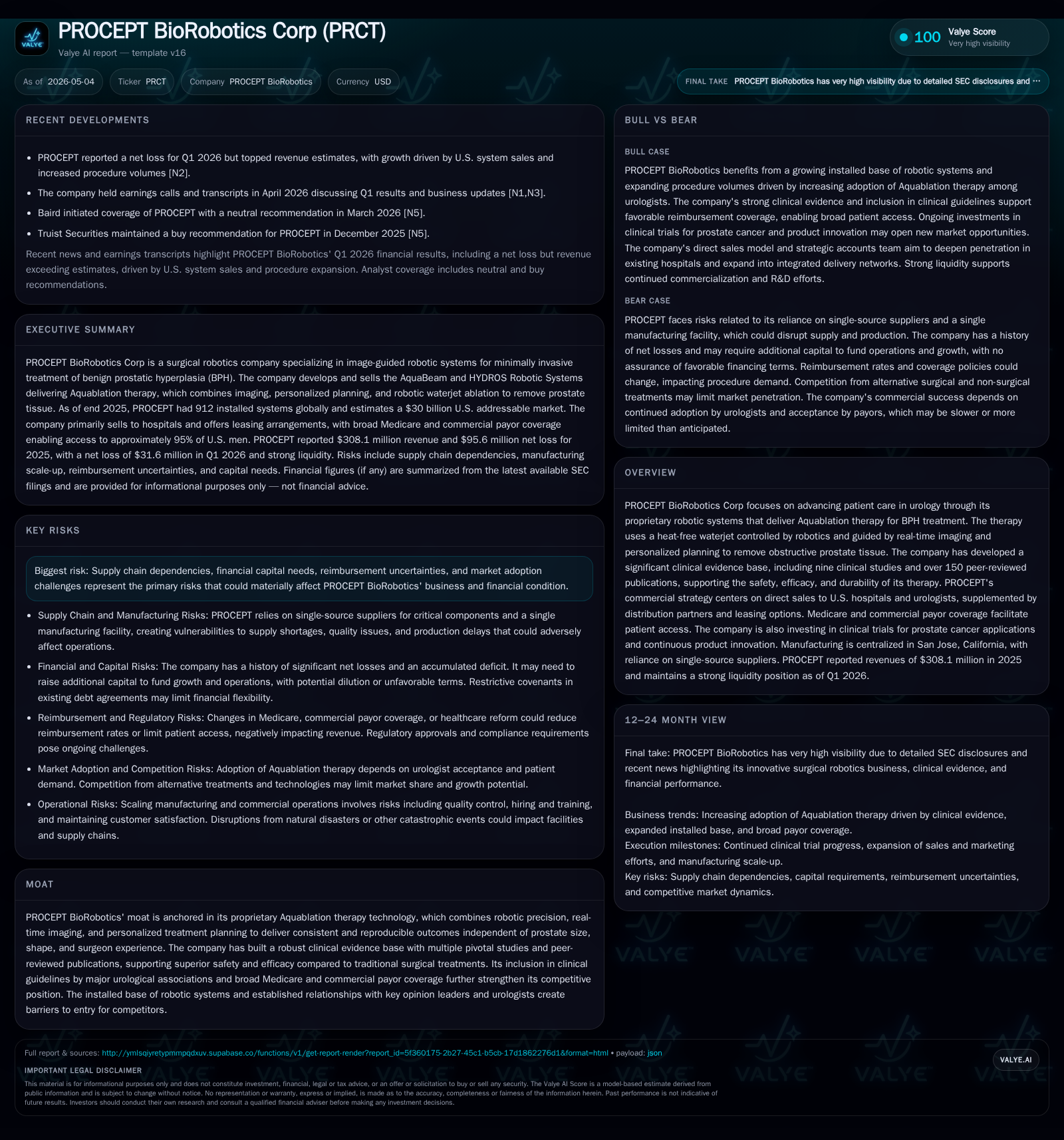
In its Q1 2026 update, PROCEPT BioRobotics Corp demonstrated strong commercial momentum primarily fueled by increasing sales of its AquaBeam and HYDROS robotic systems alongside rising procedure volumes. The company’s core Aquablation therapy, targeting benign prostatic hyperplasia (BPH), leverages proprietary robotics and real-time imaging to offer consistent outcomes unaffected by prostate size or surgeon skill. Supportive clinical evidence and reimbursement coverage fortify its competitive positioning. However, growth hinges on expanded adoption in a still-nascent market, navigating complex reimbursement landscapes, managing supply constraints, and sustaining capital investment. PROCEPT’s ongoing clinical trials aiming at prostate cancer applications and product innovations are crucial growth levers to watch.
Latest Operating Update
In its Q1 2026 report filed April 30, PROCEPT BioRobotics underscored continued commercial traction with notable sequential growth in revenue tied to both robotic system sales and increased usage of disposable handpieces integral to Aquablation procedures [S2][N1][N2]. The April 29 event filing reinforced the narrative that U.S. market adoption remains the primary revenue driver through direct hospital sales channels complemented by distribution partners [S3]. Quarterly results beat revenue expectations despite an ongoing net loss position reflecting heavy investments in sales infrastructure and R&D.
Management highlighted expanding procedural volumes within the installed base of ~912 robotic systems globally (718 in U.S.) as a critical indicator of durable adoption. This aligns with their strategy prioritizing physician awareness in ~2,700 hospitals performing resective BPH interventions nationwide [S2][S3][S1][N4].
Business Model
PROCEPT generates revenues principally from two streams: the sale or leasing of advanced image-guided surgical robotics platforms (AquaBeam and HYDROS) designed for urologic procedures; coupled with consumable single-use disposable handpieces that deliver heat-free waterjet tissue ablation known as Aquablation therapy [S1]. This creates a razor-and-blades model whereby the installed base drives recurring disposables demand.
Aquablation leverages real-time multi-dimensional imaging combined with automated robotic control to excise obstructive prostate tissue precisely irrespective of gland morphology or surgeon skill variability—addressing key shortcomings of more traditional techniques such as TURP or laser ablation [S1]. Patient benefits include improved safety profiles (e.g., reduced sexual dysfunction) and durable symptom relief backed by extensive clinical data.
The company’s focus on physician-targeted education through its direct sales force is supplemented by flexible acquisition models including leasing to overcome capital expenditure barriers for hospitals. Reimbursement by Medicare and commercial payors facilitates patient access to treatment—an essential enabler given cost sensitivity in procedural care [S1].
Industry Structure & Competitive Position
The urology surgical device market is characterized by intense competition from incumbents offering alternative minimally invasive technologies addressing BPH symptoms. PROCEPT’s differentiation rests on its proprietary robotic platform integrating personalized treatment planning with precise control over a novel energy modality (heat-free waterjet), establishing a strong clinical moat anchored in reproducible outcomes [S1].
Its significant installed base coupled with comprehensive evidence generation including nine clinical trials and over 150 publications underpins endorsement within clinical practice guidelines—a barrier reinforcing its position vs emerging competitors and incumbent modalities reliant on thermal-based technologies.
Direct relationships with urologists across thousands of U.S. hospitals create switching costs while broad payor coverage enhances commercial defensibility. However, the initial capital intensity of platform acquisition necessitates ongoing sales execution excellence amid competitive procurement environments involving Group Purchasing Organizations (GPOs) and Integrated Delivery Networks (IDNs) which negotiate aggressively on pricing [S1][S26].
Growth Drivers
Demographics & Disease Prevalence
BPH affects approximately 40 million U.S. men with about 12 million currently managed medically. Surgical intervention remains necessary after drug therapy failures affecting an addressable market estimated near $30 billion based on handpiece ASPs—a figure poised to grow as population aging doubles men over 65 by 2060 expanding BPH incidence [S1].
Clinical Adoption
Increasing procedure volumes per installed system signal growing physician confidence facilitating wider Aquablation acceptance beyond early adopters. New hospital placements add capacity for procedural expansion.
Pipeline Innovation & Indication Expansion
Investments underway into prostate cancer-focused IDE trials signal potential diversification of application areas increasing long-term market scope beyond benign conditions [S1]. Additional product innovation initiatives aim to improve usability enhancements and value proposition.
Reimbursement & Regulatory Support
Broad Medicare/commercial coverage underpins procedure affordability driving patient access; maintaining favorable reimbursement will remain critical amidst evolving healthcare policy landscapes.
Risks / Constraints
- Supply Chain Vulnerability: Sophisticated components required for robotics expose PROCEPT to supplier disruptions impacting production schedules.
- Financial Sustainability: Persistent net losses stemming from high R&D and commercialization costs demand continued capital availability despite solid cash reserves [F1][S4].
- Regulatory & Reimbursement Uncertainty: Shifts in FDA policies or payor coverage could delay product introductions or reduce procedure utilization.
- Competitive Pressure: Established alternative surgical methods benefit from entrenched usage patterns; overcoming inertia requires consistent outcome advantages.
- Legal & Compliance Risks: Exposure to product liability claims or enforcement actions under healthcare fraud statutes pose reputational risks.
- Contracting Dynamics: Negotiations with GPOs/IDNs may compress pricing or limit access despite contract awards due to member autonomy in purchase decisions.
What to Watch Next
- Quarterly procedure count growth rates indicating deeper penetration in existing accounts.
- Outcomes data or preliminary results from ongoing prostate cancer trials validating pipeline expansion.
- Updates on supply chain enhancements ensuring scale-up capability.
- Changes or reaffirmations of reimbursement status that impact procedure economics.
- Introduction of next-generation product models or enhancements improving competitive differentiation.
- Capital raise or cost management initiatives addressing sustained operating losses.
Financial Snapshot (As of March 31, 2026) [F1]
Latest financial snapshot
Despite continued operating losses reported at year-end 2025 exceeding $95 million annually, the strong liquidity position provides runway for strategic investments required to catalyze growth while managing risk exposures related to reimbursement shifts and competitive dynamics remains paramount.
This analysis is based solely on publicly available filings as cited between February and April 2026 and related secondary sources without providing investment advice or recommendations.
Disclaimer: This is research-only, informational analysis and not investment advice. It may include AI-generated interpretation and general industry context. Always verify important details using primary sources.

Comments