
Procaccianti Hotel REIT: Portfolio Focus and Capital Strategy Define Resilience
Procaccianti Hotel REIT anchors its operations on a concentrated select-service hotel portfolio and deliberate capital management despite limited liquidity.
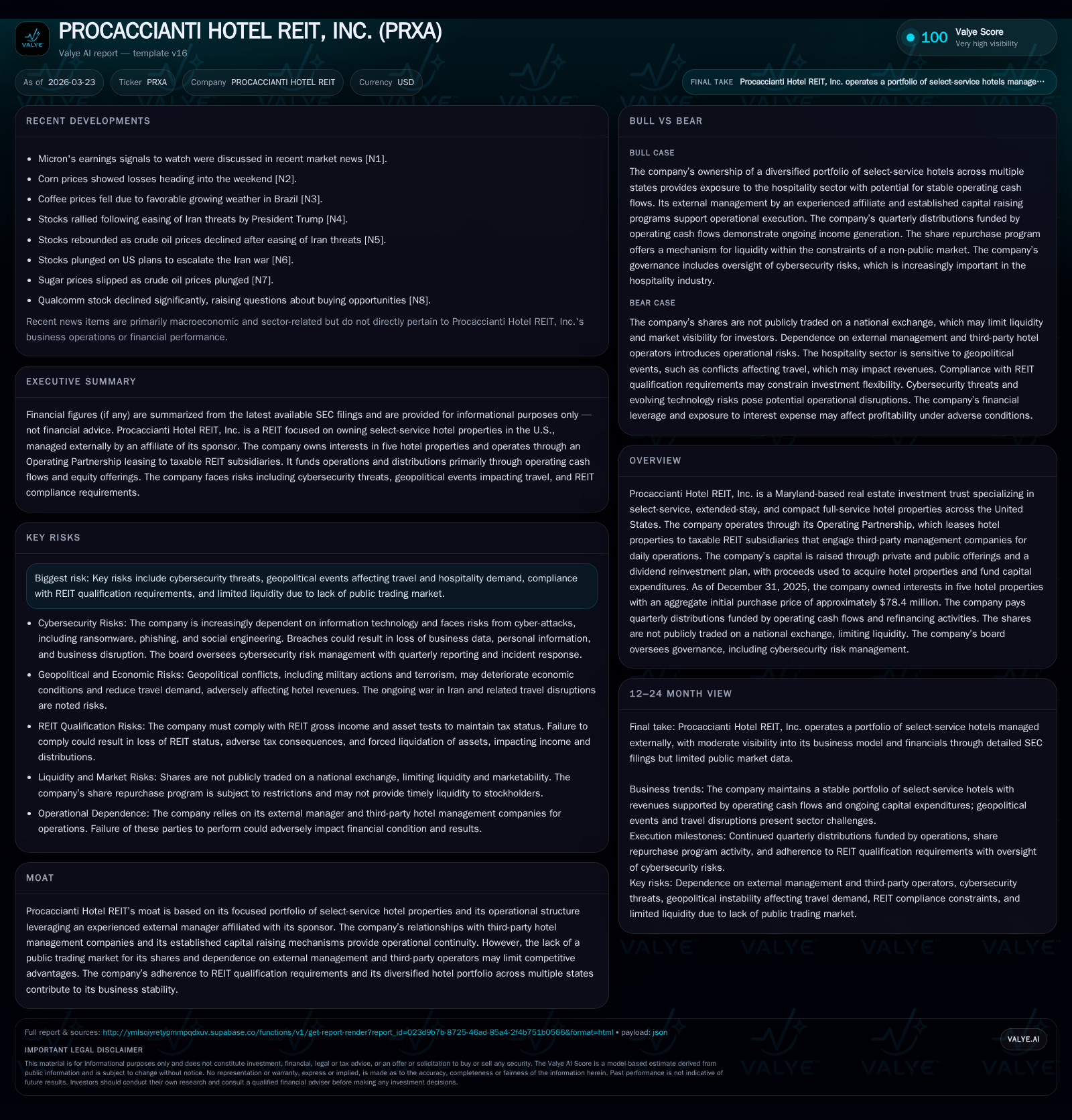
Procaccianti Hotel REIT, Inc. specializes in a niche segment of the hospitality real estate market, focusing on select-service, extended-stay, and compact full-service hotels across four U.S. states. Its operational model leverages an Operating Partnership leasing structure and experienced third-party managers, which supports business continuity but also introduces managerial dependencies. The company’s operating income grew by 10.5% in 2025 even as operating cash flows declined by 8.3%, reflecting pressures that merit close observation. With shares not publicly traded, liquidity remains constrained through a controlled share repurchase program tied to estimated NAV pricing and DRIP proceeds. Capital allocation prioritizes stable quarterly distributions funded largely by operating cash flows and refinancing activity, with modest share buybacks signaling disciplined return of capital. Governance structures actively address cybersecurity risks amid an evolving threat landscape, while geopolitical tensions pose a lingering macro risk to hospitality demand and growth prospects.
Specialized Portfolio Built for Select-Service Hospitality
Procaccianti Hotel REIT's core competency lies in its carefully curated portfolio focused on select-service hotel properties alongside extended-stay and compact full-service assets dispersed across multiple U.S. states [S1][S13]. As of December 31, 2025, PRXA held ownership interest in five hotel properties aggregating approximately 559 rooms with an initial purchase price near $78.4 million [S1][F1]. The company employs an Operating Partnership mechanism whereby these hotel assets are leased to taxable REIT subsidiaries; those subsidiaries then contract third-party management companies responsible for day-to-day operations [S1]. This layered operational framework allows the company to leverage seasoned external managers affiliated with its sponsor while facilitating adherence to REIT tax qualification requirements.
The geographic diversification within the concentrated portfolio mitigates localized market volatility but introduces exposure to managerial dependency risks inherent in third-party operator arrangements. Furthermore, the non-public nature of PRXA's common stock — shares are not listed on any national exchange — imposes unique limitations on shareholder liquidity [S1]. While this restricts tradability for investors compared to publicly traded REIT peers, it aligns with a tightly controlled capital structure emphasizing operational stability and measured growth.
Trends Driving Operating Income Growth Despite Market Headwinds
PRXA demonstrated solid growth in operating income between FY2024 and FY2025, rising from approximately $5.69 million to $6.28 million according to reported figures — a healthy 10.5% year-over-year increase [F1]. This uptick contrasts with a decline in operating cash flow over the same timeframe, which fell 8.3% from roughly $6.66 million in FY2024 to about $6.11 million in FY2025 [F1]. This divergence could reflect increased investment in working capital or elevated capital expenditures at properties aimed at long-term value preservation.
Historical performance (annual)
| FY | CFO ($mm) | OpInc ($mm) |
|---|---|---|
| 2025 | 6 | 6 |
| 2024 | 7 | 6 |
| 2023 | 6 | 5 |
| 2022 | 8 | 7 |
Source: SEC companyfacts cache [F1].
Capital returns and efficiency (annual)
| FY | Div ($mm) | Buybacks ($) |
|---|---|---|
| 2025 | 5 | 820524 |
| 2024 | 3 | 797838 |
| 2023 | 3 | 1134719 |
| 2022 | 3 | 1018355 |
Source: SEC companyfacts cache [F1].
*Note: Steep declines in FY2023 likely due to portfolio acquisitions timing or one-time impacts not detailed here; FY2024-25 shows recovery.
While operating income gains suggest improving revenue streams or margin enhancements—potentially tied to effective leasing strategies or operational efficiencies—the reduced cash flow signals necessary caution regarding sustainability of those earnings under capital expenditure demands.
Liquidity Constraints and Their Impact on Shareholder Access
Absent a public trading venue for PRXA's shares [S1], liquidity rests primarily on the Company's voluntary share repurchase program (SRP), subject to state securities laws and internal policies [S4][S6]. Repurchases are conducted quarterly at prices linked closely to estimated per share net asset values (NAV) but capped during active stock offerings to prevent arbitrage [S4]. Shareholders generally must hold their shares for at least one year before repurchase eligibility except under death or disability scenarios when immediate repurchases can occur at full NAV pricing [S4][S22]. These provisions mitigate redemption risk but inherently limit flexibility for investors seeking quicker exits.
Furthermore, repurchase volume is restricted annually to no more than approximately five percent of weighted average shares outstanding over the preceding year—an additional throttle on liquidity amid constrained secondary markets [S19]. Funding for repurchases depends heavily on net proceeds received through PRXA's dividend reinvestment plan (DRIP), creating a cyclical dependency between new equity inflows and availability of retirements under the SRP [S6][S18]. Such restrictions underscore that shareholder liquidity remains a measured offering rather than a guaranteed capability.
Capital Allocation Framework: Dividends and Share Repurchase Program
Capital deployment exhibits disciplined consistency centered around steady dividends supplemented by modest share buybacks calibrated within available cash flow constraints [S4][S7][S24]. Total dividends paid rose notably from approximately $3 million in prior years to about $5.36 million for FY2025 [F1], indicating a strategic commitment to distributions predicated substantially on operating cash flows augmented by refinancing activities [S9][S14].
Repurchases hovered near $820,000 in FY2025—small relative to total equity ($27.65 million) yet illustrating management’s approach of measured capital return rather than aggressive buyback initiatives [F1]. The DRIP offering remains a critical capstone for funding acquisitions; gross proceeds exceeded $200,000 from recent cycles facilitating reinvestment into acquiring select-service hotels and enhancing existing assets [S6][S18].
This allocation balance attempts to preserve investor interest aligned with long-term holdings expectations embedded within non-traded structures while managing risks linked to property enhancement investments.
Governance and Risk Management Around Cybersecurity and Geopolitical Threats
Recognizing cybersecurity as an increasingly prominent challenge given both internal operations and outsourced IT dependencies typical in hospitality properties, PRXA has instituted board-level oversight mechanisms updating risk mitigation efforts quarterly with audit committee involvement [S1]. The layered threat spectrum includes ransomware attacks, social engineering schemes, denial-of-service actions—and third-party hosting dependencies complicate preemptive defense execution [S1].
Moreover, geopolitical dynamics—ranging from trade policy shifts including tariffs impacting cost structures [S2], to instability arising from conflicts such as Russia-Ukraine or tensions involving Middle East nations—compound uncertainties affecting travel demand crucial to hotel occupancy rates [S2]. These macro factors influence not only investment returns but also operational resilience across geographic markets represented within PRXA’s portfolio.
What to Watch: Potential Catalysts and Operational Milestones Ahead
While explicit forward guidance remains limited due to structural characteristics inherent in the company's private REIT nature, investors should prioritize monitoring any announcements regarding property acquisition or disposition activity that could alter portfolio scale or risk profile [S5]. Similarly important are developments related to capital structure changes such as adjustments in leverage policy governed by board discretion given charter limits typically targeting maximum indebtedness near half asset fair value [S15][S20]. Such moves could influence future distribution capacity or fund availability for renovations enhancing competitiveness.
Additionally, shifts in broader hospitality sector trends—particularly those influenced by recovery trajectories post-geopolitical events or evolving travel behaviors—may materially affect occupancy rates underlying revenue trends fundamental to sustaining operating income growth observed recently.
Conclusion
Procaccianti Hotel REIT encapsulates a niche yet strategically managed real estate investment trust focusing on select-service hospitality assets characterized by concentrated portfolios and a reliance on external operators executed through an Operating Partnership lease model symptomatic of specialized REITs in this space [S1][S13]. Despite constraints emerging from its non-traded share status limiting liquidity access via structured repurchase programs pegged mainly at estimated NAV levels [S4][S19], consistent operating income growth paired with disciplined capital allocation reaffirms its resilient posture amid sectoral headwinds.
Cautionary signals arise from diverging operating cash flow paths contrasting income expansion plus macro risks tied to geopolitical volatility and cybersecurity vulnerabilities addressed through proactive governance frameworks [S1][S2]. Forward-looking attention is warranted toward any material portfolio adjustments or leverage shifts potentially unlocking new phases of growth or recalibrated financial flexibility.
DISCLAIMER: This analysis is based solely on information provided through referenced SEC filings and company disclosures as of March 23, 2026 ([F1], [S#]). It does not constitute investment advice or recommendations regarding any securities nor an endorsement of Procaccianti Hotel REIT’s stock or operations.
Disclaimer: This is research-only, informational analysis and not investment advice. It may include AI-generated interpretation and general industry context. Always verify important details using primary sources.

Comments