
Quantum-Si Inc Faces Delayed Proteus Launch and Nasdaq Compliance Risks Amid Development Challenges
Quantum-Si updates commercial launch timing of its Proteus platform to Q2 2027 while confronting stock-price compliance and financial pressures.
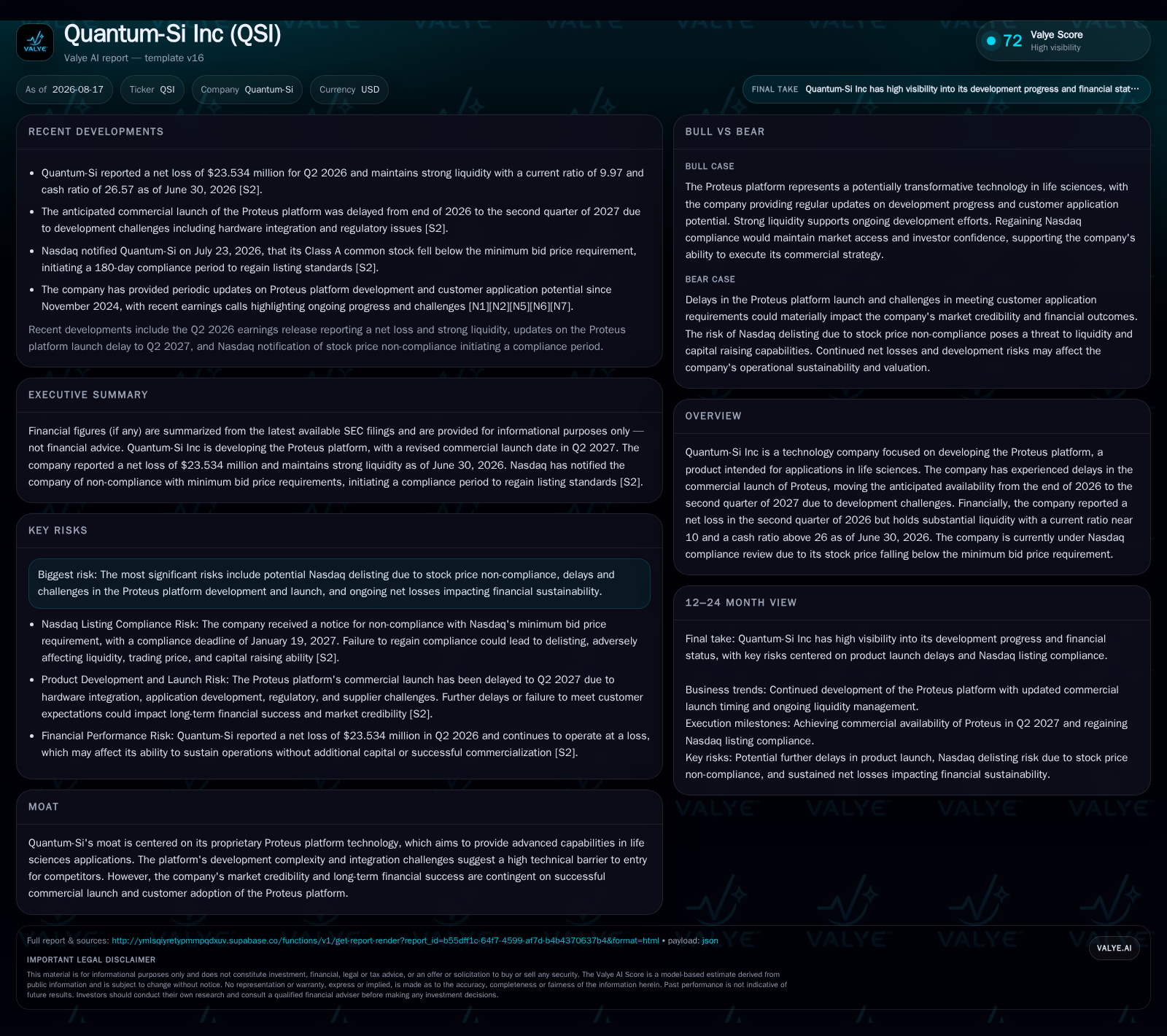
Quantum-Si Inc announced a delay in the commercial availability of its flagship Proteus platform from late 2026 to the second quarter of 2027, reflecting underlying technical and development challenges. Despite showcasing progress, this postponement heightens execution risk for achieving sustainable adoption in the life sciences instrumentation market, which values advanced proteomics and single-cell analysis tools. Financially, the company continues to operate at a net loss but maintains a robust liquidity position with a nearly 10x current ratio as of June 30, 2026. Meanwhile, QSI faces Nasdaq’s minimum bid price non-compliance, introducing potential listing risks that could affect capital-raising capabilities.
Recent Operating Update: Delay in Proteus Commercial Launch & Nasdaq Compliance Concern
Quantum-Si Inc disclosed in its latest quarterly filing dated August 13, 2026, that the anticipated commercial launch of its Proteus platform has been postponed from the end of 2026 to the second quarter of 2027 [S2]. This shift highlights ongoing development complexities in finalizing an instrument platform that integrates cutting-edge measurement technologies for proteomics and single-cell biological assays. The delay underscores both technical integration challenges and the company's cautious approach to ensuring the instrument meets application capabilities demanded by prospective customers. Given that revenue generation is heavily dependent on timely commercialization and customer adoption, this postponement raises material execution risk.
Concurrently, Quantum-Si faces regulatory compliance pressure from Nasdaq due to its Class A common stock trading below $1.00 for over 30 consecutive business days as of July 23, 2026 [S2]. The company was notified it has a compliance period ending January 19, 2027, to restore its share price above this threshold or potentially face transfer to Nasdaq Capital Market or delisting. Failure to maintain Nasdaq listing could hamper liquidity for shareholders and impede future capital-raising efforts necessary for navigating the commercialization phase.
Business Model: Proprietary Instrument Platform Focused on Life Sciences Applications
Quantum-Si generates value through the development and eventual sale of its proprietary Proteus platform—designed as an advanced instrument integrating hardware, specialized reagents, software analytics, and calibration protocols primarily targeted at proteomics and single-cell analysis markets [S1]. The company’s monetization model relies on direct sales to research institutions, pharmaceutical companies engaged in drug discovery pipelines, as well as clinical diagnostic labs aiming for biomarker detection capabilities.
In this sector, revenue depends not only on instrument sales but also on recurring consumable sales (e.g., assay kits), service contracts including instrument calibration and maintenance, software licenses for data analytics platforms, and regulatory approvals that enable clinical-grade applications. Customer adoption hinges on demonstrated analytical sensitivity, throughput capacity, platform accuracy, ease of integration into laboratory workflows, and cost-effectiveness relative to incumbent methods.
Proteus embodies a high-technology-entry barrier given its novel approach; however, delayed availability impacts sales cycle momentum—a critical KPI in life sciences instrumentation due to long lead times between prototype demonstration and final purchase decisions by conservatively oriented customers.
Industry Structure and Competitive Positioning
Life sciences instrumentation is characterized by towering R&D intensity with extended product development cycles often stretching multiple years before commercial viability materializes. Quantum-Si’s position centers on delivering an innovative proteomics platform meant to enhance protein sequencing accuracy through single-molecule detection technologies—a niche adjacent but distinct from dominant genomics sequencing players.
Peer reference points such as Illumina specialize broadly in next-generation sequencing platforms underpinning genomics research while Thermo Fisher Scientific offers a diversified suite across analytical instruments and reagents catering to multiple research domains. Companies like Fluidigm and 10x Genomics have carved out leadership in single-cell analysis tools focused on spatial genomics and multi-omics integration.
Quantum-Si’s Proteus seeks differentiation through novel hardware-software synergy aimed at increasing analytical sensitivity beyond established mass spectrometry or antibody-based techniques. Yet the field's competitive landscape includes mature products with proven reliability alongside emerging entrants pursuing alternative technologies.
Successful penetration requires demonstration of superior data quality metrics—platform sensitivity, throughput capacity—and robust regulatory compliance pathways enabling clinical diagnostics applications beyond pure research use cases.
Growth Drivers: Scientific Advances Fueling Demand for Next-Gen Platforms
The expanding footprint of precision medicine and proteomics research drives demand for high-throughput instrumentation capable of comprehensive protein characterization at single-cell resolution. Growing investment by pharmaceutical companies in biomarker discovery intensifies need for accurate biological assays that reduce time-to-market for therapeutics.
Furthermore, integration of AI-powered data analytics with instrumentation enhances utility by enabling actionable insights from complex datasets generated during experiments. Partnerships or collaborations with pharmaceutical industry leaders could accelerate validation cycles accelerating customer pipeline growth.
Regulatory approvals permitting broader clinical use would unlock additional revenue streams from diagnostic testing providers interested in non-genomic biomarkers. Given these multipronged growth drivers tied closely to technological milestones—a successful Proteus launch encompassing required application capabilities is pivotal.
Risks / Watchpoints / Growth Constraints
The foremost risk remains delay or failure in delivering Proteus within revised commercial timelines or below customer expectations limiting market acceptance [S2]. High R&D expense incurred with uncertain return on investment amplifies financial sustainability concerns amid sustained net losses recorded in recent periods [F1].
Nasdaq’s minimum bid price deficiency constitutes a regulatory headwind posing risk of stock delisting that would impair investor confidence and hamper access to capital markets crucial during product rollout stages [S2].
Moreover, the life sciences instrumentation market demands persistent innovation given rapid technological obsolescence risks alongside intense competition from entrenched incumbents with established distribution channels and customer relationships. Supply chain vulnerabilities for specialized components needed by Quantum-Si can also constrain manufacturing scale-up post-launch.
Customer adoption may be slowed by lengthened sales cycles customary in scientific instruments procurement where validation against existing workflows is required prior to purchase commitments.
What To Watch Next
Key milestones include monitoring progress towards meeting updated Q2 2027 Proteus commercial availability target [S2]. Evidence confirming successful completion of internal development benchmarks or third-party validation reports will be critical.
Tracking any change in Nasdaq compliance status by early 2027 will inform risk related to liquidity or capital access [S2]. Additionally, announcements regarding strategic partnerships within pharmaceutical or biotechnology sectors could signal market readiness or broaden acceptance.
Management commentary during quarterly earnings calls about order pipelines versus lengthy sales cycles can shed light on prospective revenue inflection points [N1][N2]. Metrics such as reductions in product defect rates or improvements in calibration protocols will provide operational confidence during commercialization ramp.
Financial Profile Discussion
As of June 30, 2026, Quantum-Si reported cash and equivalents totaling approximately $23.7 million with current assets near $119 million relative to current liabilities around $11.9 million yielding a strong current ratio close to 9.97x [F1]. This suggests ample short-term liquidity available as it proceeds through capital-intensive product development phases.
Notwithstanding liquidity strength, Quantum-Si continues operating at a net loss level reflective of heavy R&D spend typical for biotechnology-related instrument developers lacking revenue scale [F1]. Sustained negative operating income amplifies reliance on external funding until commercial revenues gain traction associated with Proteus availability.
Given the nascent stage within commercialization lifecycles common among peers such as emerging genomics tools providers whose margin profiles improve post-scale-up, deliberate expense control balanced against innovation investments will dictate longer-term financial sustainability.
Careful monitoring of cash burn rates relative to any forthcoming non-dilutive funding sources or partnership revenue streams will be important signals guiding future capital strategies.
Summary Disclaimer
This analysis is based solely on publicly available filings up to August 2026 combined with industry-contextual knowledge without extrapolating unverified forward-looking financial projections or undisclosed customer information. It does not constitute investment advice but offers an informed perspective on Quantum-Si’s strategic positioning within life sciences instrumentation amid operational challenges impacting near-term outlook.
Disclaimer: This is research-only, informational analysis and not investment advice. It may include AI-generated interpretation and general industry context. Always verify important details using primary sources.

Comments