
Sinovac Biotech Secures Nasdaq Listing with Robust Vaccine Pipeline
Nasdaq’s affirmative hearings panel ruling reinforces Sinovac’s market standing amid governance issues and underscores ongoing operational developments.
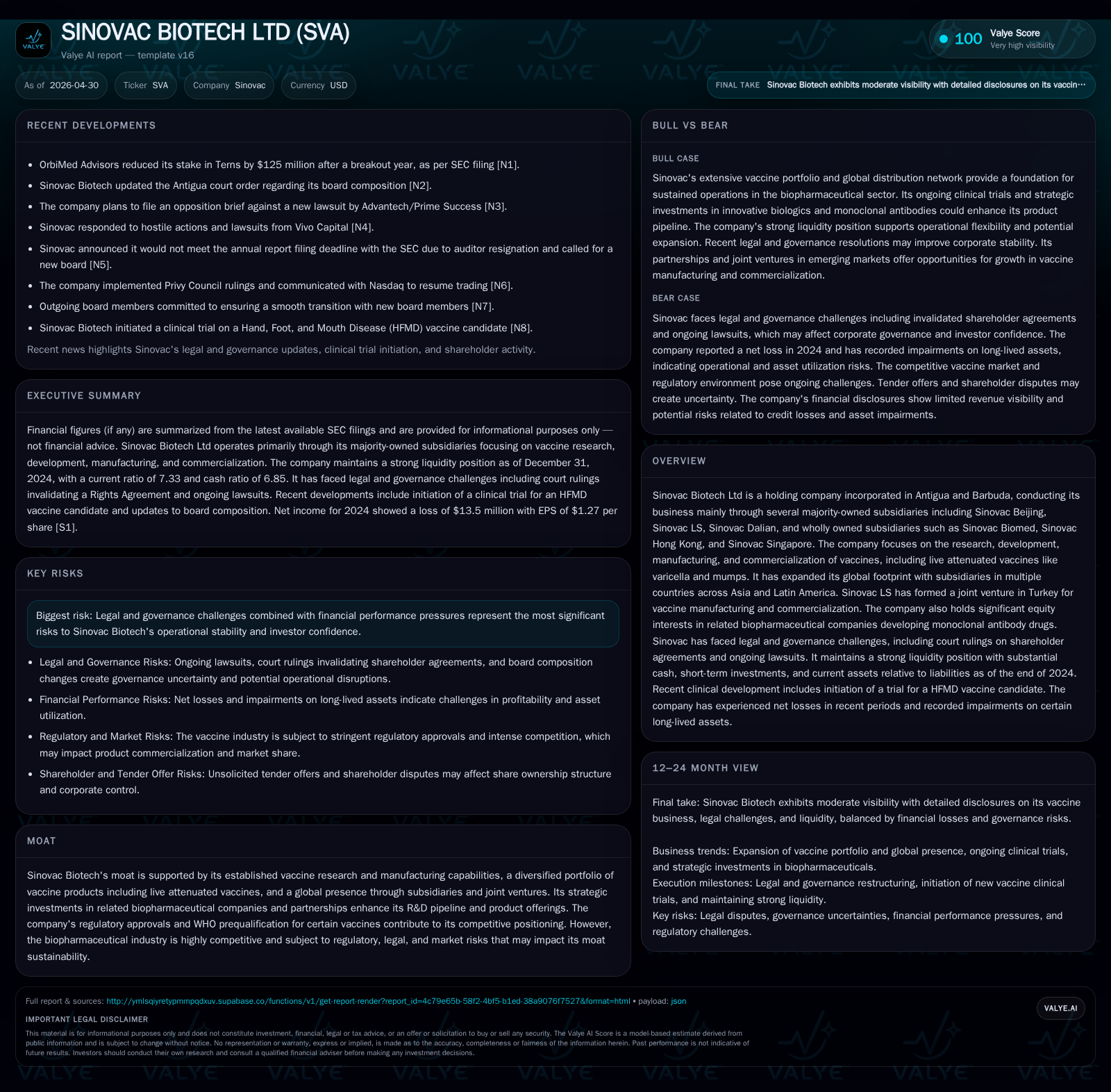
In its January 2026 6-K filing, Sinovac Biotech announced that the Nasdaq Hearings Panel granted continued listing, a critical validation following prior regulatory scrutiny. Sinovac operates through majority-owned subsidiaries focused on vaccines, including live attenuated varieties, and is expanding manufacturing via joint ventures in emerging markets. Governance challenges persist, notably legal disputes over shareholder agreements under Antigua law, which could influence corporate control. The company’s strategic growth hinges on pipeline development and global footprint expansion supported by established regulatory approvals, including WHO prequalification for some products. Financially, despite operating losses, Sinovac maintains solid liquidity with over $335 million cash and manageable net debt as of year-end 2024.
Nasdaq Listing Renewal: Implications for Market Perception
Sinovac Biotech's January 22, 2026 filing (6-K) disclosed a significant development: the Nasdaq Hearings Panel granted Sinovac continued listing status on the exchange [S2]. This resolution follows a period of regulatory uncertainty that had cast doubts on the company's market access. Maintaining its listing secures an important channel for capital access and investor visibility crucial to its international operations. This near-term regulatory reassurance stabilizes market perception against the backdrop of ongoing governance struggles discussed later.
Sinovac’s Business Model: Vaccines, Subsidiaries, and R&D Integration
At its core, Sinovac operates as a holding company incorporated in Antigua and Barbuda but conducts extensive vaccine research, development, manufacturing, and commercialization primarily through majority-owned subsidiaries such as Sinovac Beijing (73.09% owned), Sinovac LS (59.24%), Sinovac Dalian (68%) along with wholly owned entities including Sinovac Biomed Hong Kong and Singapore [S1].
Their product portfolio emphasizes live attenuated vaccines like varicella (chickenpox) and mumps — traditional vaccine categories known for established efficacy profiles that provide enduring demand stability beyond COVID-19-era dynamics [S1]. Beyond conventional vaccines, the company also holds substantial equity positions in biopharmaceutical firms developing monoclonal antibodies targeting infectious diseases, autoimmune conditions, and oncology indications. This diversification strategy blends vaccine revenue streams with higher value-add biologics pipeline potential.
Contractually and operationally, revenue recognition aligns with ASC Topic 606 standards: sales are recognized when control transfers to customers with careful estimation of product return provisions based on historical returns and channel inventory levels—maintaining prudence around variable consideration uncertainties typical in vaccine distribution agreements [S1].
Industry Positioning: Competitive Dynamics and Product Approvals
Sinovac's competitive edge rests on several pillars within the broader biopharma industry. Regulatory approvals such as World Health Organization prequalification confer substantial commercial benefits—including enhanced pricing power in international markets reliant on WHO-vetted products for procurement decisions especially in Latin America, Southeast Asia, Africa, and other emerging regions where public health budgets are constrained [S1].
The company’s geographically diversified manufacturing footprint through subsidiaries across China plus joint ventures like Turkey-based Keyvac broadens its global reach while mitigating single-market or geopolitical risks that competitors more concentrated regionally might face [S1]. Such diversification helps buffer cyclical fluctuations linked to domestic immunization policies or pandemic waves.
Vaccines inherently exhibit moderate switching costs tied to efficacy rates and safety profiles; healthcare providers tend to favor dependable suppliers with validated products to minimize logistical disruption or immunization program hesitancy. This underpins durable demand rather than purely cyclical spikes.
Strategic Growth Drivers: Expanding Manufacturing and Pipeline Potential
Looking ahead, multiple growth levers converge:
Manufacturing Scale-Up: Joint ventures like Keyvac in Turkey give localized vaccine production with lean supply chains for adjacent underserved markets. Subsidiary expansions include recent acquisitions such as Sinovac Chengdu focused on innovative vaccine technologies — enabling higher-margin specialty product launches alongside traditional vaccines [S1][S19].
Pipeline R&D: Investment in internal vaccine R&D coupled with strategic equity stakes in monoclonal antibody-focused companies expand innovation horizons beyond routine immunizations. Early stage collaborations aim at next-generation formulations that can address emerging pathogens or improve immunogenicity/safety balances.
Geographic Expansion: Subsidiaries stretching into Thailand, Mexico, Colombia and others underpin market diversification reducing single-jurisdiction dependency risk while tailoring product registration efforts regionally which aids penetration velocity [S19].
These drivers are directly connected to KPIs such as capacity utilization rates at manufacturing plants; regulatory milestones like new vaccine approvals or WHO prequalifications; climbing volumes in emerging markets; plus backlog growth from negotiated government contracts.
Governance and Legal Risks: Challenges in Corporate Control
A salient risk dimension arises from governance complexities rooted in the company's incorporation under Antigua and Barbuda law. Unlike Delaware corporations commonly used by U.S.-listed firms:
Cumulative voting—a mechanism empowering minority shareholders in director elections—is not permitted under Sinovac's bylaws aligned with Antigua law potentially diluting minority influence despite a public shareholder base [S9].
The absence of Delaware-like business combination statutes limits anti-takeover protections increasing vulnerability during unsolicited offers or proxy contests [S9].
A protracted legal saga surrounding the validity of the Rights Agreement culminated recently (January 16, 2025) when the Privy Council ruled it invalid forcing cancellation of Exchange Shares previously issued to entrench certain shareholders' control rights—a pivotal event changing ownership dynamics [S21].
Further stability questions emerge because Sinovac Antigua has not held annual shareholder meetings since February 2018 hampering shareholders’ ability to influence director elections directly [S9]. These issues have contributed to a series of unsolicited partial tender offers rejected by the board which collectively own majority shares—pointing to continued tensions between stakeholders despite operational progress [S19].
Investors must weigh these governance restrictions alongside fundamental execution risks as they may delay strategic business decisions or complicate capital allocation initiatives.
Operational Watchpoints: Upcoming Catalysts and Milestones
Key upcoming aspects to track include:
- Progress updates from ongoing vaccine trials or late-stage pipeline candidates particularly any readouts influencing regulatory filings.
- Expansion milestones at manufacturing joint ventures like Keyvac or recent acquisitions (e.g., in Chengdu) reflecting scale-up success.
- New regional registrations or contract awards reflecting growing market access especially in Latin America or Southeast Asia.
- Any developments related to shareholder meeting approvals or resolutions impacting governance structures.
- Annual updates on sales return provisions as product distribution volume fluctuates given dynamic vaccination program demands globally. Monitoring these will clarify trajectory toward operational normalization post-COVID expansion phase.
Brief Financial Overview: Liquidity, Debt, and Capital Structure
Sinovac ended fiscal year 2024 with cash & equivalents of approximately $335 million against total debt near $376 million yielding net debt around $40 million—a moderate leverage position buffered by strong current assets exceeding short-term liabilities by more than sevenfold (current ratio ~7.33) indicating comfortable liquidity headroom for working capital needs [F1].
However, operating income reflected a loss nearing $506 million underscoring ongoing investments into R&D expansion initiatives, manufacturing capacity enhancements, and corporate overheads consistent with growth phase spending patterns rather than immediate profitability priorities [F1]. Net income figures lag slightly due to accounting periods ending earlier but mirror investment-heavy stance.
This financial profile supports an operational runway allowing pursuit of strategic objectives without acute solvency pressures though efficient capital management remains prudent given the volatility inherent in vaccine markets.
This analysis synthesizes public SEC filings without providing investment advice. It aims to illuminate Sinovac Biotech Ltd's current operational environment within its industrial context.
Disclaimer: This is research-only, informational analysis and not investment advice. It may include AI-generated interpretation and general industry context. Always verify important details using primary sources.

Comments