
Tyson Foods Strengthens Liquidity with $500 Million Notes and Enhances Cybersecurity Governance
Q2 FY2026 results reflect steady protein sales, operational efficiency, and targeted board oversight of cybersecurity risks amid market and regulatory challenges.
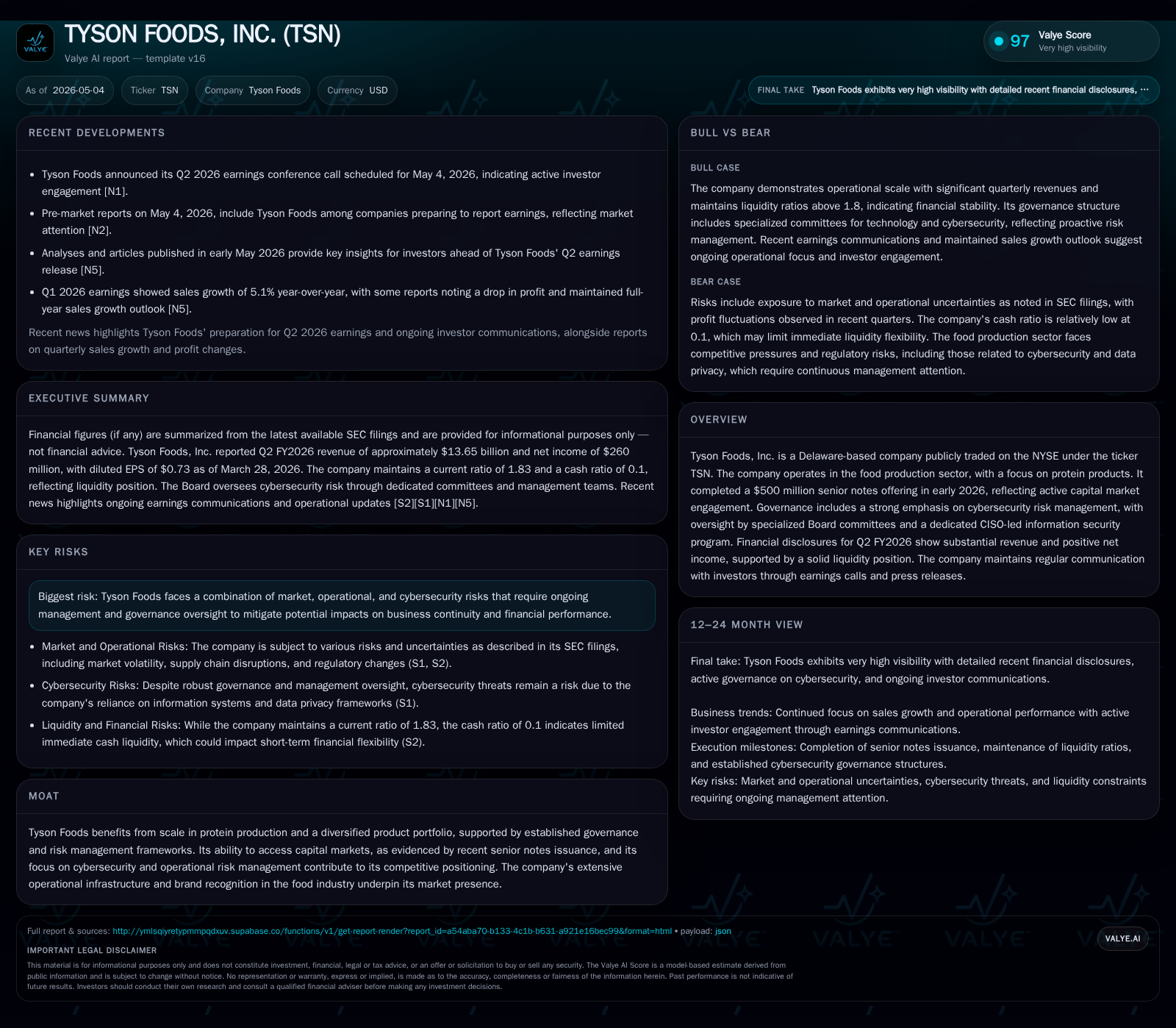
Tyson Foods, Inc. reported solid second-quarter results ending March 28, 2026, supported by strong protein product sales and effective operational execution. The company’s recent $500 million senior notes offering due 2036 bolsters its financial flexibility amid competitive industry pressures. Tyson’s governance architecture emphasizes cybersecurity risk management through dedicated board committees and an experienced CISO team, positioning it well against operational and regulatory risks. Growth is driven by portfolio diversification, scale advantages, and strategic capital deployment. Key risks include market volatility in input costs and evolving regulatory environments.
Recent Operating Update
Tyson Foods issued its Q2 FY2026 report for the quarter ended March 28, 2026, detailed in the 10-Q filed on May 4, 2026 [S2], alongside a contemporaneous earnings press release on May 4 [S3]. The company reaffirmed its ongoing operational strength as measured by continuing revenue generation and net income metrics from its diverse protein portfolio. While specific Q2 financial line items were not fully disclosed in detail here beyond the latest snapshot available from the fiscal year end September 27, 2025 balance sheet figures [F1], commentary from management in the press release highlights stable demand trends.
Complementing its operating disclosure was a material event filing confirming the completion of a $500 million senior notes offering at a fixed coupon of 4.95%, maturing in 2036 [S13][S14][S16][S17]. This capital markets activity enhances Tyson’s long-dated liquidity profile to support growth investments or refinancing flexibility.
Governance disclosures provide notable emphasis on cybersecurity risk management frameworks with structured oversight by two Board committees: the Governance & Nominating Committee and the newly established Technology Committee formed in fiscal 2025 [S1][S25][S26]. The CISO reports directly to the CTO and furnishes escalation updates on significant incidents per defined internal risk thresholds.
Business Model
Tyson Foods' core business revolves around producing and marketing protein-based foods encompassing poultry, beef, pork, prepared foods, and alternative proteins. Customers primarily include retail grocery chains, foodservice providers, and industrial food manufacturers. Revenue derives chiefly from volume sold multiplied by prevailing prices influenced by commodity input costs (feed grains, livestock) as well as value-added product mixes.
Margins are sensitive to fluctuations in raw material costs but are defended through scale economies—Tyson is among the largest U.S.-based protein producers—and extensive distribution networks enabling efficient supply chain orchestration. Furthermore, product innovation aimed at meeting evolving consumer preferences—like higher-protein diets or plant-forward trends—supports pricing differentiation.
The company maintains a multi-tiered customer engagement model prioritizing long-term contracts alongside spot market trading to mitigate demand volatility. Brand strength helps retain shelf space amidst fierce competition.
Industry Structure and Competitive Position
The global protein production industry is characterized by intense competition among large integrated producers such as Tyson Foods, Pilgrim's Pride (noted competitor), JBS USA, and Smithfield Foods. Barriers to entry are elevated given scale requirements for processing facilities, compliance with stringent food safety regulations, and capital intensive feedstock sourcing.
Commodity price cycles impose cyclical earnings variability; however, structural demand for protein products remains resilient driven by population growth and dietary trends emphasizing high-protein consumption. Tyson's diversified product slate across fresh meats to value-added prepared foods expands its addressable market.
Supply chain agility — including vertical integration features such as feed mills — allows Tyson to better control cost inputs relative to competitors who rely more heavily on external procurement.
Growth Drivers
- Demand Expansion: Rising global protein consumption fueled by demographic trends supports volume growth potential.
- Product Innovation: Development of ready-to-eat meals and alternative proteins caters to health-conscious consumers seeking convenience.
- Operational Efficiencies: Ongoing investments in automation and logistics optimize throughput while reducing unit costs.
- Strategic Capital Access: Recent senior notes issuance provides funding for capacity expansion or acquisitions aligned with growth objectives.
- Cybersecurity & Technology: Enhanced tech governance facilitates smoother digital transformation enabling better supply chain transparency and customer data analytics.
These drivers collectively position Tyson well to capture new market share despite periodic commodity headwinds.
Risks / Watchpoints / Growth Constraints
Continuous monitoring of these areas is essential for sustaining performance consistency.
What to Watch Next
Investors should monitor upcoming quarterly releases for:
- Revenue growth trends across major product segments reflecting consumer demand shifts.
- Gross margin movement signaling how well input cost inflation is being managed or passed through.
- Progress on executing technology initiatives reported under the Technology Committee’s purview impacting productivity gains.
- Debt servicing metrics following new senior note issuance including interest coverage ratios.
- Any disclosures related to cyber incident occurrences or mitigation expenses compared against risk governance protocols outlined previously.
These milestones provide key insight into Tyson’s near-term execution capabilities amid longer-term structural trends.
Financial Profile Summary
Latest financial snapshot
While leverage remains sizeable post-senior note transaction reflecting capital-intensive nature of protein production infrastructure, liquidity is adequate with a current ratio above 1.8 providing buffer against short-term liabilities [F1].
Disclaimer
This analysis is based solely on publicly available information extracted primarily from SEC filings supplemented by sector knowledge. It does not constitute investment advice or recommendations regarding Tyson Foods’ securities.
Disclaimer: This is research-only, informational analysis and not investment advice. It may include AI-generated interpretation and general industry context. Always verify important details using primary sources.

Comments