
J-Star Holding Revamps Leadership and Strategic Model to Boost Carbon Composite Market Presence
J-Star’s recent CEO reinstatement coincides with a major transition from OEM to trading, reshaping its operational and revenue framework.
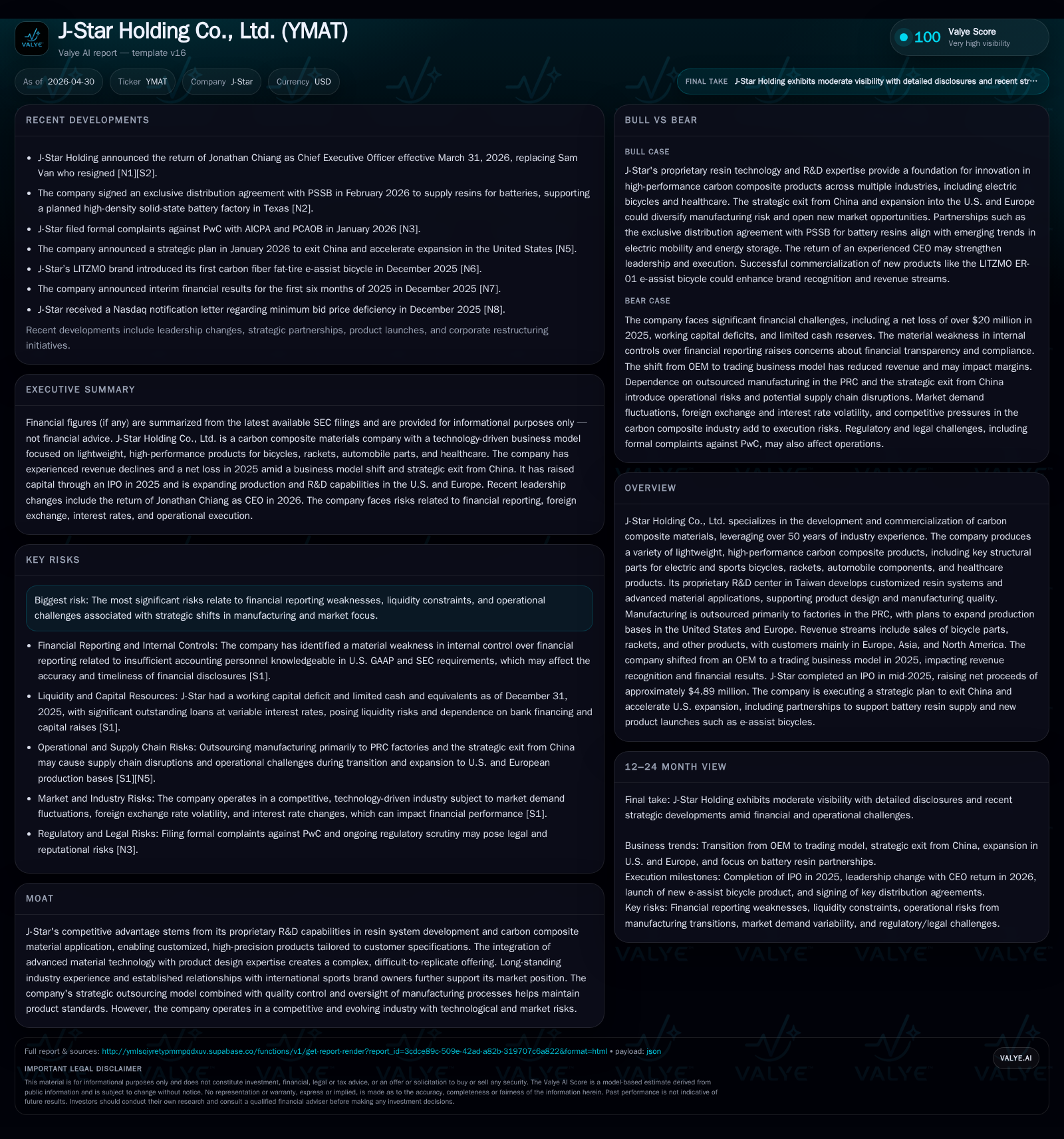
In Q1 2026, J-Star Holding Co., Ltd. underwent a significant leadership change with the return of previous CEO Jing-Bin Chiang, reflecting an inflection point amid its strategic shift from an OEM manufacturing role to a trading business model. This transformation affects revenue recognition and underscores a broader repositioning in global carbon composite markets where J-Star leverages proprietary resin R&D for lightweight, high-performance components primarily serving electric bicycles and sports equipment. The company’s competitive moat derives from deep material science integration alongside outsourced manufacturing in China, with expansion plans targeting U.S. and European production bases. Growth opportunities hinge on rising demand for carbon composites driven by emissions regulation and performance sports trends, while risks center on financial reporting challenges, supply chain concentration, and operational execution post-model shift.
Recent Operational Developments: Leadership Transition and Business Model Impact
On March 31, 2026, J-Star Holding announced the resignation of then-CEO Sam Van and immediately reinstated former CEO Jing-Bin Chiang [S2][N1]. This leadership reshuffle happens amid the company's pivot from an Original Equipment Manufacturing (OEM) structure toward a trading business model—a transition initiated in 2025 that materially changed how the company recognizes revenue. Under the new model, J-Star shifted from recognizing gross sales associated with manufacturing output to net revenue reflective of actual trade margins [S1]. Concurrently with the CEO change, management highlighted severance arrangements with Mr. Van including six months’ salary payments as part of their governance disclosures [S2].
The reappointment of Mr. Chiang—a seasoned composite materials industry executive with over 18 years’ experience who previously steered J-Star's strategy from 2016 to late 2025—signals a deliberate move to stabilize operations during this critical restructuring phase. His prior tenure involved close oversight of both R&D-led product innovation and navigating complex international supply chains which aligns tightly with current company priorities.
Earlier in February 2026, J-Star secured an exclusive global distribution agreement with Patriot Green Energy Technology (PSSB), a next-generation solid-state battery developer backed by Taiwan’s Industrial Technology Research Institute (ITRI). This deal positions J-Star to leverage emerging energy storage advancements within its carbon composite ecosystem—particularly relevant given anticipated growth in electric bicycle demand integrating advanced batteries [S3][S8].
J-Star's Business Model and Product Innovation in Carbon Composites
J-Star operates principally as a technology-driven manufacturer and trader specializing in carbon composite materials. Its portfolio spans key structural components for electric and sports bicycles, rackets across tennis and badminton categories, automotive structural parts such as hoods and seatbacks requiring heat-resistant composites, as well as healthcare devices like wheelchairs [S1].
The company's core competitive asset is its proprietary R&D center located in Taichung, Taiwan. Here it develops advanced resin formulations tailored precisely for diverse product requirements—optimizing parameters like thermal stability, curing times, viscosity profiles, durability, stiffness, and strength specific to application needs. Unlike many competitors relying on standard resin blends with limited flexibility, J-Star’s capability to customize resin systems allows close alignment with customer design specifications while maintaining outsized control over performance characteristics [S1].
Manufacturing is largely outsourced to multiple factories in mainland China under strict quality controls dictated by J-Star’s R&D expertise. The company exercises product design oversight throughout outsourced fabrication stages to ensure adherence to exacting standards and technical requirements. Plans are underway for geographic diversification with additional production bases targeted for the United States and Europe—reflecting sensitivities around supply chain risk concentration especially given geopolitical headwinds affecting China-based manufacturing hubs [S1][S8].
Revenue is generated through three broad streams: bicycle parts sales (most significant), racket component sales (previously meaningful but now diminishing due to model changes), and other products including automobile parts and healthcare equipment. Product mix has been shifting notably as the firm prioritizes higher-margin segments aided by its technology edge [S1].
Industry Dynamics: Competitive Positioning and Outsourced Manufacturing Strategy
The carbon composite market is characterized by fragmentation but growing demand driven primarily by mobility electrification mandates and premium sporting goods consumers who prize material performance advantages such as reduced weight combined with enhanced durability or stiffness.
J-Star’s niche within this sector centers around supplying international brand owners predominantly situated across Europe (Switzerland, France, Italy, Germany), Asia (Japan), North America (U.S., Canada), with expanding footprints through new distribution partnerships [S1][S3]. Its integration of proprietary resin systems into carbon fiber composites creates a durable barrier against commoditization since replicating these customized solutions requires substantial investment not only in material sciences but also simultaneous product design capabilities.
Strategically outsourcing production to PRC factories delivers labor cost advantages but also exposes the company to supply chain vulnerabilities—including regulatory scrutiny or geopolitical disruptions—which management is actively mitigating via planned facility expansion abroad particularly US/EU sites aligned with regulatory compliance preferences among Western customers [S1][S8]. The company maintains quality control through continuous R&D involvement overseeing process enhancements at contracted plants.
Pricing power appears linked strongly to product customization depth rather than commodity volume metrics; thus J-Star’s margins benefit when focusing on specialized composite components instead of broadly distributed commodity items. However competitive pressures remain intense from larger-scale composites manufacturers who may compete aggressively on volume or pricing especially within lower-margin segments.
Growth Catalysts: Market Demand for Lightweight High-Performance Composites
J-Star benefits from secular growth drivers tied directly to global sustainability trends emphasizing lightweight mobility solutions. Electric bicycles continue rapid adoption growth worldwide due both to regulatory incentives targeting emissions reduction as well as consumer preferences shifting towards eco-friendly personal transport modes. Carbon composite frames offer significant weight savings translating directly into longer battery range or better ride performance compared with traditional steel or aluminum equivalents—a compelling value proposition amplifying demand prospects.
Simultaneously rise in premium sporting goods—such as tennis or badminton rackets—that employ carbon fiber composites enhances exposure within consumer discretionary categories attuned to technological differentiation. Expanding automotive applications for composites including structural parts capable of replacing metal subassemblies further extend addressable markets.
Healthcare-related products such as carbon-fiber wheelchair frames or mobility aids reflect early signs of product innovation leveraging composite materials’ unique ergonomic/lightweight qualities suitable for aging populations.
Underpinning these tangible demand segments is J-Star’s dedicated R&D engine facilitating tailored resin systems enabling quick adaptation of new product shapes, performance requirements or market entry verticals without sacrificing precision or robustness—enabling broader diversification potential beyond legacy bicycle/racket focuses [S1].
Risks and Constraints: Reporting Challenges and Supply Chain Dependencies
A central risk theme flagged extensively relates to financial reporting complexities introduced during J-Star’s transition from OEM gross-based revenue accounting towards net revenue recognition under its trading business model initiated FY2025. This shift reflects auditors’ concerns over risk transfer validation because production is outsourced externally—the company cannot demonstrate retention of prior levels of risk assumption tied directly to manufacturing output ownership. Consequently reported revenues declined markedly although adjusted margins improved due primarily to recognition timing differences rather than underlying sales erosion alone [S1].
Further audit diligence now demands enhanced documentation rigor including detailed correspondence exchanges and design drawings evidencing contractual commitments between suppliers and customers—a potential administrative burden impacting operational cadence.
Additional constraints stem from dependence on predominantly PRC-based outsourced factory hubs exposing exposure not only to geopolitical tensions but also escalating wage pressures amid increasingly constrained labor markets requiring geographic diversification efforts underway but only at early stages [S8].
Management liquidity signals reflect ongoing stress manifested through working capital deficits supported partly by short-term loans from related parties bearing favorable interest rates but nonetheless indicative of funding tightness requiring careful cash flow management especially as COVID-era support schemes wane globally [S7][S19][S21].
Lastly executive transitions raise operational execution risks particularly managing harmonization of legacy management experience under Mr. Chiang against evolving market realities necessitating agility around sales channels reconfiguration triggered recently by signing exclusive distribution agreements aimed at broadening footprint under new trading operations framework [S2][S3].
Key Milestones Ahead: Monitoring Execution on Expansion and Sales Contracts
Key upcoming markers include:
- Progress deployment of planned US/Europe production bases aiming at reducing reliance on Chinese suppliers slated for phased commissioning post-2026,
- Implementation scale-up of the exclusive global distribution agreement signed February 2026 with PSSB expected to drive incremental sales particularly via integrated energy storage-enabled products,
- Early quarterly filings subsequent to Q1 2026 providing updated KPIs on order backlog evolution, capacity utilization improvements under diversified production mix,
- Operational stabilization gauged through normalized margin profiles reflecting migration success from OEM-related volatile recognition towards steadier trading margin flows,
- Management commentary clarity under Mr. Chiang addressing financial reporting enhancements responding proactively to auditor concerns,
- Execution effectiveness around inventory management optimization post-disposal of majority equity interests in China subsidiaries April 2023 continues critically shaping working capital trends.
Tracking these developments will be paramount for stakeholders evaluating J-Star's ability to convert its deep R&D moat coupled with evolving go-to-market models into sustainable profitable growth trajectories.
This analysis draws exclusively upon publicly available SEC filings and disclosed corporate developments up through April 30, 2026. No forward-looking financial guidance or investment recommendations are provided herein.
Disclaimer: This is research-only, informational analysis and not investment advice. It may include AI-generated interpretation and general industry context. Always verify important details using primary sources.

Comments