
zSpace’s AR/VR Education Model Faces Critical Liquidity and Delisting Pressure
The latest quarter highlights mounting financial stress aggravated by nascent delisting and sluggish education market cycles in a capital-intensive AR/VR edtech platform.
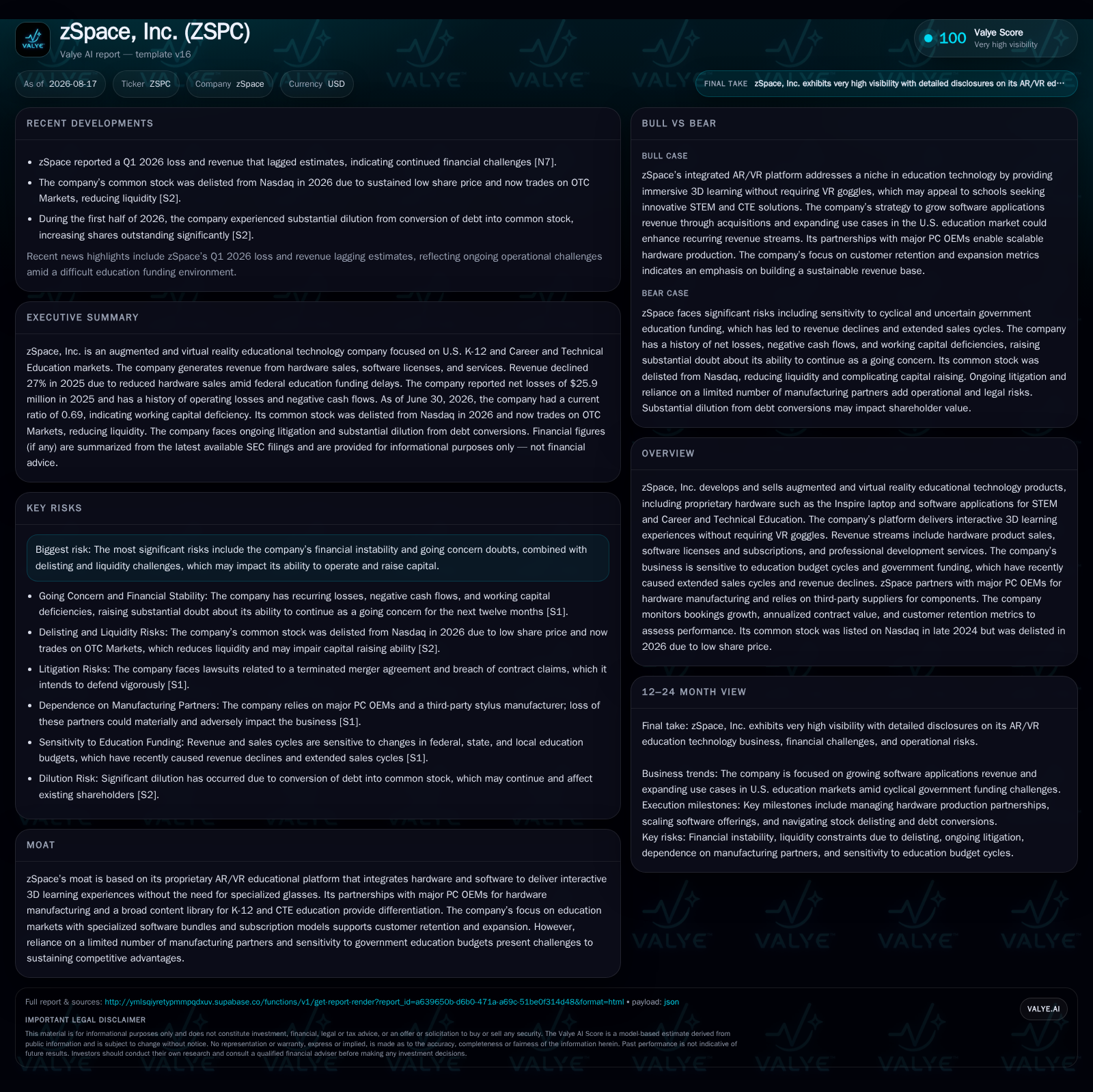
zSpace, Inc. reported its delisting from Nasdaq effective August 2026, intensifying liquidity challenges amid extended sales cycles driven by volatile government education budgets. Its hybrid model—proprietary AR/VR hardware combined with software licenses and subscription services—faces execution risks as sales bookings moderate and hardware manufacturing depends critically on OEM partnerships. Despite content and STEM-focused growth drivers, escalating legal disputes alongside substantial shareholder dilution from debt conversions heighten near-term financial uncertainty.
Nasdaq Delisting Magnifies Liquidity Challenges Affecting Strategic Options
On August 14, 2026, zSpace formally disclosed its delisting from the Nasdaq Capital Market following a trading suspension initiated in April due to the stock's closing bid price remaining below $0.10 for ten consecutive trading days [S2]. Transitioning from Nasdaq listing to OTC Markets results in reduced liquidity characterized by wider bid-ask spreads, lower trading volumes, higher price volatility, and diminished institutional investor participation. This shift severely impairs shareholder exit opportunities and complicates future equity capital raises by subjecting offerings to state-level securities regulations rather than federal preemption protections. Margin purchasing restrictions post-delisting further reduce demand for shares among retail investors, while institutional disqualification exacerbates shareholder base erosion [S2].
This market status change compounds underlying financial stress by constraining access to public capital markets at favorable terms.
Compounding these pressures, zSpace’s common shares outstanding ballooned from about 1.3 million at year-end 2025 to over 37 million by June 30, 2026 due primarily to extensive debt-to-equity conversions executed at low fixed prices amid liquidity constraints—most notably the May 28 issuance of over 30 million shares linked to loan conversions with Fiza Investments Limited at $0.2385 per share [S2]. This dilution dramatically reduces incumbent shareholder ownership percentages and signals tightening capital structure flexibility. The large share count relative to authorized limits may restrict future equity issuances absent corporate charter amendments.
Hybrid Hardware-Software Educational Platform Compounded by Long Sales Cycles
zSpace operates an integrated augmented reality (AR) and virtual reality (VR) educational technology platform delivering interactive 3D learning experiences without conventional VR headsets or goggles. Its proprietary Inspire laptop, developed through OEM partnerships with established PC manufacturers, targets STEM curricula and Career Technical Education (CTE) programs predominantly within K-12 educational institutions [S1].
The company generates revenue through a mix of one-time hardware sales, recurring software license fees under subscription or perpetual models, and professional development services designed to facilitate adoption. However, the business exhibits sensitivity to public education budget cycles: fluctuating government appropriations extend procurement lead times causing elongated sales cycles that delay bookings recognition and compress near-term revenue visibility. This cyclicality challenges revenue predictability despite underlying demand for AR/VR-enabled experiential learning tools [S1], [S2].
While specific unit shipment volumes are undisclosed recently, indications of declining hardware revenues suggest softness potentially exacerbated by supply chain constraints tied to OEM manufacturing capacity.
Interdependence on OEM Partnerships Amplifies Manufacturing and Scale Constraints
Central to zSpace’s operating model is reliance on contractual OEM partnerships for manufacturing proprietary hardware such as the Inspire device line. This approach minimizes capital expenditure but exposes the company to supply chain vulnerabilities prevalent in electronics industries—including semiconductor shortages and component sourcing bottlenecks.
Delays or capacity limitations at OEM facilities directly impact hardware shipments that underpin cash inflows critical for balancing operational cash burn. Additionally, meeting stringent quality standards demanded by educational clients adds complexity that can constrain production scalability. These dependencies introduce execution risks reminiscent of other education device collaborations involving OEMs like Lenovo or Dell [S1], [N3].
Scalability is bounded by partnership breadth and negotiation dynamics affecting lead time flexibility and cost control.
Education Budget Cycles Dictate Sales Timing Amid Government Funding Volatility
Public sector educational institutions constitute the primary customer base for zSpace’s offerings. The company explicitly identifies government funding volatility as a driver of prolonged decision-making timelines: appropriations at federal, state, and local levels often precede actual purchasing actions by months or quarters, creating unpredictable sales funnel timing unrelated directly to product competitiveness but tied closely to external fiscal policy shifts [S1], [S2].
This dynamic introduces cyclical revenue fluctuations that complicate forecasting models common in commercial technology sectors.
Despite these timing challenges, zSpace maintains innovation momentum through proprietary AR-enabled content libraries tailored for K-12 STEM programs aimed at enhancing curriculum engagement.
Subscription Retention Reflects Platform Stickiness but Margins Remain Pressured
Recurring revenue streams predominantly arise from software licenses bundled in subscription arrangements supporting both standalone content delivery and integrated experiential learning aligned with CTE objectives. Subscription renewal rates serve as a proxy for platform relevance within institutional clients.
Operating losses approaching $22 million annually persist despite incremental traction in software recurring revenues unable yet to offset fixed cost burdens across R&D, marketing, sales, and administration necessary for competitive positioning expansion [S1], [S2].
Growth Potential From STEM and CTE Focus Requires Stable Capital Access
Market tailwinds favoring immersive digital learning environments—particularly growing AR/VR adoption within education alongside expanding STEM initiatives—align strategically with zSpace’s platform capabilities. Nationwide efforts emphasizing modernized instructional methods increase addressable market size especially within public K-12 systems seeking enriched CTE resources [N2].
Realizing this growth potential depends critically on securing stable capital resources sufficient to fund continuous R&D innovation plus curricular content development essential for sustaining differentiation amid competitive pressures from specialized content providers (e.g., Pearson) and modular SaaS platforms (e.g., Kahoot!, Nearpod) [S1].
Risks from Legal Disputes, Stock Dilution, and Capital Market Restrictions
Operational execution risks are compounded by litigation uncertainties including pending lawsuits stemming from a terminated SPAC merger agreement scheduled for trial in January 2027 as well as contract disputes alleging unpaid revenue shares [S1]. These proceedings impose management distraction risks alongside potential contingent liabilities that could strain resources further.
Significant stock dilution arising from massive loan-to-equity conversions contributes negatively to investor confidence amid declining share prices post-delisting—constraining future fundraising options by increasing equity issuance costs or rendering such raises impractical absent demonstrable turnaround progress [S2].
This confluence of legal challenges alongside deteriorating capital market access compounds strategic inflexibility relative to peers with lighter balance-sheet burdens.
Watching Forward: Execution Milestones and Capital Inflection Triggers
Key near-term indicators include stabilization or improvement in bookings growth signaling renewed customer acquisition strength despite continuing procurement delays. Subscription renewal rate trends will inform assessments of platform stickiness critical for expanding recurring revenue bases. On financial fronts, successful capital infusion events—through new convertible preferred issuances or restructured debt agreements—and disciplined expense management will be vital milestones indicating improved liquidity management capability [S2], [S3].
Failure on these dimensions could exacerbate existential threats heightened by regulatory delisting consequences limiting broader market access.
Financial Profile Discussion: Current Liquidity, Debt Position, and Dilution Impact
As of June 30, 2026 balance sheet data reveal constrained liquidity conditions with current assets approximating $7.3 million against current liabilities near $10.7 million yielding a precarious current ratio around 0.69 indicative of working capital deficits [F1]. Total debt stood near $13 million as measured at March-end prior period; net debt approximates this figure given limited cash reserves below liabilities reflecting ongoing cash burn pressures requiring reliance on capital markets for survival funding historically evidenced through large-scale debt conversions into equity diluting existing shareholders substantially [F1], [S2].
These metrics highlight sustained financial fragility compounded further by reduced trading liquidity post-Nasdaq delisting necessitating vigilant monitoring of cash conservation strategies alongside execution of milestone-driven financing initiatives essential for maintaining technological leadership within competitive AR/VR educational technology markets.
Disclaimer: This is research-only, informational analysis and not investment advice. It may include AI-generated interpretation and general industry context. Always verify important details using primary sources.

Comments