
Alpha Star Acquisition Corp: Navigating the SPAC Transition with XDATA Merger Pending
Alpha Star Acquisition Corp remains a blank-check entity with no operating revenue, pursuing a transformative merger with OU XDATA GROUP. The company’s future hinges on consummating this business combination amid liquidity constraints and regulatory approvals, while its structural characteristics as a SPAC define its operational and competitive dynamics.
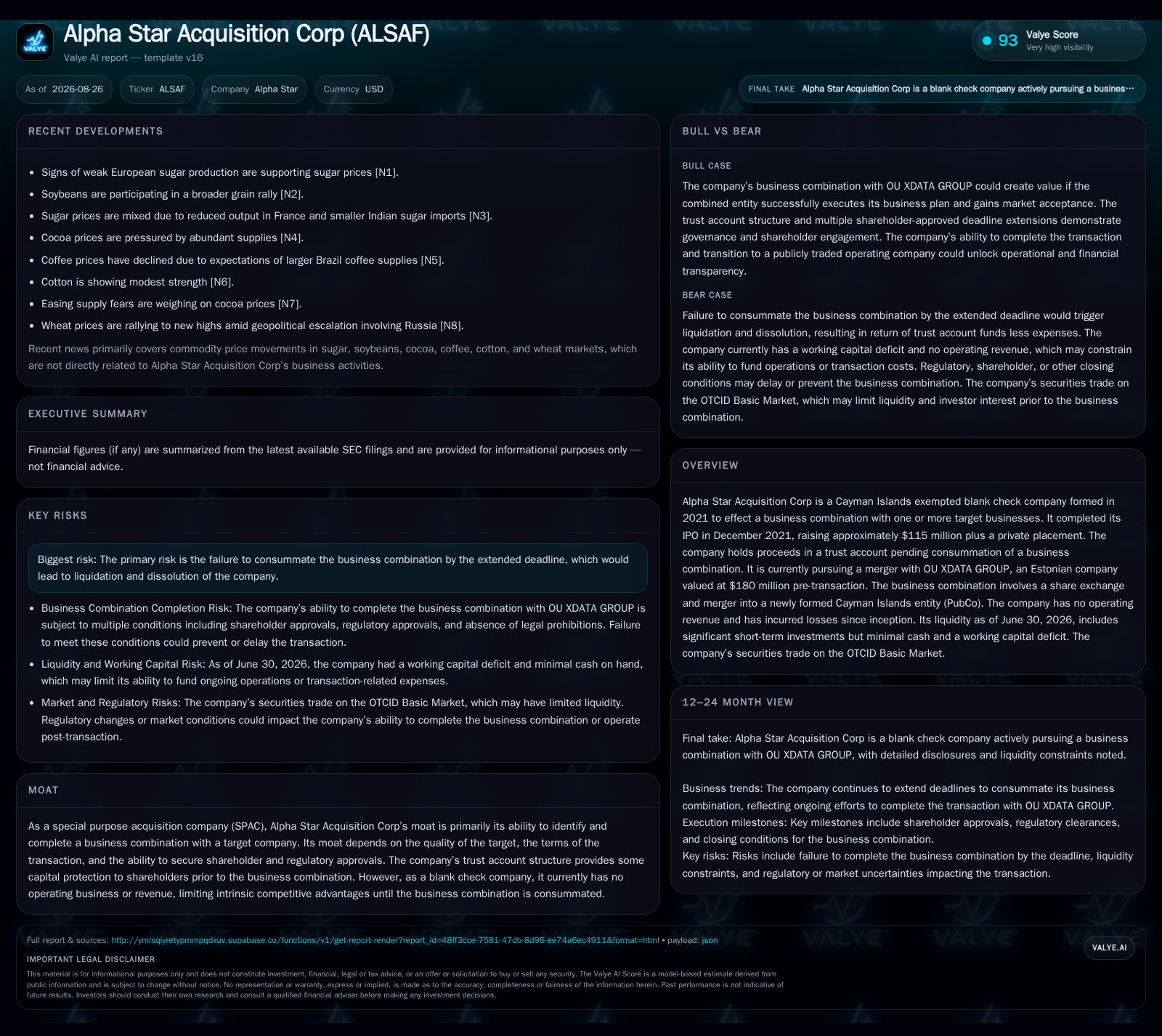
Alpha Star Acquisition Corp is a Cayman Islands-based SPAC that completed a $115 million IPO in 2021 and is currently pursuing a merger with Estonian company OU XDATA GROUP, valued at $180 million pre-transaction. Despite holding substantial funds in trust, the company has no revenue and faces working capital deficits and liquidity challenges. Its future value depends on closing the merger by December 15, 2026, navigating shareholder and regulatory approvals. The SPAC’s moat is limited until the business combination completes, and the stock trades on an OTC market, constraining liquidity and investor interest. Performance post-merger will depend on XDATA’s operational success and market acceptance.
Alpha Star Acquisition Corp exemplifies the structural and execution risks inherent in special purpose acquisition companies (SPACs) as it approaches a critical deadline to consummate a merger with OU XDATA GROUP, an Estonian firm valued at $180 million. Despite raising over $115 million in its 2021 IPO and holding these funds in trust, Alpha Star remains without operating revenue and faces a working capital deficit as of mid-2026. The successful merger, contingent on shareholder and regulatory approvals, will transform Alpha Star from a blank-check shell to an operating company, unlocking potential value but also exposing investors to operational execution risks and market acceptance challenges. The company’s OTC market listing further complicates liquidity and investor interest pre-merger, underscoring the pivotal nature of the upcoming milestones.
Latest Operating Snapshot
Alpha Star Acquisition Corp currently operates as a blank-check company incorporated in the Cayman Islands with no operating revenue since its inception in 2021. It completed its IPO in December 2021, raising approximately $115 million plus a $3.3 million private placement, with proceeds securely held in a U.S.-based trust account. The company is actively pursuing a business combination with OU XDATA GROUP, an Estonian company with a pre-transaction valuation of $180 million, structured as a merger and share exchange that will result in XDATA becoming a wholly owned subsidiary of a new Cayman Islands entity (PubCo) [S1][S2].
As of June 30, 2026, Alpha Star reported a working capital deficit of about $2 million and zero cash and cash equivalents, although it retains roughly $99.4 million in short-term investments from earlier periods. Current liabilities stood at approximately $2.5 million, leading to a severely constrained liquidity profile. The company’s shares trade on the OTCID Basic Market under multiple symbols, which limits liquidity and potentially investor interest in advance of the business combination [S2]. These financial and operational facts underscore the critical importance of completing the merger to transition into an operating company capable of generating revenue and sustaining operations.
Business Model and Unit Economics
Alpha Star’s business model is inherently transactional and contingent: as a SPAC, its core function is to raise capital through an IPO and then identify and merge with a target operating business, here OU XDATA GROUP. Until the merger consummates, Alpha Star does not generate revenue or meaningful operating cash flow, and its financial results reflect administrative expenses and transaction-related costs. The SPAC structure centralizes capital in a trust account, limiting spending but exposing the company to fixed costs related to governance, regulatory filings, and shareholder communications.
Post-merger, the combined entity’s economics will depend entirely on XDATA’s operational model, which is not detailed in the current report. Critical economic levers will include XDATA’s revenue mix, pricing power, customer acquisition costs, and margins, as well as capital expenditure requirements. The transition could introduce operating leverage if fixed costs are spread over growing revenues, but this depends on XDATA’s scale and efficiency. Alpha Star’s current capital intensity is low aside from the funds held in trust, but successful integration may require additional capital investment and working capital management—a challenge given existing liquidity constraints.
Moat, Competition and Counterforces
Alpha Star’s moat as a SPAC is limited and primarily resides in its ability to identify a suitable target and consummate the business combination. The company’s trust account structure offers shareholders some capital protection prior to the merger, and repeated shareholder approvals to extend the deadline indicate engaged governance. However, as a blank-check company, Alpha Star holds no intrinsic competitive advantages such as proprietary technology, customer relationships, or recurring revenue streams.
Post-merger, competitive positioning will depend entirely on OU XDATA GROUP’s business dynamics, including its market differentiation, competitive landscape, and barriers to entry. The SPAC framework’s inherent counterforces include dilution risks, public market scrutiny, and vulnerability to regulatory changes. Furthermore, the OTCID Basic Market listing limits liquidity and profile, which can undermine investor confidence and share price stability before the merger closes.
Bull Case
In an optimistic scenario, Alpha Star successfully completes its business combination with OU XDATA GROUP by the December 15, 2026 deadline, securing all requisite shareholder and regulatory approvals without significant delays. This transition unlocks operational and financial transparency, allowing public investors to assess XDATA’s business fundamentals and growth prospects. The merger could generate value if XDATA’s business model proves scalable and profitable, leveraging operational leverage from fixed costs and expanding its customer base.
Confirming evidence would include timely regulatory clearances, shareholder votes in favor, and early indications of XDATA’s revenue growth and margin expansion post-merger. Conversely, failure to complete the merger or signs of operational underperformance from XDATA post-transaction would falsify this scenario. Successful integration and public market acceptance would enhance liquidity and valuation multiples, validating the SPAC’s initial capital raise and investor patience.
Base Case
The baseline outlook envisions Alpha Star consummating the merger with OU XDATA GROUP within the extended timeline but encountering moderate execution challenges such as regulatory delays or shareholder pushback. Liquidity constraints may require careful management of transaction expenses and administrative costs. After closing, the combined entity delivers modest revenue growth with mixed margin results as it invests in integration and market development.
This scenario anticipates incremental progress in operational performance offset by some headwinds, such as the need for additional capital or slower-than-expected customer adoption. The OTCID Basic Market listing may continue to suppress trading volumes and investor engagement in the near term. Key falsification tests include a failure to close the merger by the deadline or a rapid deterioration in liquidity and operational performance that forces expensive capital raises or restructuring.
Bear Case
A downside scenario emerges if Alpha Star fails to consummate the business combination with OU XDATA GROUP by the December 15, 2026 deadline, triggering liquidation and dissolution. In this event, investors would receive a pro-rata return of trust account funds net of expenses, representing a capital return but no participation in future growth. The company’s working capital deficit and zero cash exacerbate the risk of being unable to fund transaction costs or administrative expenses, accelerating failure risk.
Additional bear catalysts include regulatory impediments, shareholder disapproval, or adverse market conditions that prolong or prevent closing. The company’s OTCID Basic Market listing limits liquidity, potentially depressing share prices and complicating capital raises. Confirming evidence for this scenario would be missed deadlines, public indications of regulatory or shareholder hurdles, and worsening liquidity metrics. A sudden improvement in cash reserves or shareholder approvals would falsify this downside path.
What Matters Next
Key performance indicators and milestones to monitor include: (1) shareholder vote outcomes on the business combination proposal; (2) receipt of all necessary regulatory approvals without significant conditions or delays; (3) successful closing of the merger by the December 15, 2026 deadline; (4) post-merger operational metrics from OU XDATA GROUP such as revenue growth, profitability, and cash flow generation; (5) liquidity metrics including cash balances and working capital post-transaction; (6) trading volume and price action on the public markets indicative of investor confidence and liquidity improvements; (7) any announcements of additional financing or capital raises needed for integration or growth; and (8) disclosures regarding integration progress and strategic milestones by the new combined entity.
While not currently disclosed, metrics like XDATA’s customer retention rates, unit economics, and capital expenditure requirements would be critical to assess the sustainability of the combined business model. Observing the evolution of these KPIs post-merger will provide investors with the necessary transparency to evaluate the long-term investment thesis.
Disclaimer: This is research-only, informational analysis and not investment advice. It may include AI-generated interpretation and general industry context. Always verify important details using primary sources.

Comments