
Toll Brothers, Inc. (TOL) Equity Analysis: Navigating Luxury Homebuilding with Strategic Focus Amid Market Sensitivities
Toll Brothers leverages a diversified luxury residential portfolio and broad geographic footprint to sustain growth and profitability, but faces sector cyclicality, capital intensity, and execution risks amid shifting market dynamics and strategic portfolio shifts.
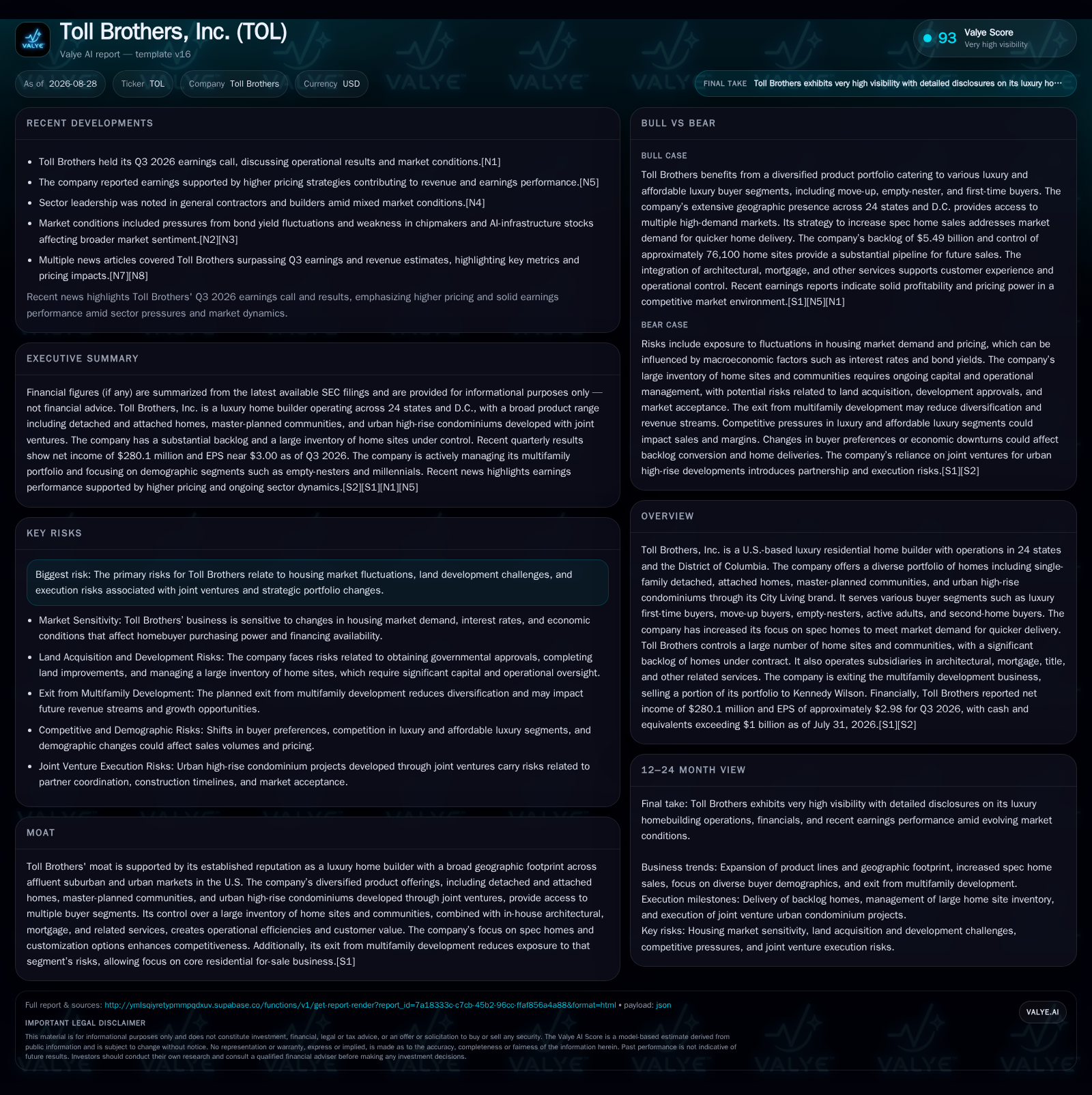
Toll Brothers operates a substantial luxury homebuilding platform across 24 states and D.C., with a broad product mix and integrated ancillary services supporting customer experience and operational control. Its sizable backlog and home site inventory provide near-term revenue visibility. The company’s pivot to increasing spec home sales enhances responsiveness to market demand, while exiting multifamily development sharpens focus but reduces diversification. Pricing power and operational scale underpin profitability, yet exposure to macroeconomic factors, land development complexity, and joint venture execution constitute meaningful risks. The company's future hinges on balancing growth and capital deployment amid evolving buyer preferences and economic conditions.
Toll Brothers, Inc. stands as a prominent luxury homebuilder operating across a broad U.S. footprint, offering diverse residential products from detached single-family homes to urban high-rise condominiums. With a substantial backlog nearing $5.5 billion and control over more than 76,000 home sites, the company exhibits significant near-term revenue visibility. Its strategic shift toward increasing spec home inventory aims to better match market demand for faster delivery, while exiting multifamily development refocuses the business on core residential for-sale operations. Despite recent earnings strength driven by pricing power, Toll Brothers navigates complex macroeconomic headwinds, land development challenges, and execution risks inherent in joint ventures, positioning it at a critical inflection point between growth opportunities and sector cyclicality.
Latest Operating Snapshot
As of October 31, 2025, Toll Brothers held a backlog of $5.49 billion representing 4,647 homes, with approximately 98% expected to be delivered in fiscal 2026, signaling strong near-term revenue visibility supported by contracted sales [S1]. The company controlled roughly 76,100 home sites across 1,137 communities, of which 57% were optioned, providing a significant land inventory to sustain multi-year development activity [S1]. In fiscal 2025, spec homes—completed without signed contracts—comprised about 54% of deliveries, reflecting a strategic shift toward inventory that can address market demand for quicker home availability [S1].
Financially, Toll Brothers reported net income of $280.1 million and earnings per share of approximately $2.98 in Q3 2026, backed by higher pricing strategies that bolstered revenue and earnings performance despite sector pressures including bond yield fluctuations [S2][N5]. The company operates a diversified portfolio encompassing single-family detached and attached homes, master-planned communities, and high-rise urban condominiums developed through joint ventures, serving multiple buyer demographics including luxury first-time, move-up, and active adult buyers [S1]. The planned exit from multifamily development by selling assets to Kennedy Wilson streamlines focus but alters future revenue composition [S1].
Business Model and Unit Economics
Toll Brothers generates revenues primarily through the design, construction, and sale of luxury residential homes, selling both customized homes and spec homes. The pricing model benefits from substantial option value, averaging $202,000 per home in fiscal 2025, constituting about 24.5% of the base sales price, thereby enhancing margins through product mix and customization [S1]. Approximately 25% of buyers pay cash, while the remainder finance roughly 69% of the purchase price, highlighting sensitivity to mortgage rates and credit availability [S1]. Pricing power is critical given the luxury segment’s exposure to economic cycles and buyer confidence.
Operating leverage arises from fixed costs embedded in land acquisition, development, and overhead for architectural, engineering, and other in-house services. While land inventory control offers strategic advantages, it also ties up significant capital and limits flexibility if market conditions deteriorate. The shift toward spec homes improves operational agility, reducing cycle times and aligning supply more closely with demand fluctuations. However, capital intensity remains substantial due to land development, construction, and optioning costs. Integration of mortgage, title, and related services can lower transaction friction and improve unit economics but requires ongoing investment and risk management. Operating leverage may emerge if fixed costs are spread over increasing deliveries, but this depends on sustained sales velocity and margin maintenance.
Moat, Competition and Counterforces
Toll Brothers’ moat is anchored in its established brand in the luxury homebuilding market, broad geographic coverage across 24 states and Washington D.C., and a diversified product portfolio spanning single-family detached homes to urban high-rise luxury condominiums. Control over a large inventory of home sites and the operation of integrated subsidiaries offering architectural, mortgage, and title services create synergies that can enhance customer experience and operational efficiency [S1]. The company’s ability to offer extensive customization and maintain high option values further differentiates it in a competitive market.
However, the housing sector’s inherent cyclicality and sensitivity to macroeconomic variables such as interest rate changes and buyer credit constraints remain significant counterforces. Competition from other luxury homebuilders, regional developers, and existing home resale markets challenges pricing and volume growth. The exit from multifamily development concentrates risk in the for-sale residential segment, potentially reducing diversification benefits. Urban condominium projects developed through joint ventures introduce partnership execution risks and depend on local market conditions and regulatory environments. The increasing share of spec homes improves market responsiveness but also exposes the company to inventory risk if demand weakens.
Bull Case
In a favorable scenario, Toll Brothers leverages its diversified product portfolio and geographic footprint to capture robust demand from multiple buyer segments, including move-up, empty-nester, and affluent first-time buyers. Continued pricing power supported by strong brand equity and customization options enables margin expansion. The company’s backlog and extensive land bank provide a stable revenue base, while the increased spec home inventory meets market demand for faster delivery, improving sales velocity and cash flow dynamics. Integrated subsidiaries for architectural, mortgage, and title services deliver operational efficiencies and enhance customer retention.
Confirming evidence for this scenario includes sustained backlog conversion rates, stable or rising home prices despite macroeconomic headwinds, accelerating spec home absorption, and successful execution of joint venture urban projects. Falsification would occur if pricing power erodes due to competitive pressures or if backlog conversion slows materially, signaling weakening demand. Failure to realize expected operational synergies or disruptions in capital deployment for land development would also challenge this optimistic outlook [S1][N5][N1].
Base Case
Under the base case, Toll Brothers maintains steady but modest growth, with backlog supporting revenue but facing margin pressure from rising costs and competitive pricing dynamics. The shift to spec homes partially offsets slower contract sales by enabling quicker market response, but overall volume growth is constrained by macroeconomic factors such as moderate interest rate increases and cautious buyer sentiment. The exit from multifamily development refines focus but reduces diversification and growth optionality, making the company more dependent on the for-sale luxury housing cycle.
Operationally, the company manages capital intensity through disciplined land acquisition and development while leveraging its integrated services to contain transaction costs. Challenges in joint venture urban projects persist but are managed within expected variability. Pricing power remains intact but limited, resulting in stable margins. Confirming signals include consistent backlog conversion rates near historical averages, moderate home price appreciation, and stable spec home inventory turnover. Falsification would involve sustained backlog declines, material margin compression, or significant delays in urban project execution impacting earnings [S1][S2].
Bear Case
In a downside scenario, Toll Brothers faces significant headwinds from a downturn in the luxury housing market triggered by rising interest rates, tighter mortgage availability, and weakening buyer confidence. Demand softens, leading to backlog erosion and increased inventory carrying costs, especially given the large spec home exposure. Land development becomes more capital intensive with regulatory delays or market resistance, straining liquidity and operational flexibility. The exit from multifamily development eliminates a revenue stream that could have offset declines in for-sale homes, concentrating risk in a cyclical segment.
Joint venture urban condominium projects suffer from execution delays or market acceptance issues, further pressuring earnings. Competitive intensity intensifies, forcing price concessions and margin declines. Confirming evidence includes falling backlog, increased cancellations or price reductions, slower spec home sales, and rising land or development impairments. Falsification would require stabilization or recovery in homebuyer demand, successful capital recycling, or improved urban project outcomes that mitigate downside risks [S1][S2].
What Matters Next
Key performance indicators to monitor include backlog conversion rates and cancellation levels, which provide early insight into demand sustainability and revenue visibility. Spec home absorption rates and days on market will indicate the company's ability to manage inventory risk and respond to market conditions. Pricing trends, including average selling prices and option values, will signal pricing power and margin trajectory.
Capital deployment efficiency, measured by land acquisition spend relative to sales and development progress, will reflect operational discipline amid capital intensity. Progress and financial returns from joint venture urban condominium projects are critical to assessing execution risk and diversification potential. Additionally, monitoring macroeconomic indicators such as mortgage rates and buyer credit availability is essential, given their direct impact on demand. Finally, updates on the multifamily exit strategy and potential reinvestment plans will clarify future growth pathways.
Disclaimer: This is research-only, informational analysis and not investment advice. It may include AI-generated interpretation and general industry context. Always verify important details using primary sources.

Comments