
Amphastar Pharmaceuticals Faces Revenue Pressure Amid Margin and R&D Shifts
The company's vertical integration supports complex generics and proprietary products, but recent earnings show signs of strain.
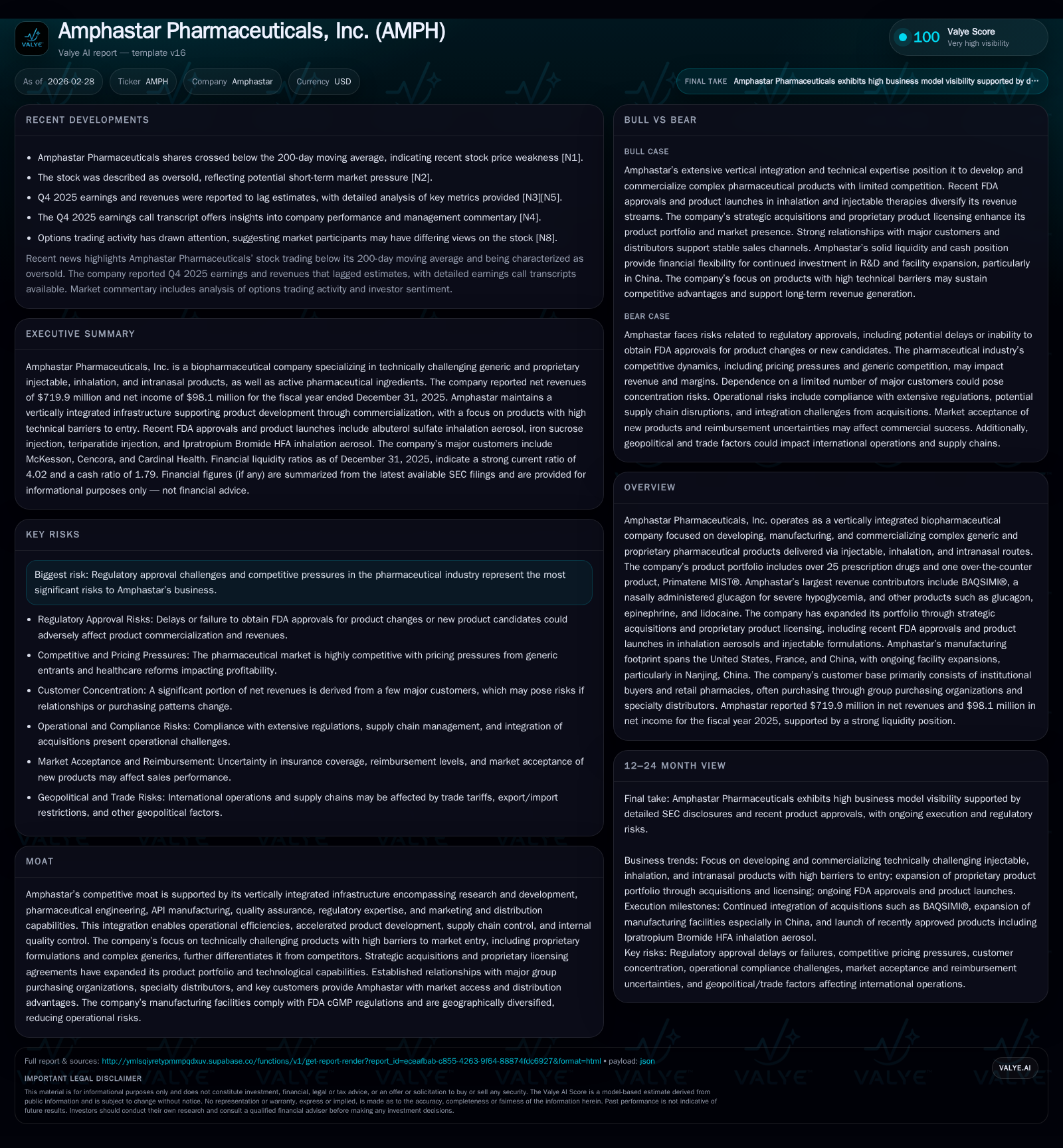
Amphastar Pharmaceuticals has built a vertically integrated platform focusing on technically challenging generic and proprietary injectable, inhalation, and intranasal pharmaceuticals. Despite steady revenue growth through 2024, top-line slipped slightly in 2025 due to product mix and competitive factors. Operating income and net income declined more noticeably, reflecting increased R&D spend and commercial integration costs following acquisitions like BAQSIMI®. The company’s expansion into biosimilars and proprietary pipelines positions it for future growth, but regulatory hurdles and supply chain risks remain key uncertainties. Amphastar maintains a solid liquidity base with consistent free cash flow generation, alongside active share repurchases.
Company Overview
Amphastar Pharmaceuticals operates as a vertically integrated biopharmaceutical company specializing in technically complex generic and proprietary pharmaceutical products delivered primarily via injectable, inhalation, and intranasal routes [S1][S13]. Its portfolio exceeds 25 prescription drugs plus the over-the-counter Primatene MIST®. The firm’s notable revenue contributors include BAQSIMI®, its branded nasal glucagon treatment for severe hypoglycemia acquired in mid-2023; other injectables such as glucagon, epinephrine, lidocaine; along with inhalation aerosols [S13][S28]. The manufacturing infrastructure spans the United States, France, and China — covering API synthesis through finished dosage form production — enabling greater operational control compared to many peers that rely heavily on third-party manufacturers [S10][S26].
Historical Financial Performance
Amphastar experienced robust revenue growth from $499.0 million in fiscal 2022 to $731.9 million in fiscal 2024 before seeing a modest decline to $719.9 million in fiscal 2025 (-1.7% year-over-year) [F1]. This trajectory reflected expansion driven by new product launches such as BAQSIMI®, internal development of complex generics with high technical barriers to entry, plus broadening distribution relationships including major group purchasing organizations like McKesson (24% of revenues) and Cencora (22%) [S5][S16].
However, profitability metrics have faced more significant challenges. Operating income peaked at $205.4 million in 2024 but dropped sharply to $140.4 million in 2025 (-31.7%), largely attributable to the higher costs associated with assuming full commercial operations for BAQSIMI® after transitioning from Eli Lilly’s support agreements as well as incremental R&D expenses linked to expanding biosimilar and proprietary pipelines [S3][S10]. Net income similarly shrank by nearly 39% YoY to $98.1 million [F1]. Operating cash flow also contracted by roughly 27%, though Amphastar maintained positive free cash flow estimated around $121 million after capital expenditures of nearly $35 million [F1].
Historical performance (annual)
| FY | Rev ($mm) | Net ($mm) | CFO ($mm) | OpInc ($mm) | Rev YoY | Net YoY |
|---|---|---|---|---|---|---|
| 2025 | 720 | 98 | 156 | 140 | -1.7% | -38.5% |
| 2024 | 732 | 160 | 213 | 205 | +13.6% | +16.0% |
| 2023 | 644 | 138 | 184 | 197 | +29.1% | +50.5% |
| 2022 | 499 | 91 | 89 | 107 |
Source: SEC companyfacts cache [F1].
Capital returns and efficiency (annual)
| FY | Buybacks ($mm) | FCF ($mm) |
|---|---|---|
| 2025 | 76 | 121 |
| 2024 | 85 | 172 |
| 2023 | 58 | 145 |
| 2022 | 40 | 65 |
Source: SEC companyfacts cache [F1].
Growth Drivers & Future Prospects
Strategically, Amphastar is pivoting from primarily complex generics toward higher-margin proprietary products and biosimilars over the medium term [S19]. Its extensive vertically integrated infrastructure underpins several competitive advantages — notably accelerated product development cycles, internal API production reducing supply risks, tight quality control complying with FDA cGMP standards across multiple global sites (US, France for porcine insulin API & AMP-028 biosimilar candidate manufacturing; China for expanding capacity) — enabling focus on products with limited competition due to formulation complexity or material sourcing challenges [S10][S26].
Pipeline efforts include generic ANDAs targeting substantial injectable market opportunities alongside biosimilar candidates emphasizing interchangeable insulin analogs such as Insulin Aspart (AMP-004) and Recombinant Human Insulin (AMP-005), aiming for interchangeability designations which could drive uptake given diabetes prevalence [S23]. Proprietary peptides under development include AMP-107 (anti-VEGF receptor peptide for macular degeneration), AMP-109 (peptide-docetaxel conjugate to reduce toxicity), AMP-110 (synthetic ACTH analog targeting multiple indications) [S28].
Commercially, Amphastar completed the transition of BAQSIMI® sales and supply chain management fully away from Eli Lilly by January 1, 2025, allowing complete profit capture but temporarily increasing SG&A costs during integration [S28]. This acquisition expanded their international reach into over two dozen countries.
Risks tempering outlook include regulatory approval challenges related to biosimilar interchangeability designations amid evolving FDA guidelines; supply chain dependencies such as hydrofluorocarbon availability mandated under the AIM Act impacting inhalation products like Primatene MIST®; and intense competition from both brand innovators and specialized generic manufacturers across injectables and inhalation markets.
Operating Leverage & Capital Allocation
Operating leverage was pressured in fiscal year 2025 due to increased R&D staffing—163 employees dedicated to advanced formulation studies including clinical trial design essential for proprietary candidate approvals [S10]. Margin contraction follows strategic shifts toward innovation-driven growth.
Capital allocation balances reinvestment with shareholder returns: share repurchases totaled approximately $75 million in fiscal year 2025 under the ongoing November 2014 repurchase program [F1]. The company reported no long-term debt as of December 31, 2025 enhancing financial flexibility while maintaining revolving credit lines for working capital needs [S7][F1].
Liquidity remains robust with cash & equivalents exceeding $170 million at year-end supporting operations through potential regulatory or supply disruptions; current ratio stood above four times indicating strong short-term solvency [F1].
Industry Context & Competitive Positioning
The injectable pharmaceutical market is highly regulated with stringent cGMP requirements limiting competitors mostly to technically capable manufacturers like Amphastar . The inhalation therapy segment also features elevated barriers post-CFC phase-out reforms.
Amphastar’s vertical integration—from research through API manufacture to marketing—provides operational agility uncommon among peers dependent on external suppliers vulnerable to quality or supply issues . Established relationships with major group purchasing organizations further strengthen its hospital and alternate-site distribution channels critical for both generics and proprietary brands alike [S5][S29].
What To Watch
Key upcoming milestones include:
- Clinical trial progress for proprietary peptides plus biosimilar interchangeability submissions.
- Commercial performance of BAQSIMI® internationally post-integration.
- Regulatory developments impacting hydrofluorocarbon supply for inhalation products.
- Facility expansion timelines particularly at Nanjing site.
- Quarterly results indicating margin stabilization or improvement post-commercial cost integration.
Conclusion
Amphastar Pharmaceuticals leverages vertical integration across research, manufacturing, quality control, and commercialization focused on complex injectable/inhalation generics alongside innovative biosimilar/proprietary pipelines targeting diabetes care—a sector marked by high volume demand yet strict regulatory scrutiny.
FY25 results revealed earnings pressure from acquisition-related integration costs and rising R&D outlays indicative of near-term margin compression risks amid a competitive regulatory environment; however, solid free cash flow generation combined with disciplined capital returns supports operating resilience.
Investors should monitor upcoming clinical/regulatory milestones alongside execution progress as Amphastar transitions toward higher-value innovative pharmaceuticals while maintaining its core niche strength.
This document reflects information available through February 28, 2026 without investment advice or recommendations.
Disclaimer: This is research-only, informational analysis and not investment advice. It may include AI-generated interpretation and general industry context. Always verify important details using primary sources.

Comments