
Keros Therapeutics Advances Clinical Pipeline with Strong Financial Turnaround in 2025
Keros Therapeutics leverages its expertise in TGF-β signaling modulation to develop novel therapies for neuromuscular and hematologic disorders, supported by a robust financial profile and strategic partnerships.
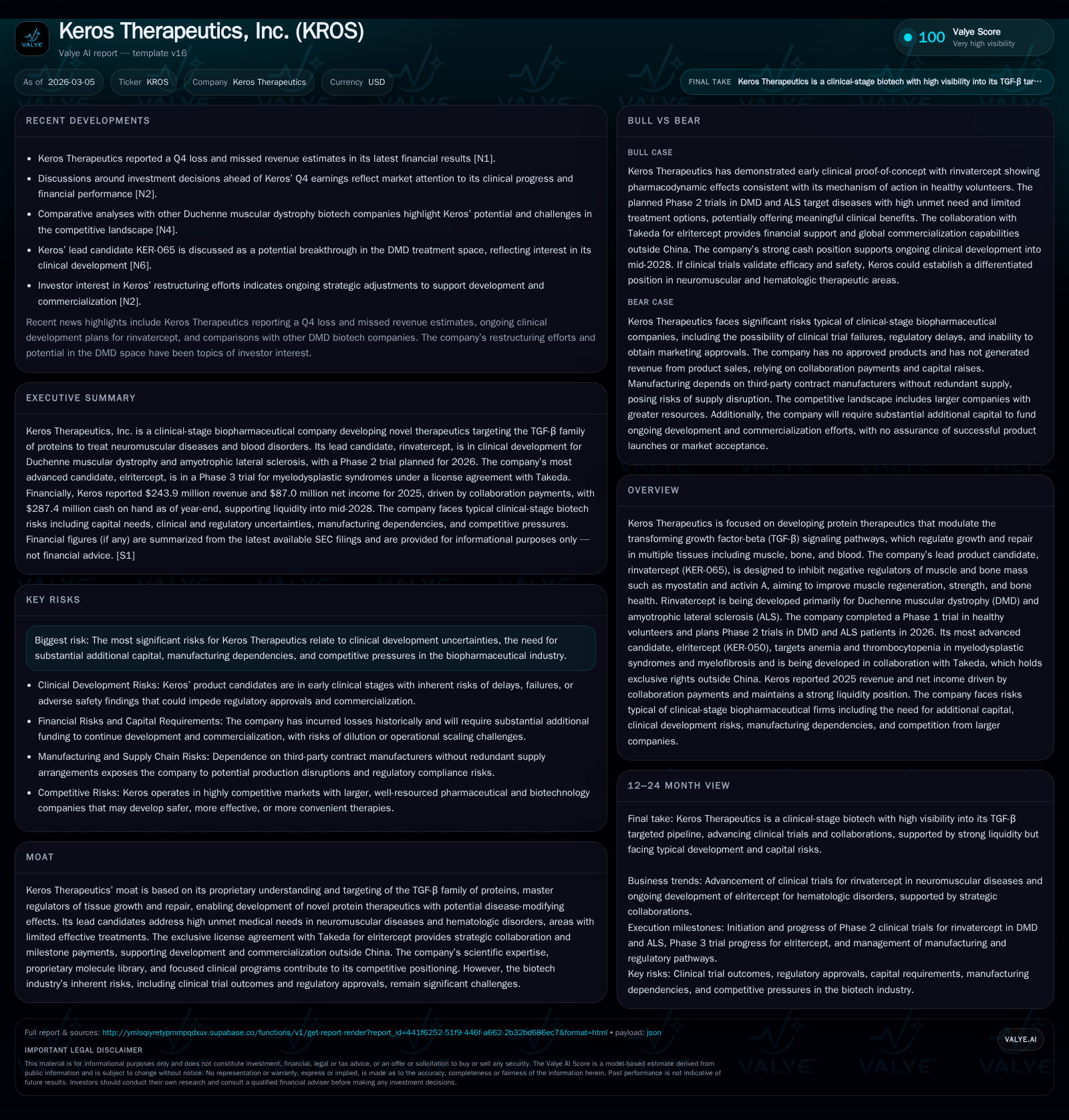
Keros Therapeutics is developing protein therapeutics targeting the TGF-β family, with lead candidates rinvatercept for neuromuscular diseases including Duchenne muscular dystrophy and ALS, and elritercept for hematologic cytopenias. The company achieved profitability in 2025 driven by licensing revenues from Takeda Pharmaceuticals and marked clinical progress including completion of a Phase 1 trial for rinvatercept and initiation of a Phase 3 trial for elritercept. Keros's strong cash position and collaboration agreements support upcoming clinical milestones in 2026, though risks remain around clinical development, regulatory approvals, and competitive pressures.
Financial Performance Reflects Milestone-Driven Growth
Keros Therapeutics reported a significant turnaround in fiscal year 2025 with revenues reaching approximately $243.9 million driven primarily by upfront license payments from its collaboration with Takeda Pharmaceuticals effective January 16, 2025 [F1][S1]. This milestone revenue contributed to operating income of $67.6 million compared to operating losses exceeding $210 million in the previous year. Net income similarly shifted to a positive $87 million from losses over $187 million in FY2024. Operating cash flow rose substantially to approximately $107.5 million while capital expenditures remained modest at about $1.55 million [F1].
Liquidity remains strong with cash and equivalents totaling roughly $287 million at year-end alongside current assets of $315 million versus current liabilities near $20 million yielding a current ratio around 15.5 [F1]. Equity stood at approximately $303 million resulting in an estimated return on equity near 29%, reflecting non-recurring licensing inflows rather than operational profitability alone.
Historical performance (annual)
| FY | Net ($mm) | CFO ($mm) | OpInc ($mm) | Capex ($mm) | Net YoY |
|---|---|---|---|---|---|
| 2025 | 87 | 108 | 68 | 2 | +146.4% |
| 2024 | -187 | -161 | -211 | 2 | -22.5% |
| 2023 | -153 | -125 | -170 | 2 | -46.2% |
| 2022 | -105 | -70 | -115 | 1 |
Source: SEC companyfacts cache [F1].
Capital returns and efficiency (annual)
| FY | FCF ($mm) | ROE% |
|---|---|---|
| 2025 | 106 | 28.7 |
| 2024 | -163 | -32.8 |
| 2023 | -127 | -46.1 |
| 2022 | -71 | -37.7 |
Source: SEC companyfacts cache [F1].
Pipeline Progress – Rinvatercept Targets Neuromuscular Diseases
Rinvatercept (KER-065) is designed as a ligand trap that inhibits key TGF-β ligands myostatin (GDF8) and activin A which negatively regulate muscle mass and bone strength [S1]. By blocking these ligands, Keros aims to enhance skeletal muscle regeneration, reduce fibrosis, increase muscle size and strength, decrease body fat, and improve bone density.
The candidate is being developed primarily for Duchenne muscular dystrophy (DMD) — a genetic disorder causing progressive muscle degeneration — and amyotrophic lateral sclerosis (ALS), characterized by motor neuron loss leading to muscle wasting [N6][N5]. Keros completed a Phase 1 safety trial in healthy adults as reported in March 2025 [S1] with plans to initiate Phase 2 trials for DMD patients in Q2 of calendar year 2026 and regulatory discussions regarding an ALS Phase 2 study anticipated later that year [N6][S1].
This extracellular ligand trap approach distinguishes rinvatercept from competitors focusing on intracellular pathways or gene therapies by broadly modulating tissue repair signaling cascades related to muscle homeostasis.
Elritercept Collaboration with Takeda Addresses Hematologic Cytopenias
Elritercept (KER-050) is an engineered fusion protein combining a modified extracellular domain of activin receptor type IIA with an Fc antibody segment enabling prolonged activity [S1]. It targets subsets of the TGF-β superfamily that inhibit hematopoiesis aiming to increase red blood cell and platelet production.
Indications include anemia and thrombocytopenia associated with myelodysplastic syndromes (MDS) and myelofibrosis patients who are refractory or intolerant to existing treatments [S1][N1]. In December 2024, Keros granted Takeda exclusive rights outside mainland China to develop, manufacture, and commercialize elritercept under a license agreement effective January 16, 2025 [S1].
Milestone payments have been triggered including a $10 million payment upon dosing the first patient in the placebo-controlled Phase 3 RENEW trial initiated in July 2025 [S3]. This partnership leverages Takeda’s global commercial infrastructure while allowing Keros to focus resources on clinical development.
Upcoming Clinical Milestones & Regulatory Engagements
Key catalysts expected through the remainder of calendar year 2026 include:
- Initiation of the Phase 2 trial for rinvatercept in DMD patients during Q2.
- Regulatory interactions concerning design elements for an ALS Phase 2 study anticipated in H2.
- Continued patient enrollment progression within elritercept’s pivotal Phase 3 RENEW trial.
These milestones will provide important data readouts influencing future development decisions while informing potential accelerated approval pathways given the severity of targeted diseases.
Capital Allocation & Financial Position Supports Development Programs
Keros ended FY2025 with strong liquidity comprising approximately $287 million cash on hand complemented by minimal capital expenditures consistent with outsourced manufacturing strategies typical for biologic drug developers [F1]. Free cash flow approximated $106 million reflecting efficient operational management post-license milestone inflows.
The company maintains prudent financial discipline enabling continued investment into costly clinical programs without immediate capital raises required but acknowledges future financing needs depend on clinical outcomes.
Risk Factors & Industry Challenges
Keros faces multiple inherent risks common among clinical-stage biopharmaceutical companies including:
- Ongoing need for successful clinical trial execution across multiple indications.
- Dependence on third-party contract research organizations (CROs) and manufacturers subject to quality control risks.
- Intellectual property protection challenges amid competitive innovation landscape.
- Compliance obligations under extensive healthcare regulations such as HIPAA, Anti-Kickback Statute, False Claims Act alongside evolving privacy laws increasing operational complexity [S4][S5][S6].
The strategic partnership with Takeda mitigates certain commercial execution risks associated with elritercept while leveraging shared expertise.
Disclaimer: This analysis is based solely on publicly available information up to March 2026 without forward-looking investment recommendations regarding securities issued by Keros Therapeutics.
Disclaimer: This is research-only, informational analysis and not investment advice. It may include AI-generated interpretation and general industry context. Always verify important details using primary sources.

Comments