
Mayville Engineering Company Confronts Profitability Challenge Despite Strong Operating Cash Flow
MEC exhibits resilient operations and deep customer relationships but faces severe margin pressure reflected in recent losses.
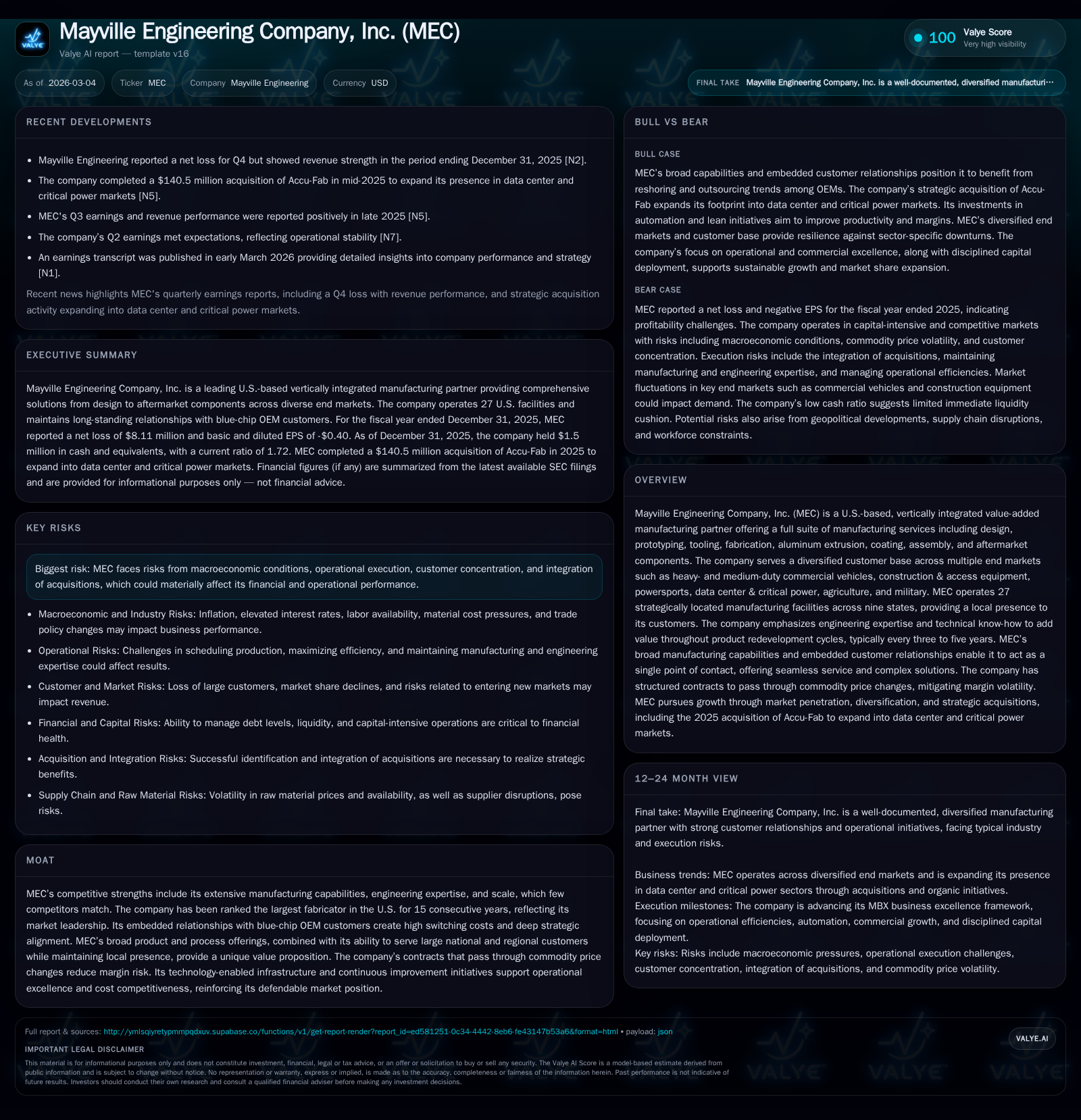
Mayville Engineering Company, Inc. (MEC) maintains its position as the largest U.S. fabricator with broad capabilities and a diversified customer base spanning heavy vehicles to data centers. Historically profitable with double-digit operating income growth from 2022 to 2024, MEC took a notable operating loss in 2025 despite strong cash flow generation. The company’s growth is anchored by embedded OEM relationships, technological investments, and its ability to pass commodity cost fluctuations to customers, but risks include macroeconomic volatility, operational execution, and acquisition integration. Key factors to monitor include return to profitability, capital deployment in high-growth segments like data center power solutions, and how MEC manages cost pressures within its vertical integration model.
Company Overview and Historical Performance
Mayville Engineering Company (MEC) is a vertically integrated value-added manufacturer headquartered in Milwaukee with a comprehensive offering spanning design, prototyping, tooling, aluminum extrusion, coating, assembly, and aftermarket components [S1][S13]. The company caters to diversified markets including heavy- and medium-duty commercial vehicles, construction & access equipment, powersports, data center & critical power infrastructure, agriculture machinery, and military components [S4][S6]. With 27 strategically located plants across nine U.S. states totaling approximately three and a half million square feet of manufacturing area [S4], MEC marries scale with regional presence.
Exemplifying deep OEM ties—John Deere alone accounted for over $54 million in sales across multiple platforms in 2025 [S4]—the firm leverages engineering expertise to embed itself firmly through product life cycles that refresh every three to five years [S13]. The Fabricator magazine has recognized MEC as the largest U.S. fabricator for fifteen consecutive years (2011–2025), underscoring its prominent industry standing [S12].
Financially MEC experienced solid operating income growth from $25.8 million in FY2022 to $44.6 million by FY2024 before encountering substantial challenges driving a $3.8 million operating loss in FY2025 [F1]. Net income similarly deteriorated from gains exceeding $25 million down to an $8.1 million loss over this period [F1]. Despite this earnings pressure, operational cash flows remained robust at $38.6 million in 2025 owing to effective working capital management [F1].
Historical performance (annual)
| FY | Net ($mm) | CFO ($mm) | OpInc ($mm) | Capex ($mm) | Net YoY |
|---|---|---|---|---|---|
| 2025 | -8 | 39 | -4 | 12 | -131.2% |
| 2024 | 26 | 90 | 45 | 12 | +231.1% |
| 2023 | 8 | 40 | 20 | 17 | -58.1% |
| 2022 | 19 | 52 | 26 | 59 |
Source: SEC companyfacts cache [F1].
Capital returns and efficiency (annual)
| FY | Buybacks ($mm) | FCF ($mm) | ROE% |
|---|---|---|---|
| 2025 | 5 | 27 | -3.4 |
| 2024 | 6 | 78 | 10.3 |
| 2023 | 3 | 24 | 3.4 |
| 2022 | 5 | -6 | 8.6 |
Source: SEC companyfacts cache [F1].
*Revenue figures for recent years were not explicitly provided in the disclosed data [F1].
Factors Driving Past Growth
Several elements underpin MEC's historical performance:
- Strategic OEM Relationships: Long-standing contracts with blue-chip customers like John Deere and PACCAR support revenue stability across multiple product lines [S4][S6]. Such embedded relationships lead to high switching costs.
- Diversified End Markets: Engagement across multiple cyclical industries provides balance; downturns in construction or commercial vehicles are offset by growth areas such as powersports or data center critical power solutions [S7][S18].
- Broad Manufacturing Capabilities: MEC’s extensive process portfolio—from stamping and extrusion to sophisticated coatings like military-grade CARC painting—enables it to serve diverse applications requiring complex engineering solutions [S12][S27].
- Technology Investments: Adoption of advanced fiber laser cutting systems and robotic automation enhances throughput precision while reducing labor effort and energy costs [S17]. Implementation of cobots for welding optimizes employee utilization.
- Customer Contract Structuring: Contracts pass through raw material price changes helping mitigate exposure to steel/aluminum commodity fluctuations [S9], essential given historic steel price volatility.
Future Growth Prospects
Growth drivers going forward relate closely to MEC's ability to leverage its strengths while navigating economic uncertainties:
- Expansion into High-Growth Segments: MEC explicitly prioritizes expanding its footprint in data center & critical power markets due to underlying secular infrastructure demand trends [S10]. Commercial excellence initiatives aim at broadening penetration here.
- Cross-Selling Within Existing Customers: By demonstrating engineering value upstream during product development phases every few years [S13], MEC deepens wallet share through multiple product lines across various platforms.
- Automation and Operational Efficiency Gains: Continued investments are expected in flexible automation technology enabling throughput expansion without proportional increases in labor or overhead costs [S17][S9].
- Disciplined Capital Allocation: Management emphasizes balancing organic investment against strategic acquisitions targeting adjacent manufacturing capabilities at attractive returns under the MBX framework [S10].
- Reshoring Trends: OEMs increasingly seek domestic suppliers able to simplify supply chains—a theme that favors MEC’s local footprint and scale advantages [S11].
Conversely some factors may cap growth or introduce risk:
- Macroeconomic Headwinds: Inflationary pressures on materials/energy costs remain elevated amid global geopolitical tensions impacting supply chains; recessionary environments could reduce OEM spending affecting order volumes [S19][N2].
- Operational Execution Risks: The notable operating loss incurred in FY2025 indicates challenges possibly linked with acquisition integrations or cost inflation that threaten margin recovery if unresolved [F1][N1].
- Customer Concentration Effects: Top ten customers represent over sixty percent of sales; loss or order reduction from any sizeable client may materially impact results even though no single customer exceeds ~14% of revenue alone [S6] .
- Supply Chain Volatility: Despite extensive supplier diversification (>900 direct material sources), unforeseen disruptions or regulatory changes could affect input availability or costs adversely.[S6]
Forecasts and What to Watch
While explicit forward guidance was not detailed in filings or recent transcripts available as of March 2026 [N1][N2], future milestones will likely hinge on:
- Return to profitability indicated by improved operating income trajectories beyond the losses recorded in FY2025.
- Successful ramp-up of business within targeted high-growth end markets such as data center infrastructure solutions through both organic expansion and acquisitions.
- Continuous improvement KPIs related to MBX framework implementation tracking progress on lean initiatives and automation impacts on cost structure.
- Management commentary on supply chain environment stabilization post-pandemic and geopolitical disruption effects.
- Capital deployment plans balancing growth investments with prudent balance sheet management given ongoing share repurchases alongside investment funding needs.
Returns and Capital Allocation
Despite recent losses at the net income level (-$8.1 million in FY2025), MEC generated strong operating cash flow ($38.6 million) reflecting healthy working capital execution amid profit headwinds [F1]. Capital expenditures were held relatively steady around $11–12 million annually after significant elevated spikes earlier reflecting modernization programs undertaken several years ago [F1].[F1]
The company continued its share repurchase program returning $4.6 million of capital through buybacks during FY2025 indicating ongoing shareholder return commitment even during tougher financial periods [F1].[F1]
Equity stands robust at approximately $241 million exiting FY2025 supportive of absorbing cyclical volatility without compromising financial flexibility [F1].[F1]
Return on equity calculated approximately at -3.4% for FY2025 reflects earnings setbacks but is tempered by strong asset base capitalization that could support rebound if operational improvement initiatives succeed [F1].[F1]
Industry Context Analysis
The contract manufacturing landscape MEC operates within is highly fragmented dominated by smaller niche players lacking the integrated scale or process breadth MEC possesses . This fragmentation combined with high barriers stemming from complex customer requirements creates defensible moat conditions.
OEMs' strategic shift towards outsourcing non-core manufacturing components fuels demand for integrated suppliers capable of handling large national footprints while maintaining localized service characteristics—a balance MEC appears structured well for given its geographic spread across nine states providing service versatility coupled with centralized technological expertise [analysis + S11].
Investment trends toward Industry 4.0 automation tools reflect broader manufacturing sector priorities addressing tight skilled labor availability issues common among industrial manufacturers today as also experienced by MEC who pursues workforce retraining alongside automation adoption for optimized labor deployment [analysis + S9].
Summary Conclusion
Mayville Engineering Company sustains a commanding position grounded on longstanding OEM partnerships coupled with extensive manufacturing capabilities that few competitors replicate fully. While facing near-term profitability challenges manifesting most recently in the FY2025 loss situation noted above [F1], MEC's stable cash flow profile along with disciplined reinvestment into technology-enabled infrastructure forms a foundation for potential recovery. The company's diversified exposure across several end-markets mitigates exposure risk somewhat but remains vulnerable given economic complexities impacting those industries broadly.
Forward-looking success will depend heavily on effective operational execution under their MBX transformation strategy leveraging lean principles along with expanding presence into higher growth verticals such as data center & critical power segments while continuing prudent financial stewardship balancing capital expenditures against shareholder returns through buybacks.[S10]
Investors should closely track subsequent earnings releases and management commentary regarding margin turnaround efforts plus integration progress on recent acquisitions such as Accu-Fab which will be critical variables influencing near-term trajectory.
This report synthesizes publicly available information without offering investment advice or recommendations. Readers should consider multiple sources before forming conclusions about Mayville Engineering Company’s financial prospects or strategic positioning.
Disclaimer: This is research-only, informational analysis and not investment advice. It may include AI-generated interpretation and general industry context. Always verify important details using primary sources.

Comments