
FIRSTSUN CAPITAL BANCORP’s Growth Fueled by Deposit Expansion and Strategic Merger Execution
Strong loan growth, robust capital management, and a pending merger position FirstSun for geographic and product diversification.
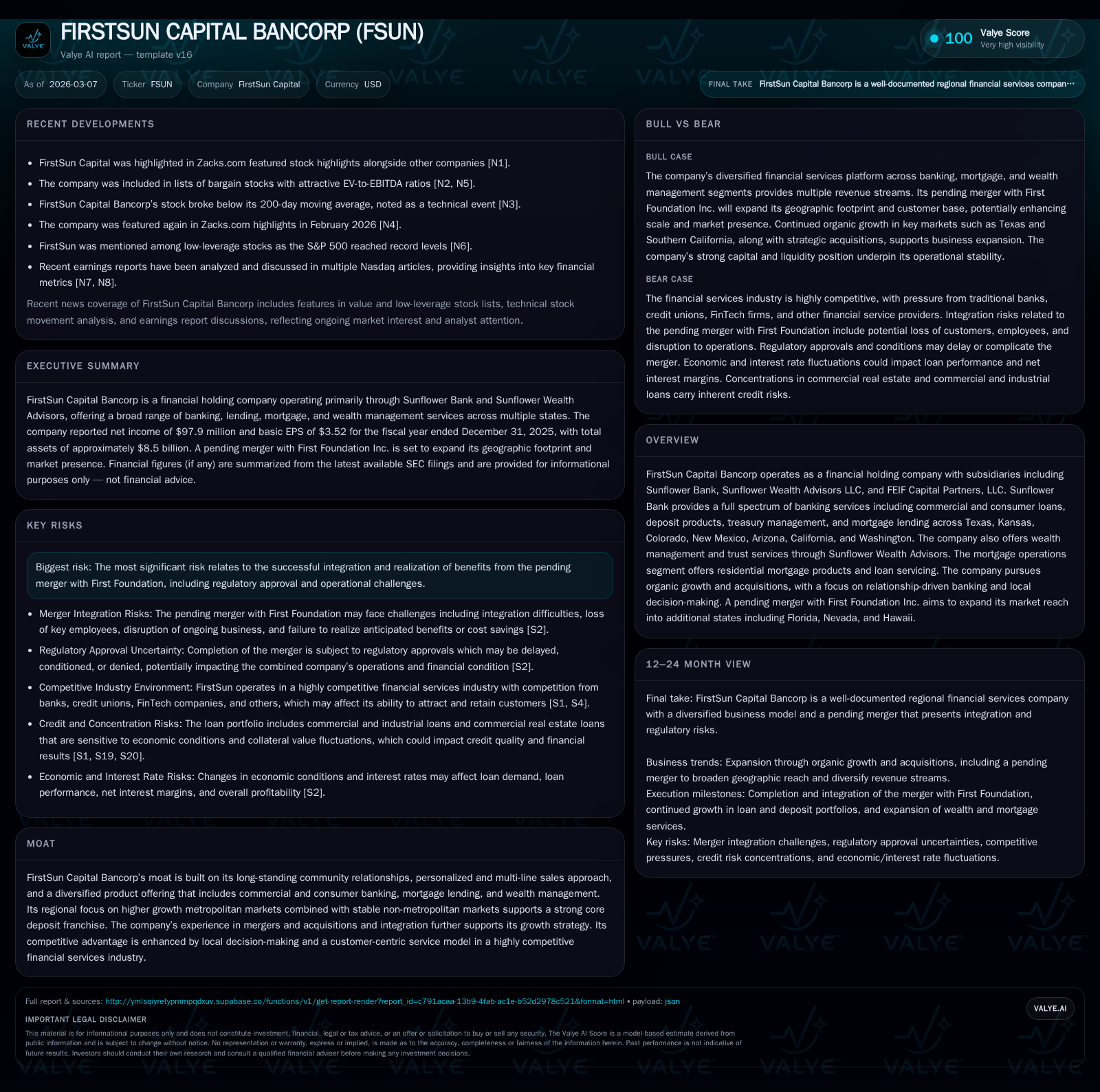
FirstSun Capital Bancorp (FSUN) demonstrated solid financial performance in 2025, highlighted by a near 30% increase in net income and a growing deposit base. The company maintains a diversified loan portfolio emphasizing commercial and industrial loans while expanding in Texas and Southern California markets. Active capital deployment includes modest dividends and reinvestment into infrastructure, supported by strong operating cash flow. Looking ahead, the pending merger with First Foundation Inc. aims to significantly increase FirstSun’s asset base and market footprint. However, integration risks and regulatory approvals remain key considerations for realizing anticipated benefits.
Company Overview
FirstSun Capital Bancorp (FSUN), headquartered in Denver, Colorado, is a diversified financial holding company providing comprehensive banking services primarily through its subsidiary Sunflower Bank, N.A., along with wealth management via Sunflower Wealth Advisors LLC, and credit fund management via FEIF Capital Partners LLC [S1]. With a history dating back to 1892 through Sunflower Bank, the company has steadily expanded across western and central U.S. states including Texas, Kansas, Colorado, New Mexico, Arizona, California, and Washington.
Its product suite covers commercial lending—particularly commercial & industrial (C&I) loans—and diverse deposit products supplemented by treasury management solutions. The mortgage operations segment offers residential mortgage lending and servicing capabilities across 44 states. Complementing these are wealth advisory services focused on discretionary investment management for retail and institutional clients.
The company pursues growth both organically within higher-growth metropolitan markets (notably Dallas-Fort Worth) and through opportunistic acquisitions emphasizing strategic fit and synergistic expansion [S16].
Historical Financial Performance
Between FY2022 and FY2025, FirstSun exhibited notable earnings progression:
Historical performance (annual)
| FY | Net ($mm) | CFO ($mm) | Capex ($mm) | Net YoY |
|---|---|---|---|---|
| 2025 | 98 | 111 | 8 | +29.5% |
| 2024 | 76 | 101 | 5 | -27.0% |
| 2023 | 104 | 125 | 4 | +74.9% |
| 2022 | 59 | 97 | 2 |
Source: SEC companyfacts cache [F1].
Capital returns and efficiency (annual)
| FY | Div ($mm) | FCF ($mm) | ROE% |
|---|---|---|---|
| 2025 | 8 | 104 | 8.5 |
| 2024 | 0 | 96 | 7.3 |
| 2023 | 26 | 121 | 11.8 |
| 2022 | 0 | 95 | 7.6 |
Source: SEC companyfacts cache [F1].
This pattern reveals strong cyclical profitability coupled with solid cash generation—operating cash flows grew annually by roughly 10%, highlighting effective core operations funding capital investments which nearly doubled since 2022 [F1].
Return measures approximate an ROE around 8.5% for the latest full year derived from reported net income relative to equity [F1], which is consistent with regional bank peers balancing moderate risk appetite.
Dividends had been paused in prior years but resumed modestly in 2025 reflecting confidence in sustainable earnings.
Portfolio Composition & Credit Overview
Loan portfolio distribution as of late-2025 emphasizes C&I lending at approximately 44%, followed by commercial real estate at nearly 29%, residential real estate about 18%, public finance at close to 8%, smaller consumer lending constituencies completing the balance [S19]. This mix underscores an emphasis on middle-market business credit alongside diversified collateral types.
Credit quality metrics remain stable with nonperforming loans at roughly one percent of total loans—a typical level for similar institutions—and allowance for credit losses sufficiently covering impaired exposures [S18]. SBA loans participation leverages FirstSun’s designation as a Preferred Lender enhancing small business support without extensive SBA approval delays [S12].
Mortgage servicing rights are carried at fair value with active hedging programs mitigating volatility associated with prepayment speeds or interest rate movements [S14], an important detail given fluctuating mortgage rates impact servicing income volatility.
Revenue Drivers & Noninterest Income
Interest income derives heavily from the loan book yielding around mid-6% marks on average balances reported through the latest quarters; yields decreased modestly due to recent interest rate declines affecting variable rate segments but were offset partially by increasing earning asset volumes near $6.7 billion [S24][S20]. Cost of funds trended down as well owing to declining deposit rates.
Noninterest income is materially supported by mortgage banking gains—which grew to $12.6 million in Q3 2025 weighted by increased loan originations sold—and wealth management fees linked to advisory assets under management [S23]. Treasury management service fees also expanded with business client growth enhancing fee income diversity.
Capital Deployment & Liquidity Positioning
FirstSun maintains a solid liquidity profile anchored by approx $653 million cash & equivalents at year-end plus access to substantial Federal Home Loan Bank borrowing capacity (~$1.37 billion available) and fed funds lines exceeding $2 billion ensuring flexibility to meet funding needs or capitalize on acquisition opportunities without undue stress [S4][S6][F1].
Capital ratios comfortably exceed regulatory minima with Tier 1 leverage above double digits reinforcing resilience even ahead of integration complexities posed by pending merger activities [S21].
Free cash flow after capex stands near $104 million supporting dividends resumed cautiously in FY25 along with reinvestment initiatives focused on technology upgrades and branch expansion particularly in emerging Texas and Southern California markets where new branches opened early in FY25 augmenting organic growth pursuits [F1][S16].
Growth Prospects & Strategic Priorities
Market Expansion
The company continues organic penetration particularly within the Dallas-Fort Worth metroplex—a rapidly growing economic region where FirstSun launched a team lift-out in late-2019 yielding substantial loan & deposit inflows by end-2020—as well as southern California markets via selective branch openings in Los Angeles and San Diego during early CY25 to bolster local banking relationships [S16].
Merger Integration Impact
A defining catalyst is the pending merger with First Foundation Inc., announced October 2025 with amended terms reaffirmed February 2026 allowing stockholder approval processes to advance favorably by February’s special meeting [N1][N3][S3]. Projected closing targets early Q2 CY26 will combine assets approaching $17 billion repositioning FirstSun as a more formidable regional player extending reach into Florida, Nevada, Hawaii alongside existing western U.S markets [N1][S1][S2].
The transaction involves equity issuance converting First Foundation shares into approximately one-sixth of FirstSun capital stock per terms outlined (0.16083 ratio), alongside warrant holders receiving shares plus ~$17.5 million cash consideration bolstering deal economics for stakeholders from both sides [S2].
Risks Around Integration
Foremost risks arise from assimilating disparate corporate cultures and systems—the combined board merges executive teams requiring alignment on strategy amid complex integration workstreams that may temporarily distract management from core operations impacting customer retention or revenue momentum if mismanaged [S1][S2]. Regulatory approvals must be secured timely; otherwise delays could affect synergy realization timelines. Operational integration could cause employee turnover or client disruptions especially around IT systems consolidation or standardized controls implementations causing short-term cost overruns or revenue deferrals. These factors pose downside risks offsetting upside synergy expectations that include expanded cross-selling opportunities especially leveraging combined private banking / wealth advisory franchises now encompassing broader geographies.
Competitive Landscape Context (Analysis)
Regional banks like FirstSun compete vigorously against national banks offering scale benefits but often less localized customer service; FinTech entrants augment traditional disrupters focusing on digital delivery yet lack embedded community ties essential for relationship-based lending dominant here. This niche reinforces FirstSun’s moat through personalized service models augmented by experienced bankers empowered locally enhancing client loyalty even amid intensifying competition for core deposits vital for self-funding loan growth. Technology investments remain critical to offer seamless multichannel experiences demanded increasingly by sophisticated business clients accustomed to instant transactions while maintaining human advisory touch essential for wealth planning segments.
What to Watch Going Forward (Analysis)
Key upcoming metrics are focused on successful completion of the First Foundation merger followed by tangible evidence of integration synergies arriving within one year post-close reflected through revenue accretion beyond pro forma asset scale alongside disciplined cost control mitigating potential overlap expenses. Loan portfolio diversification changes especially absorption of new markets outside historic western footprint will merit monitoring along with credit quality trends given macroeconomic uncertainties influencing commercial borrower performance. Capital allocation decisions such as continued measured dividend policy or share repurchases following merger stabilization will reveal board confidence level in organic growth versus external acquisition appetite going forward. Lastly technological modernization progress impacting operating efficiencies constitutes an important qualitative performance driver supporting long-term competitive positioning.
Conclusion
FirstSun Capital Bancorp sits at an inflection point combining steady historical growth driven by disciplined commercial lending practices grounded in community banking philosophy with transformative expansion fueled through a comprehensively structured merger poised to elevate its scale markedly across high-growth U.S regions whilst retaining its relationship-first service ethos. Sound capitalization paired with ample liquidity provides financial flexibility necessitated by integration demands although inherent operational execution risks warrant vigilant oversight given potential disruption effects on earnings momentum. Successful realization of projected benefits could enhance sustainable profitability enabling superior returns creation balanced against prudent risk governance required within evolving regional bank industry dynamics.
This report synthesizes publicly available financial data, SEC filings, recent corporate disclosures, and sector context without providing investment advice or recommendations.
Disclaimer: This is research-only, informational analysis and not investment advice. It may include AI-generated interpretation and general industry context. Always verify important details using primary sources.

Comments