
BETA Technologies Charts Bold Course in Electric Aviation Amid Certification and Capital Hurdles
BETA Technologies pursues vertical integration and strategic partnerships to drive electric aircraft innovation while confronting certification delays and escalating financial pressures.
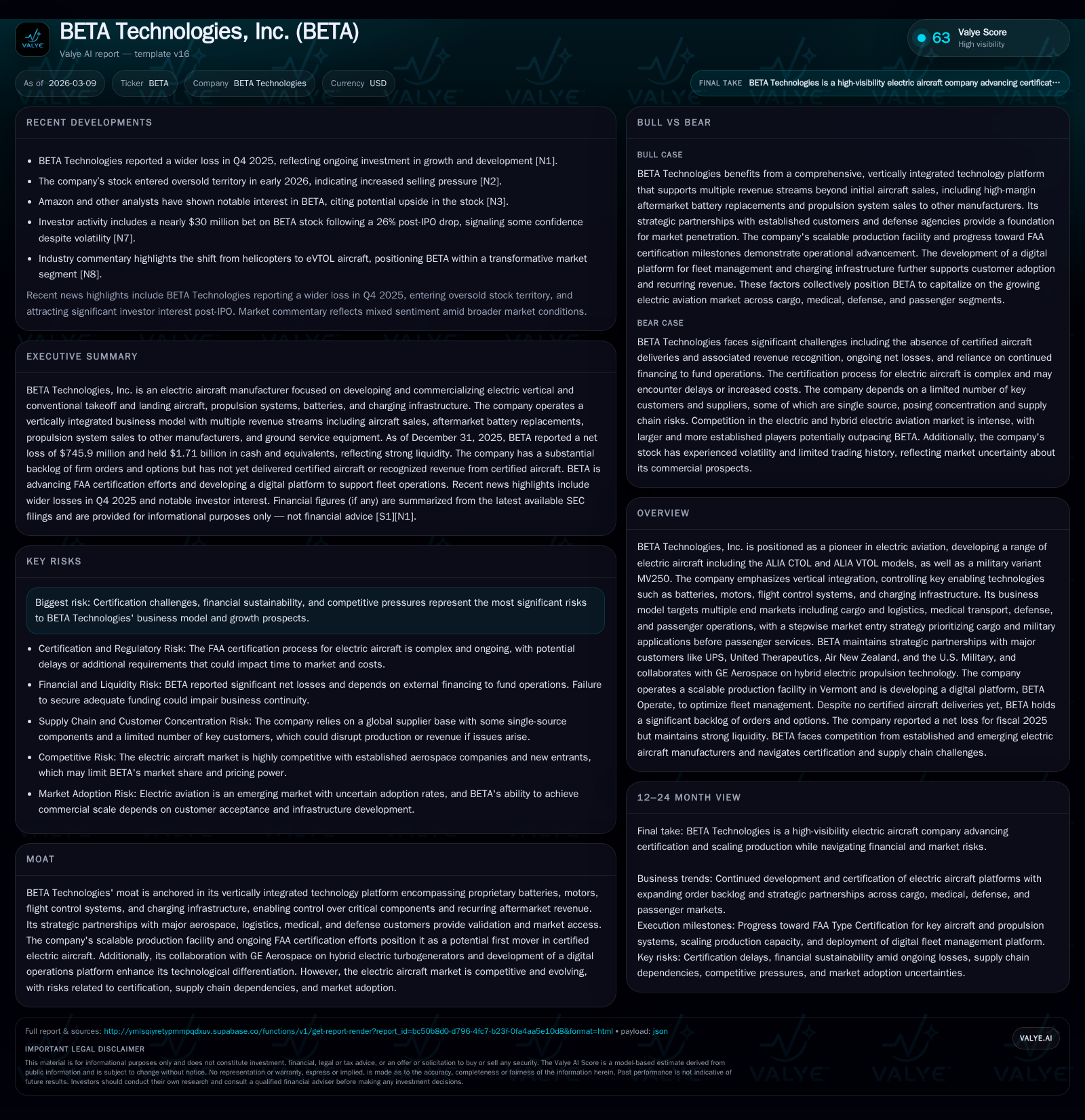
BETA Technologies has emerged as a pioneer in electric aviation, advancing cutting-edge aircraft and propulsion technologies supported by a vertically integrated platform. The company leverages partnerships with major logistics, defense, and medical customers to execute a stepwise market entry focusing initially on cargo and military applications. However, BETA’s ambitious growth is accompanied by significant operating losses, negative free cash flows, and looming certification challenges that pose material risks to its financial sustainability and commercialization timelines. Monitoring milestones such as FAA approvals and backlog conversion will be critical to assessing the maturation of BETA’s commercial prospects.
Tracking BETA’s Growth Trajectory: From Aviation Innovation to Widening Losses
BETA Technologies stands at the forefront of electric aviation innovation with its ALIA CTOL and VTOL platforms alongside military variants. This leadership comes with substantial investment costs reflected in its latest financial performance. In fiscal year 2025, BETA reported an operating loss of approximately $372.7 million and a net loss totaling $745.9 million [F1]. These losses have expanded relative to prior years, highlighting the company's pre-commercial phase marked by heavy R&D, production ramp-up, and certification expenses.
Cash flows from operations remained negative at around $171 million after capital expenditures were considered, resulting in free cash flow deficits nearing $313 million [F1]. Despite these pressures, BETA maintains a strong liquidity buffer with over $1.7 billion in cash and equivalents as of December 31, 2025, giving it runway for ongoing investments though raising fresh capital remains crucial [F1][N1]. The current ratio of nearly 23 further underlines short-term solvency.
Historical performance (annual)
| FY |
|---|
| 2025 |
Source: SEC companyfacts cache [F1].
The widening losses are consistent with BETA's aggressive strategy to dominate the initial stages of electric aircraft commercialization through accelerated development and market positioning rather than near-term profitability.
The Integrated Technology Advantage: Batteries, Motors, and Charging as Differentiators
At the core of BETA’s competitive moat is its vertically integrated technology platform that spans proprietary batteries, motors tailored for aerospace requirements, flight control systems designed specifically for electric aircraft dynamics, and an international charging infrastructure using the CCS-1 standard [S9][S26].
This end-to-end control enables rapid iterative design cycles reducing development costs relative to competitors reliant on third-party components. Moreover, it establishes multiple revenue streams beyond unit aircraft sales by capturing aftermarket opportunities such as battery replacements — expected to exceed initial aircraft sale revenues over a typical 20-year operational life — as well as maintenance services supported by digital monitoring modules within BETA Operate platform [S10][S26].
The modular nature of these enabling technologies also facilitates scalability across different aircraft families currently under development (ALIA CTOL/VTOL/MV250), creating economies of scale that can expand margins once production volume increases significantly.
Market Entry Strategy and Strategic Partnerships: Cargo, Military, and Passenger Expansion
BETA’s commercial approach deliberately phases market entry starting with cargo and logistics customers where electric mission profiles are less complex operationally but offer immediate cost savings — exemplified by partnerships with UPS — followed by military applications through contracts with U.S. Air Force, Army, and Marine Corps units focused on autonomous readiness and mission flexibility [S9][N3].
Medical transport operations form the next tier benefiting from low operating costs suitable for time-sensitive patient transfers, supported by clients such as United Therapeutics and New Zealand Air Ambulance. Finally, passenger services targeted via collaborations like those with Air New Zealand represent longer-term growth opportunities requiring the highest regulatory certifications.
This stepwise market penetration mitigates risk by allowing certification experiences from earlier models to transfer knowledge downstream while progressively unlocking broader addressable markets.
Certification Pathway and Regulatory Hurdles: Impact on Commercialization Timelines
A pivotal milestone for BETA’s commercial success lies in achieving Federal Aviation Administration (FAA) type certifications across its product portfolio. The company targets late 2026 for final civil certification approval yet explicitly discloses inherent schedule risks stemming from evolving regulatory frameworks governing electric propulsion systems [S28][S29].
Certification involves comprehensive demonstration of safety equivalencies for batteries under abnormal conditions, electromagnetic interference resilience in flight control avionics, noise emission compliance particularly for urban vertiports (ALIA VTOL), plus ongoing cybersecurity measures aligned with Department of Defense standards for military variants [S22][S14].
While incremental certifications across models can leverage engineering continuity to reduce documentation burdens with FAA personnel, unpredictable test outcomes or airworthiness concerns remain material risks that could delay commercialization or increase costs dramatically.
Financial Architecture under Pressure: Capital Structure, Cash Burn, and Liquidity Risks
Despite its strong cash reserves exceeding $1.7 billion at fiscal year-end 2025 [F1], BETA faces significant cash burn pressures driven by sizable operating losses compounded by capital expenditures on scaling production capabilities.
Its $170 million credit facility backed by the U.S. Export-Import Bank matures only in December 2038 but imposes restrictive covenants limiting asset disposals or new liens that could hamper operational flexibility or refinancing initiatives if liquidity tightens unexpectedly [S4][S7].
Management acknowledges reliance on equity offerings or additional debt issuances to bridge funding gaps as well as potential leasing arrangements for infrastructure needs including vertiports — none guaranteed or assured at favorable terms given industry cyclicality exacerbated by recent higher global interest rates that dampen funding availability especially for pre-revenue enterprises [S18][N1].
Failure to access capital markets timely could force delays or reductions in R&D programs critical to maintaining technological edge.
Capital Allocation Review: Investments, Operating Cash Flow, and Capital Expenditures
Capital deployment prioritizes research & development alongside building out a highly automated Final Assembly Facility capable of producing up to 300 aircraft annually at maturity located in Vermont — already scaling towards full capacity per internal disclosures [F1][S16][S19].
The absence of dividends or share repurchase programs aligns with growth-stage aerospace technology companies where reinvestment into product innovation and certification efforts typically supersedes distributions to shareholders.
BETA also invests heavily into digital ecosystem development through its "BETA Operate" platform comprising maintenance tracking launched mid-2025 plus forthcoming modules enhancing real-time fleet management reflecting a holistic approach to lifecycle customer engagement [S26].
Forward Outlook: Orders Backlog, Product Launches, and Market Adoption Signals
As of December 31, 2025 BETA maintains a substantial civil aircraft order backlog totaling approximately 891 units valued at $3.47 billion inclusive of firm orders (289 units) plus options (602 units) underpinning future revenue visibility [F1][S9]. This reflects material customer commitment from UPS among others.
Upcoming milestones include FAA certification events expected late 2026 alongside progressive commercial deliveries where the conversion rate from backlog options to firm contracts will serve as key performance indicators moving forward [N3][S28].
Additionally, launch phases of expanded modules within the BETA Operate software suite intended to optimize fleet operations represent further differentiation points supporting aftermarket monetization strategies.
Analyst sentiment improvements following major contract announcements convey cautious optimism tempered by execution uncertainty given sector dynamics [N7][N3].
Risks That Could Compromise Trajectory: Certification Delays, Competitive Dynamics, and Funding Gaps
Significant risk factors delineated in official disclosures underscore exposure to prolonged FAA certification timelines potentially delaying time-to-revenue realization thereby pressuring cash needs beyond current projections [S1][S29].
Competition intensifies from both established aerospace entities such as Textron eAviation and Embraer-backed EVE Air Mobility deploying electric VTOL solutions targeting overlapping use cases threatening customer acquisition momentum [S27].
Intellectual property litigation risks persist given rapidly evolving patent landscapes which may constrain proprietary advantage or lead to costly settlements potentially diverting resources away from core innovation activities [S20].
Financial sustainability remains sensitive to equity/debt market appetite conditions; should capital access deteriorate amid wider macroeconomic stress or investor sentiment shifts towards profitability mandates over growth narratives post-pandemic recovery cycle setbacks may impair execution capability materially.
In conclusion monitoring quarterly delivery cadence versus backlog conversion alongside informed updates on FAA certifications emerges as imperative to gauge whether BETA can surmount inherent hurdles transforming pioneering advancements into sustainable commercial enterprise amid complex aerospace ecosystem challenges.
This report is prepared solely for informational purposes reflecting data including SEC filings and publicly disclosed company statements without providing investment recommendations.
Disclaimer: This is research-only, informational analysis and not investment advice. It may include AI-generated interpretation and general industry context. Always verify important details using primary sources.

Comments