
Repay Holdings Struggles with Falling Profitability and Debt Constraints as Payment Industry Evolves
Repay Holdings faces steep operating losses and restrictive covenants amid regulatory demands and competitive pressures.
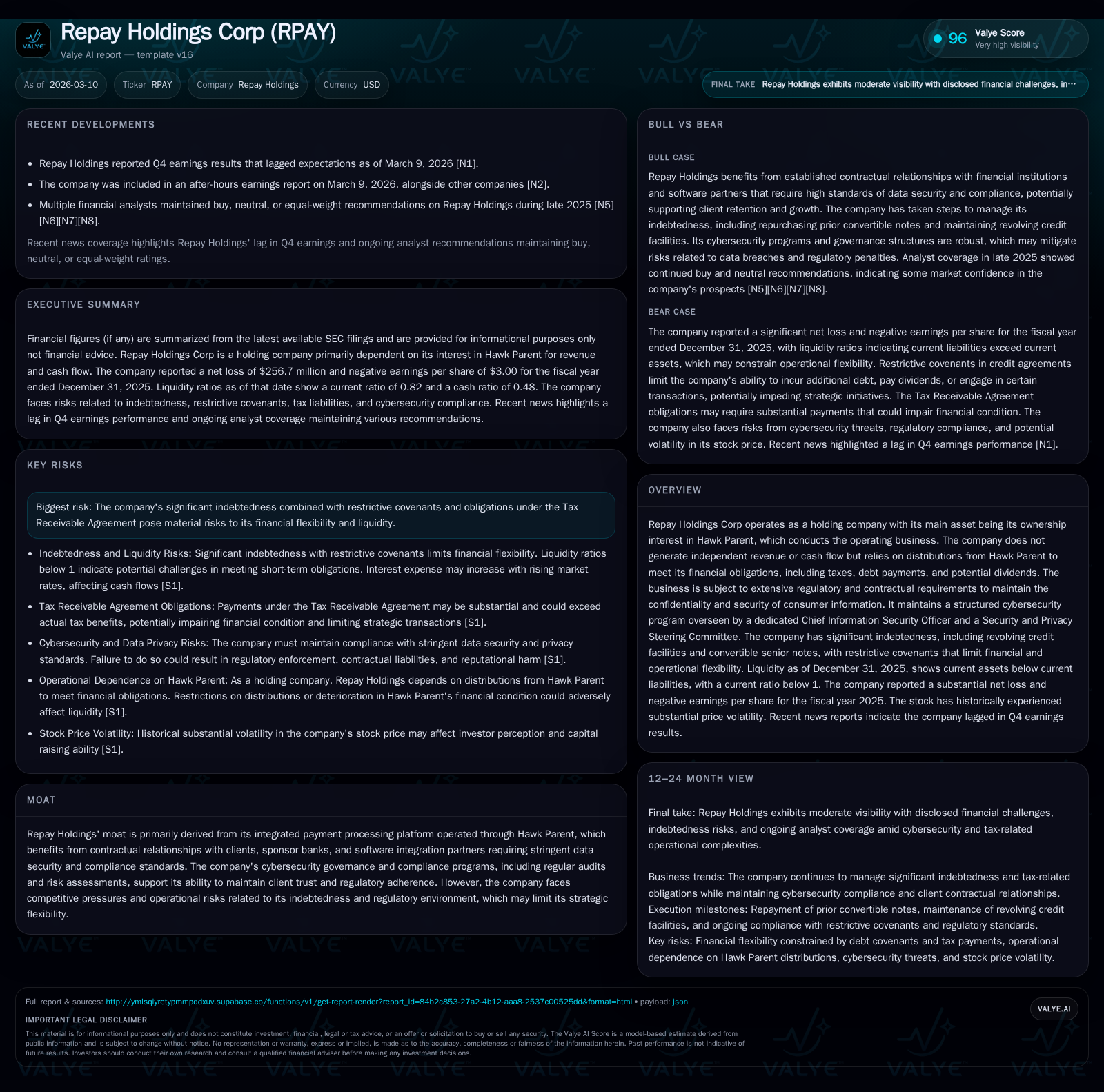
Repay Holdings Corp operates primarily through its subsidiary Hawk Parent, managing an integrated payment processing platform that must navigate stringent cybersecurity and regulatory requirements. The company’s financials reveal deepening operating losses reaching $255 million in 2025, despite strong operating cash flows, underscoring challenges in profitability alongside high leverage. Indebtedness and restrictive debt covenants limit strategic flexibility, while tax-related agreements may further strain liquidity. Going forward, growth depends on client retention under tight compliance regimes, but operational constraints and competitive pressures cast uncertainty on margin recovery.
Business Overview
Repay Holdings Corp functions primarily as a holding company whose main asset is its stake in Hawk Parent, the operating entity. This structure means Repay Holdings itself does not generate independent revenue or cash flow but depends heavily on distributions from Hawk Parent to meet its financial commitments—including taxes, debt service, and any dividends [S17].
Hawk Parent operates an integrated payment processing platform serving clients bound by contracts that require stringent security and confidentiality standards for consumer data. Maintaining compliance with these regulations through independent audits and internal controls is essential for retaining contracts and client trust. Failure here exposes the company to enforcement actions, contractual liabilities, reputational damage, and potential revenue loss [S1][S8].
Financial Performance: Historical View
The company’s financials show escalating operating losses over the last four years:[F1]
Historical performance (annual)
| FY | Net ($mm) | CFO ($mm) | OpInc ($mm) | Capex ($mm) | Net YoY |
|---|---|---|---|---|---|
| 2025 | -257 | 91 | -255 | 0 | -2427.8% |
| 2024 | -10 | 150 | -8 | 1 | +90.8% |
| 2023 | -110 | 104 | -111 | 1 | -960.8% |
| 2022 | 13 | 74 | -47 | 3 |
Source: SEC companyfacts cache [F1].
Capital returns and efficiency (annual)
| FY | Buybacks ($mm) | FCF ($mm) | ROE% |
|---|---|---|---|
| 2025 | 91 | -53.0 | |
| 2024 | 149 | -1.3 | |
| 2023 | 2 | 103 | -13.6 |
| 2022 | 3 | 71 | 1.4 |
Source: SEC companyfacts cache [F1].
Key takeaways:
- Operating income plummeted nearly thirty-twofold from a loss of $7.7 million in FY24 to $255 million loss in FY25.[F1]
- Net losses intensified sharply by over twenty-four times between FY24 and FY25.[F1]
- Despite large non-cash charges affecting profits (details implicit in divergence between net income and CFO), the company maintained positive operating cash flows—though notably lower than the previous year.
- Capital expenditures saw aggressive cuts in FY25 compared to preceding years.
- Equity base contracted substantially from $894 million in FY22 to $484 million in FY25.[F1]
These figures reflect a company enduring severe margin pressure amid either high operating costs or restructuring charges.
Capital Structure and Liquidity Constraints
The company's capital structure is characterized by significant indebtedness including revolving credit facilities expanded to a $250 million limit as of mid-2024 and convertible senior notes maturing in the mid-to-late 2020s. Notably:
- The Second Amended Credit Agreement imposes financial covenants restricting additional debt issuance; dividends; stock repurchases; mergers; asset sales; and investments [S4][S5].
- Convertible senior notes issued include zero-coupon ($440M repaid early except remaining $0 balance after Feb. '26 paydown) and $287.5M at low coupon due in 2029 [S4][S5].
- Liquidity risks stem from obligations to repurchase convertible notes upon certain triggering events like fundamental changes or conversions which may exceed available cash reserves [S14].
- The variable interest expense linked to SOFR exposes financing costs to upward market rate trends [S4].
- If covenant breaches occur or accelerations happen under debt instruments or convertible note indentures due to default events or fundamental changes (such as M&A), liquidity pressure could severely constrict operations or force bankruptcy scenarios [S5][S14].
Current ratio stands below one at approximately 0.82 as of end-2025 indicating short-term liabilities outstrip current assets which flags near-term liquidity tightness[F1].
Tax Receivable Agreement Impact
Repay Holdings is subject to a Tax Receivable Agreement (TRA) requiring it to pay unitholders a share of the tax benefits related to basis step-ups resulting from exchanges of Post-Merger Repay Units into Class A common stock. This arrangement can materialize into sizable payments that reduce available cash flow post-tax reductions:
- Payments are obligations independent of Hawk Parent’s tax liabilities but tied directly to realized tax benefits.
- TRA payments could exceed actual realized tax savings if assumptions prove optimistic or if accelerated by events such as insolvency or changes of control [S7][S15][S26].
- These liabilities may inhibit strategic transactions like mergers or sales due to resulting accelerated cash outflows. [...]
Operational Risk Profile: Compliance & Cybersecurity
Regulatory compliance is central given the sensitive financial data the company processes. Hawk Parent's contracts with sponsor banks and integration partners demand rigorous confidentiality adherence backed by periodic independent audits [S1][S8].
Failure in compliance could lead not only to monetary penalties but also loss of client trust critical for client retention or acquisition. The company actively manages cybersecurity risk through:
- A Security Incident Response Plan (SIRP), regular penetration testing,
- Structured cybersecurity governance featuring a Chief Information Security Officer directly accountable for cyber risk management,
- A Security and Privacy Steering Committee comprising members from legal compliance to finance ensuring cross-functional oversight,
- Ongoing employee training programs emphasizing security awareness,
- Utilization of external managed security providers for control assessments. These efforts reflect sector best practices aiming to mitigate both reputational damage risks and financial settlements potentially arising from data breaches [S20][S22][S23].
Industry Context Analysis
The payment processing industry contends with rapid technological integration into points of sale combined with evolving regulatory demands on data privacy (e.g., PCI DSS standards), forcing constant systems upgrades which impose cost pressure. Competitors often leverage scale advantages translating into thinner margins for smaller operators. Moreover fluctuating interest rates affect financing costs for platforms weighted by leverage.
Future Growth Prospects & Outlook Analysis
Though explicit guidance is unavailable,[N1] future growth drivers may include expansion through new client acquisitions enabled by integration partnerships—assuming continued regulatory compliance success—and operational improvements leveraging positive operating cash flows.
However several constraints loom:
- Operating losses highlight profitability challenges possibly tied to integration costs or pricing competition.
- Heavy debt burden restricts financing flexibility needed for scaling or opportunistic investments.
- Tax Receivable Agreement obligations create contingent liquidity demands.
- Competitive industry dynamics favoring scale players could cap market share gains.
These tradeoffs define a cautious outlook where profitability restoration must coincide with sustained compliance amid limited operational freedom due to debt covenants.
Capital Allocation & Returns Dynamics
Repay Holdings has historically engaged lightly in share repurchases but does not currently declare dividends given its negative earnings trend and liquidity considerations.[F1][S7]The board retains discretion over any future dividend declarations which remain uncertain amidst restrictive financial covenants limiting distributions[S24].
Free cash flow calculated as operating cash flow minus capex remained positive at approximately $90.8 million for FY2025 — evidence of internal cash generation capability despite losses — albeit possibly earmarked largely towards debt servicing given high leverage[S7][F1]. Return on equity approximates negative fifty-three percent driven largely by net losses offsetting equity base[F1], flagging shareholder return challenges.
Going forward monitoring will center on quarterly operating results showing margin improvement signs; covenant compliance developments; management commentary regarding capital allocation priorities including potential debt reduction versus shareholder returns; and regulatory updates affecting compliance costs.
This analysis synthesizes recent SEC filings up through March 9th, 2026 along with latest reported full-year financials[F1] supplemented by contemporaneous news coverage, aiming solely at providing an informed assessment without offering investment advice.
Disclaimer: This is research-only, informational analysis and not investment advice. It may include AI-generated interpretation and general industry context. Always verify important details using primary sources.

Comments