
Tenaya Therapeutics’ Gene Therapy Path to Address Cardiovascular Disease Impact
Early-stage Tenaya pursues innovative cardiovascular gene therapies while managing capital and developmental risks.
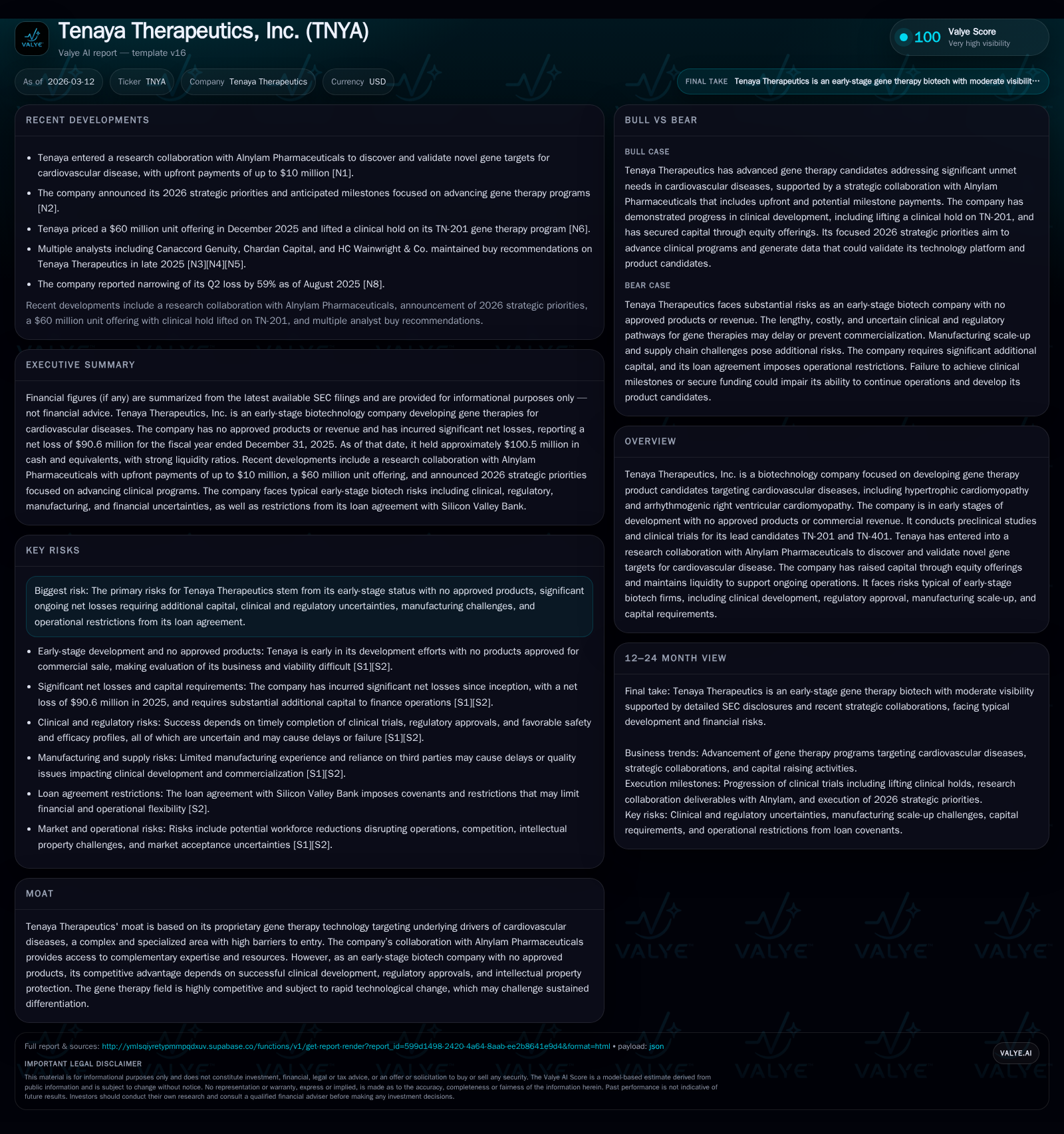
Tenaya Therapeutics is an emerging biotech company focused on gene therapy candidates targeting complex genetic cardiovascular diseases such as hypertrophic and arrhythmogenic right ventricular cardiomyopathies. The company remains pre-revenue, incurring significant net losses that have moderately improved in recent years alongside controlled cash burn. Its pipeline centers on TN-201 and TN-401, advanced through preclinical to early clinical stages, complemented by a newly announced collaboration with Alnylam Pharmaceuticals to leverage RNA interference expertise for novel target discovery. Despite robust liquidity and strategic partnerships, Tenaya faces substantial regulatory, manufacturing scale-up, and capital financing risks typical of gene therapy developers. Ongoing milestones, regulatory progress, and funding rounds will be critical to monitor.
Historical Financial Performance: Progress Amid Ongoing Losses
Tenaya Therapeutics operates as an early-stage clinical biotech without approved products or commercial revenue streams. Its financials from FY2022 through FY2025 reflect a pattern common among gene therapy startups: substantial operating losses gradually improving amid persistent cash burn.
Annual operating income deficits narrowed from approximately -$125.6 million in FY2022 to -$93.3 million in FY2025, representing a 19.5% year-over-year improvement from the prior fiscal year [F1]. Net income losses similarly improved by roughly 18.5%, reaching -$90.6 million in FY2025 [F1]. These trends suggest disciplined cost management alongside advancing development efforts.
Operating cash flows remain negative but improved by about 24.6% from the prior fiscal year to -$68.3 million annually [F1], reflecting continued investment in pipeline expansion and clinical programs.
Capital expenditures have declined sharply since FY2022—from over $20 million down to roughly $618,000 in FY2025—indicating a shift away from fixed asset investment toward research-focused spending [F1].
Historical performance (annual)
| FY | Net ($mm) | CFO ($mm) | OpInc ($mm) | Capex ($mm) | Net YoY |
|---|---|---|---|---|---|
| 2025 | -91 | -68 | -93 | 1 | +18.5% |
| 2024 | -111 | -91 | -116 | 1 | +10.4% |
| 2023 | -124 | -102 | -131 | 1 | -0.3% |
| 2022 | -124 | -104 | -126 | 21 |
Source: SEC companyfacts cache [F1].
Capital returns and efficiency (annual)
| FY | FCF ($mm) | ROE% |
|---|---|---|
| 2025 | -69 | -73.5 |
| 2024 | -92 | -119.7 |
| 2023 | -103 | -89.0 |
| 2022 | -125 | -50.8 |
Source: SEC companyfacts cache [F1].
Note: All figures sourced from [F1]; OpInc = Operating Income; YoY comparisons are sequential fiscal years.
Pipeline Focus: TN-201 and TN-401 Preclinical and Clinical Development
Tenaya’s therapeutic focus is on gene therapy vectors addressing genetic cardiovascular diseases characterized by structural heart abnormalities — specifically hypertrophic cardiomyopathy (HCM) and arrhythmogenic right ventricular cardiomyopathy (ARVC). These monogenic disorders often resist conventional treatments due to complex molecular mechanisms.
TN-201 is the lead candidate progressing through preclinical efficacy studies and early-phase clinical trials evaluating safety, biodistribution of viral vectors, and biomarker validation critical for regulatory engagement [S1][S2][N1]. TN-401 targets complementary pathways implicated in ventricular arrhythmias.
Both utilize proprietary adeno-associated virus (AAV)-based constructs engineered for cardiac tissue specificity—a challenge given vector tropism and immune clearance mechanisms affecting durable gene expression in myocardium cells [S1]. Clinical endpoints remain exploratory due to the novelty of these mechanisms.
Strategic Collaboration with Alnylam Pharmaceuticals: Leveraging RNAi Expertise
A recent collaboration with Alnylam Pharmaceuticals aims to accelerate novel gene target discovery using RNA interference (RNAi), complementing Tenaya’s gene replacement approach [N1]. The agreement includes potential upfront payments up to $10 million, supporting liquidity while sharing research costs.
Alnylam’s RNAi expertise complements Tenaya’s AAV-mediated strategies by enabling co-development opportunities that may optimize therapeutic effects or address overlapping pathogenic pathways [S1]. This partnership mitigates some development risk by diffusing costs and broadening intellectual property potential.
Regulatory and Clinical Development Risks Specific to Cardiovascular Gene Therapies
Regulatory pathways remain nascent for cardiovascular gene therapies compared with other fields like oncology or hematology. FDA requirements for Chemistry, Manufacturing, and Controls (CMC) scale-up pose bottlenecks due to complex viral vector production demands including purity, potency, stability, and batch consistency [S4][S6][S9].
Clinical trial enrollment challenges stem from the rarity of targeted cardiomyopathies requiring multicenter international studies for statistical power [S4]. Outcome measures rely heavily on surrogate biomarkers pending validation of clinical endpoints such as mortality or hospitalization rates.
Post-approval pricing and reimbursement uncertainties exist amid evolving specialty drug pricing regulations including Medicaid Drug Rebate changes and Medicare negotiation provisions outlined in recent healthcare reforms [S9][S18].
Capital Structure, Cash Position and Liquidity Outlook
As of December 31, 2025, cash and equivalents totaled approximately $100.5 million with current assets near $105.6 million against current liabilities around $15.4 million yielding a strong current ratio of about 6.8 — indicating solid near-term liquidity under typical operations [F1]. Equity stood at approximately $123 million reflecting capital raised primarily through equity financings [F1].
The company is subject to loan covenants under its agreement with Silicon Valley Bank that restrict financing flexibility including limits on additional indebtedness, asset disposals, dividends, or share repurchases [S13][S14]. Compliance with these covenants is critical to avoid default risks impacting working capital availability.
Operating Cash Flows and Capital Expenditure Trends Reflect Investment Priorities
Operational cash flow remains negative but shows improvement of nearly 25% YoY from approximately -$90.5 million in FY2024 to about -$68.3 million in FY2025 reflecting effective cash burn control tied closely to R&D progress [F1].
Minimal capital expenditures — less than $1 million annually post-FY2022 — underscore prioritization of consumable research inputs over fixed assets amid dynamic experimental protocols requiring frequent technology refreshes rather than facility expansion [F1].
Equity Growth, Buybacks, and Implications for Shareholder Returns
Equity increased from roughly $92.9 million in FY2024 to $123.3 million in FY2025 indicating successful capital raises primarily via stock issuances given restrictive loan covenants limiting debt use [F1]. No share repurchases occurred during these periods highlighting emphasis on preserving runway rather than returning capital to shareholders.
Return on equity remains negative at about -73.5%, consistent with early-stage biotech investment profiles where heavy losses continue until commercial scalability is achieved [F1]. This underscores expectations of investor patience tied more directly to scientific milestones than near-term profitability.
What to Monitor Ahead: Milestones, Approval Pathways, and Capital Needs
Key upcoming developments include progression milestones for TN-201 into later-stage clinical trials assessing safety/tolerability data essential for regulatory submissions [N1][S3]. Outcomes from the Alnylam collaboration may reveal novel product opportunities underpinning longer-term pipeline expansion.
Capital market activities warrant close attention as sustained negative free cash flow implies ongoing reliance on fundraising or partnerships beyond existing liquidity—delays or unfavorable terms could impede development timelines or dilute shareholder value [F1][N1]. Regulatory agency interactions shaped by evolving drug approval frameworks may significantly affect go-to-market timing.
Ultimately Tenaya balances scientific promise against typical biotech scalability hurdles requiring prudent financial stewardship coupled with successful translational progress within an environment of considerable technological novelty and regulatory complexity.
Disclaimer: This is research-only, informational analysis and not investment advice. It may include AI-generated interpretation and general industry context. Always verify important details using primary sources.

Comments