
Serve Robotics' Scale-Up Challenges and Acquisition-Driven Growth Prospects in Specialty Industrial Robotics
Serve Robotics advances autonomous delivery with AI-enabled robots amid escalating losses and evolving healthcare deployments.
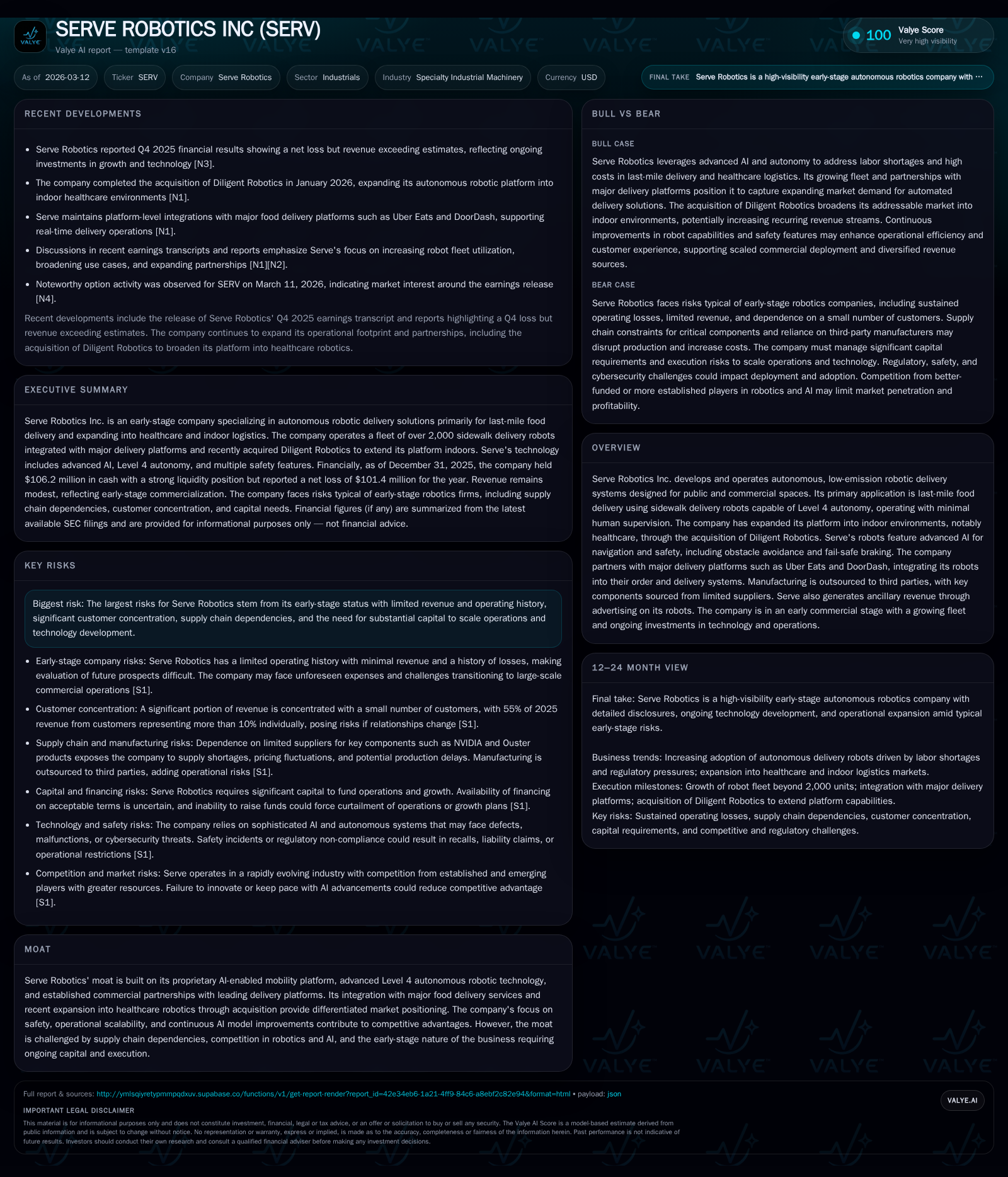
Serve Robotics Inc. operates at the forefront of autonomous sidewalk delivery robots focused on last-mile food delivery integrated with major platforms like Uber Eats and DoorDash. Despite revenue growth, the company remains in an early-stage commercial phase burdened by mounting operating losses and significant cash burn driven by R&D expansion and capex increases. The recent acquisition of Diligent Robotics marks a strategic pivot toward indoor healthcare applications, broadening Serve’s addressable market but also introducing new regulatory complexities. Key risks include supply chain constraints, concentrated customer revenues, and technological execution amid intensifying competition in AI and robotics.
Company Overview and Historical Performance
Serve Robotics Inc., originally spun out from Postmates' robotics project post-2021 Uber acquisition, crafts advanced Level 4 autonomous delivery sidewalk robots predominantly tailored for last-mile food deliveries.
Though the company reported nominal top-line revenue—$207,545 in calendar year 2023 [F1]—the business remains embryonic commercially, reflected in sizeable operating deficits that escalated from approximately -$20.7 million in 2023 to a dramatic -$112.8 million in 2025 [F1]. Correspondingly, net losses ballooned from -$24.8 million (2023) to -$101.4 million (2025), illustrating heavy reinvestment into R&D, scaling costs, and operational expansion.
Operating cash flow followed suit, worsening to -$80.2 million by end-2025 from -$15.97 million three years earlier, while capital expenditures accelerated sharply to $37.3 million in 2025 [F1], indicating substantive investment in hardware deployment and systems infrastructure crucial for fleet expansion.
Historical performance (annual)
| FY | Net ($mm) | CFO ($mm) | OpInc ($mm) | Capex ($mm) | Net YoY |
|---|---|---|---|---|---|
| 2025 | -101 | -80 | -113 | 37 | -158.6% |
| 2024 | -39 | -22 | -38 | 10 | -57.9% |
| 2023 | -25 | -16 | -21 | 0 | -48219.0% |
| 2022 | 0 | 0 | 0 |
Source: SEC companyfacts cache [F1].
Capital returns and efficiency (annual)
| FY | FCF ($mm) | ROE% |
|---|---|---|
| 2025 | -118 | -28.9 |
| 2024 | -32 | -29.8 |
| 2023 | -16 | 615.2 |
| 2022 | 41.6 |
Source: SEC companyfacts cache [F1].
Revenue shown only for FY23 as available; margins reflect early-stage scale-up costs.
Technology and Market Positioning
Serve’s products are unique among specialty industrial machinery through their focus on public sidewalks with low-emission Level 4 autonomous mobility powered by proprietary AI enabling robust obstacle avoidance and fail-safe mechanisms [S1]. The platform integrates deeply with leading food delivery marketplaces such as Uber Eats and DoorDash providing seamless order processing and real-time telematics data exchange.
The company has leveraged these synergies into an expanding commercial deployment exceeding a fleet size of 2,000 units by the end of 2025 [S1], underscoring operational traction despite continuing high fixed costs.
A pivotal development is the January 2026 acquisition of Diligent Robotics—an indoor healthcare-focused AI robotic assistant developer—which strategically extends Serve's footprint beyond outdoor food delivery into regulated hospital environments [S1]. This diversification enhances future total addressable market but introduces new challenges around healthcare compliance (HIPAA/HITECH-related) and operational safety standards [S6][S12][S25].
Growth Drivers and Opportunities
Serve’s growth potential hinges on several vectors:
- Platform Expansion: Scaling existing sidewalk robot deployments into new metropolitan areas under evolving pilot regulatory frameworks (e.g., Chicago, Los Angeles) presents significant upside [S19].
- Vertical Diversification: Healthcare robotics post-Diligent acquisition opens access to hospital logistics markets where labor shortages intensify demand for automation [S1].
- Ancillary Revenue Streams: Emerging monetization via onboard robot advertising leverages deployed assets without incremental operational overheads [S1].
- AI Evolution: Continuous improvements in AI navigation software aim to reduce human oversight costs per unit, enhancing margin potential [S1][S24].
Nonetheless, expansion is tempered by regulatory uncertainty around municipal personal delivery device licensing regimes that often require pilot approvals before full commercialization [S19], significant supply chain dependencies—most critically semiconductors—that could increase component lead times or costs [S18], as well as risks stemming from substantial customer concentration where a handful generate over half of revenues [S26].
Financial Outlook and Expectations
The company provided no explicit forward guidance post-2025 results disclosed on March 11, 2026 [N1][N3]. However, key milestones to monitor include:
- Fleet size growth trajectory beyond current ~2,000 units;
- Integration success metrics from Diligent Robotics acquisitions including new contracts within hospital networks;
- Progression towards improved operating leverage reflected in reduced quarterly operating losses;
- Development of recurring revenue streams outside core delivery fees such as data licensing or advertising;
- Regulatory clearances facilitating broader market entry.
From an analytical standpoint, watch for shifts in revenue composition versus cost base expansions given intense R&D and capex spending inherent at this scale.
Capital Allocation and Returns Analysis
Despite lack of profitability to date—with approximate return on equity near -28.9% based on net loss relative to equity base at end-2025—the company maintains a strong liquidity position with $106 million cash plus equivalents on hand [F1]. This liquidity buffer is critical given negative free cash flow approximated at -$117.6 million (operating cash flow minus capex) for fiscal year 2025 alone.
No dividends or share buybacks have been declared or indicated according to latest SEC reports or earnings releases [N1][S1]. Capital is being prioritized towards product development, scaling fleet operations, geographic expansion, and financing strategic acquisition integration.
Risks and Industry Challenges
A comprehensive risk framework emerges from SEC filings emphasizing:
- Early-stage commercial status presenting revenue predictability challenges;
- Customer concentration risk heightening exposure to contract renewals or changes [S18];
- Supply chain fragility especially concerning chip shortages or manufacturing partner reliability impacting production cadence [S18];
- Regulatory hurdles encompassing personal delivery device permits, FCC wireless spectrum compliance for robot telemetry systems, lithium-ion battery transport regulations affecting logistics [S19];
- Heightened cybersecurity risks related to AI use internally and potential data leaks affecting intellectual property or patient health information compliance under HIPAA/HITECH laws [S14][S15][S12];
- Competitive pressures from well-funded robotics and AI firms potentially eroding market share or shortening product life cycles [S24];
- Environmental regulations increasing energy input costs or imposing product design constraints amid tightening global climate policies [S4];
- Technological risks including product recalls stemming from defects or malfunctions leading to personal injury claims could materially damage reputation [S27].
Conclusion and Forward Look
Serve Robotics stands at an inflection point typifying deep-tech startups navigating path-to-scale amidst technological promise balanced against capital intensity and regulatory complexity typical of specialty industrial machinery innovators pushing autonomy boundaries.
The company's historical financials demonstrate substantial ongoing investment required to develop robust robotic fleets supported by advanced AI tightly integrated with ecosystem partners—a differentiating factor boosting entry barriers but demanding patient capital.
Strategic expansion into indoor healthcare robotics via acquisition diversifies opportunities but also amplifies compliance burdens that could influence deployment speed.
Key indicators for analysts will be Serve’s ability over the coming quarters/years to grow recurring revenues meaningfully beyond pilot phases while bending cost curves through operational efficiencies and further automation refinement.
Continuous monitoring of regulatory developments governing personal delivery devices will be essential given their outsized impact on market accessibility.
The company's liquidity profile presently supports its aggressive growth agenda; however, sustained negative free cash flow underscores reliance on external funding aligned with scaling milestones.
This analysis synthesizes publicly available data as of March 12, 2026, combining SEC filings (notably the Form 10-K), earnings transcripts, Nasdaq news articles, and financial statement extracts without providing direct investment recommendations.
Disclaimer: This is research-only, informational analysis and not investment advice. It may include AI-generated interpretation and general industry context. Always verify important details using primary sources.

Comments