
Trinseo’s Transformation: Specialty Materials Strategy Under Financial Strain
Trinseo PLC pursues a pivot to specialty and sustainable materials while grappling with distressing leverage and liquidity challenges.
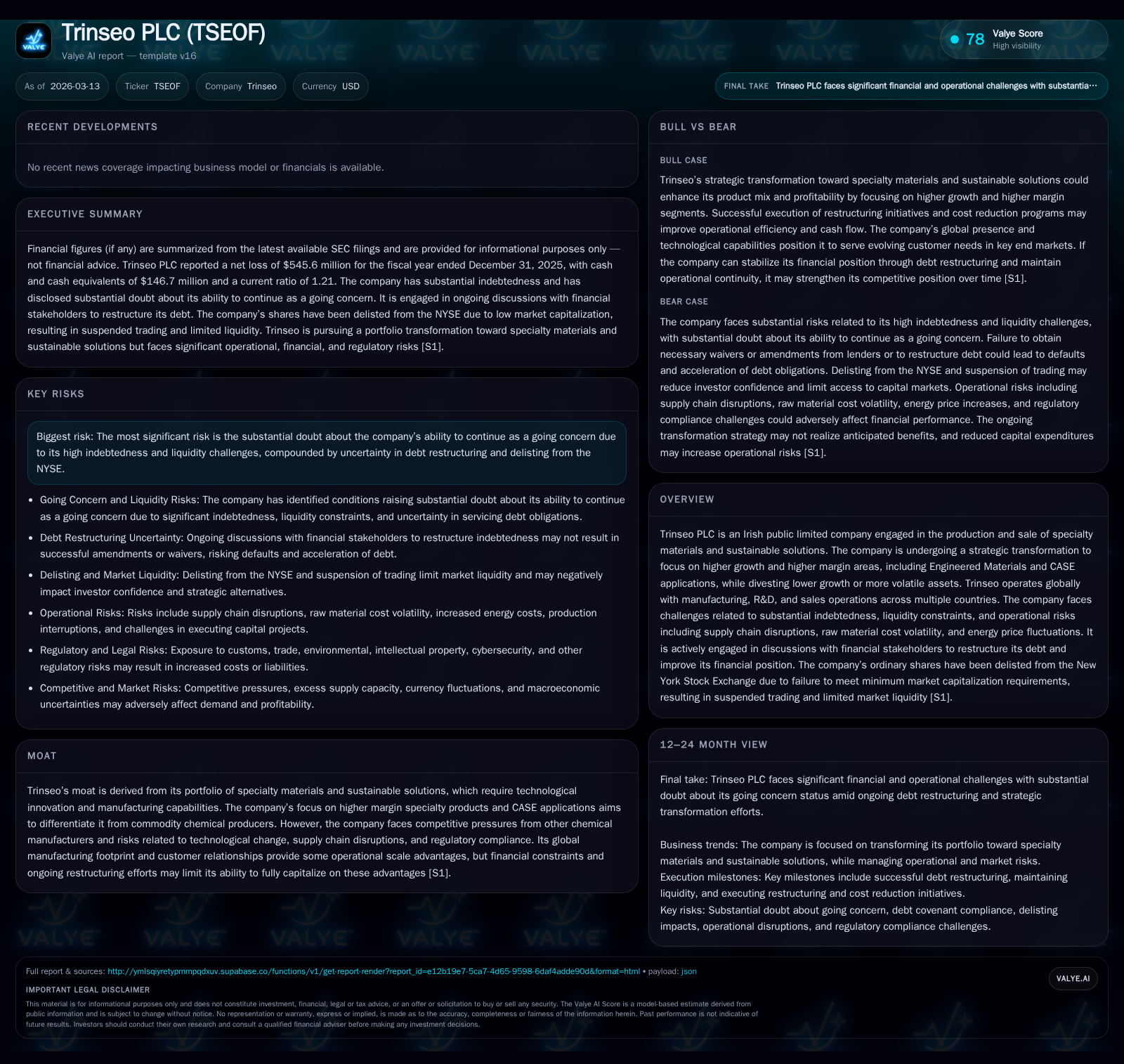
Trinseo PLC is undertaking a strategic shift to focus on higher-growth, higher-margin specialty materials and CASE applications amid significant operating losses, deteriorating cash flows, and a strained capital structure. The company faces restrictive debt covenants and upcoming grace period expirations that threaten liquidity stability. Environmental regulations and compliance costs add operational pressures. Dividend payments have been sharply reduced, and share repurchases halted as capital allocation prioritizes liquidity preservation. Key near-term milestones include creditor negotiations on restructuring and asset divestitures.
Historical Performance: Mounting Losses Amid Volatile Market Conditions
Trinseo's financial results through FY2025 demonstrate significant operational challenges. Operating income deteriorated from a loss of $46 million in FY2024 to a loss of $254.2 million in FY2025, a decline of approximately 452.6% year-over-year [F1]. Net losses expanded from $348.5 million to $545.6 million (-56.6% YoY) in the same period [F1].
Operating cash flow also turned sharply negative at -$102.4 million in FY2025 compared to -$14.2 million in the prior year [F1]. This reflects pressures on working capital amid supply chain disruptions and raw material cost volatility noted in regulatory disclosures [S1]. Capital expenditures declined nearly 20%, from $63.3 million in FY2024 to $51 million in FY2025 [F1], indicating constrained reinvestment capacity.
Historical performance (annual)
| FY | Net ($mm) | CFO ($mm) | OpInc ($mm) | Capex ($mm) | Net YoY |
|---|---|---|---|---|---|
| 2025 | -546 | -102 | -254 | 51 | -56.6% |
| 2024 | -348 | -14 | -46 | 63 | +50.3% |
| 2023 | -701 | 149 | -455 | 70 | -62.8% |
| 2022 | -431 | 44 | -364 | 148 |
Source: SEC companyfacts cache [F1].
Capital returns and efficiency (annual)
| FY | Div ($mm) | Buybacks ($mm) | FCF ($mm) |
|---|---|---|---|
| 2025 | 1 | -153 | |
| 2024 | 2 | 152 | -77 |
| 2023 | 18 | 152 | 79 |
| 2022 | 48 | 152 | -105 |
Source: SEC companyfacts cache [F1].
Data sourced from latest SEC filings [F1].
Strategic Pivot Toward Specialty Materials and CASE Applications
Trinseo is executing a strategic transformation to reposition its portfolio toward specialty materials and sustainable solutions, focusing on Engineered Materials and CASE (Coatings, Adhesives, Sealants, Elastomers) segments which typically offer higher margins and less earnings volatility [S1][S15].
This involves divesting more cyclical commodity assets such as synthetic rubber businesses and proprietary polycarbonate manufacturing operations [S18]. Sustainability initiatives include developing recycled-content products aligned with evolving regulatory frameworks targeting plastic waste reduction [S1]. These shifts occur amid ongoing operational risks including energy cost fluctuations and supply chain disruptions.
Debt Burden and Liquidity Constraints Impact Operational Flexibility
The company's capital structure is heavily leveraged with multiple secured credit facilities containing restrictive covenants limiting asset sales, incurrence of additional debt, dividend payments upstream, investments, liens, share repurchases, mergers or significant business changes without lender approval [S5].
Interest payment grace periods on key credit tranches were extended through March 19, 2026; failure to make payments thereafter would trigger defaults potentially accelerating repayment obligations across various facilities including the Senior Credit Facility, Refinancing Notes due 2028/2029, OpCo Revolver, and receivables securitization facility [S4][S8][S18][S19]. Cross-default provisions amplify liquidity risk.
Management has engaged advisors and appointed board members with restructuring expertise to negotiate amendments or waivers with lenders while exploring consensual or court-supervised restructurings that could include exchanging existing debt for new debt or equity securities [S8]. Failure to secure consents or alternative financing could materially impair liquidity.
Capital Structure Restrictions and Restructuring Outlook
Current credit ratings near the lower end of rating scales limit financial flexibility by increasing borrowing costs and restricting access to capital markets [S4]. Debt covenants impose operational constraints requiring lender consent for significant transactions including asset dispositions necessary for portfolio reshaping.
Potential restructuring approaches range from out-of-court consensual agreements to formal insolvency proceedings depending on creditor negotiations [S8]. Recent board appointments highlight management’s focus on securing sustainable capital structures amid high uncertainty.
Profitability Pressures Amid Raw Material Inflation and Competitive Environment
Profitability challenges stem largely from raw material cost inflation for inputs such as acrylonitrile, styrene monomers, bisphenol-A, coupled with energy cost pass-through limitations [S1][S15][S21]. Pricing competition intensifies particularly from Asian commodity producers with excess capacity. Supply chain bottlenecks further erode margins by disrupting production schedules.
Free cash flow was substantially negative in FY2025 (approximately -$153.4 million calculated as operating cash flow minus capex), underscoring liquidity pressures amid deteriorating earnings quality [F1].
Increasing Environmental Compliance Costs Impacting Margins
As a global chemical manufacturer, Trinseo faces extensive environmental health and safety regulations that have tightened over time requiring increased compliance expenditures including investments in pollution control technologies [S7][S9].
Regulatory trends targeting plastic waste reduction such as single-use plastic bans contribute additional fixed costs reducing margin flexibility [S7][S11]. These factors add operational burdens amid volatile raw material pricing.
Key Upcoming Milestones: Debt Restructuring and Asset Divestitures
- Interest payment grace periods expire March 19th, 2026; failure may trigger defaults leading to immediate repayment demands or collateral enforcement risking operational continuity [S8][S18].
- Progress on divesting styrenics businesses including Americas Styrenics remains critical; successful transactions could improve liquidity but depend on market conditions and regulatory approvals [S15][S18].
- Potential equity dilution may arise if new equity securities are issued as part of any debt restructuring agreements negotiated with creditors [S8].
- Monitoring amendment waiver procurements across debt facilities will provide insight into covenant relief feasibility impacting short-term viability.
Capital Allocation: Dividend Curtailment, Capex Reduction & Buyback Suspension
Reflecting constrained free cash flow generation under heavy debt service demands, dividend payments have fallen sharply from $47.5 million in FY2022 to approximately $1.2 million in FY2025 [F1], signaling prioritization of liquidity preservation.
Share repurchase programs have been suspended following prior buybacks totaling nearly $152 million annually through FY2023 no longer maintained post-financial distress onset [F1]. Reduced capital expenditures align with this preservation strategy though may impact long-term competitive positioning.
This analysis integrates quantitative data from recent SEC filings with qualitative insights from disclosed risk factors outlining Trinseo’s strategic pivot amid severe financial stress through early 2026. No explicit forward guidance was provided; close monitoring of liquidity metrics, covenant compliance developments, restructuring progress, and transaction milestones is advised.
Disclaimer: This report is for informational purposes only without constituting investment advice or recommendations regarding Trinseo PLC securities or related financial instruments.
Disclaimer: This is research-only, informational analysis and not investment advice. It may include AI-generated interpretation and general industry context. Always verify important details using primary sources.

Comments