
Asana, Inc.: Integrating AI and Human Collaboration to Drive Enterprise Work Management
Asana’s proprietary Work Graph® platform uniquely orchestrates human and AI workflows, supporting growth despite competitive and profitability challenges.
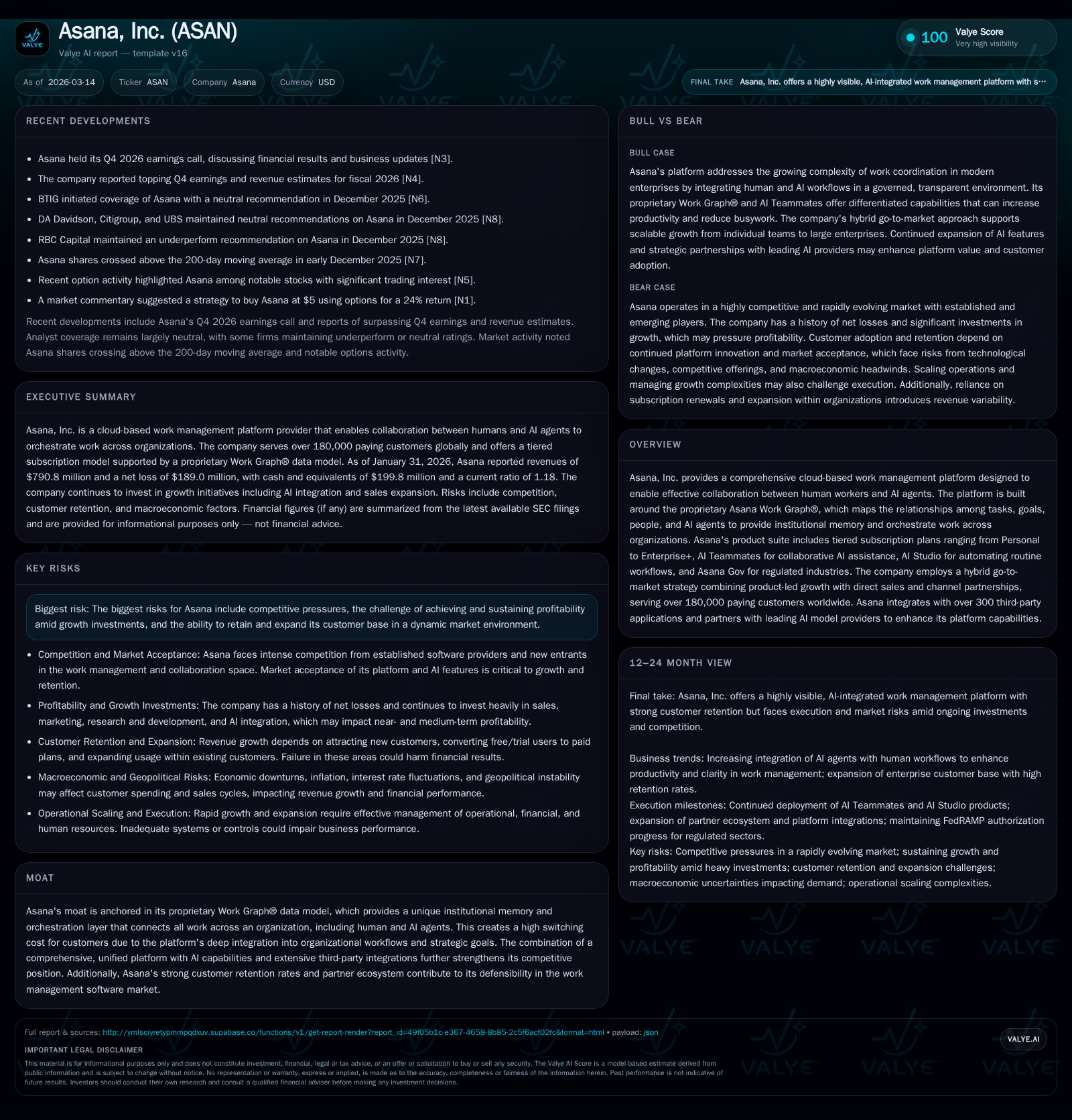
Asana, Inc. has steadily narrowed its operating losses over the past four fiscal years while transforming its cash flow profile from negative to strongly positive in FY2026. This improvement is largely underpinned by the company’s innovative Work Graph® data model which embeds institutional memory across tasks and AI agents, driving high platform stickiness and a dollar-based net retention rate near 97% among core customers. The product suite’s recent expansion with AI Teammates and AI Studio reflects a hybrid go-to-market motion combining bottom-up adoption with direct sales and channel partnerships. Despite robust free cash flow generation and sizeable stock buybacks in FY2026, margin expansion remains constrained by investments in growth and rising global regulatory compliance costs. Key metrics to watch going forward include sustained revenue acceleration, further integration of AI capabilities, and expanding partner ecosystem scale.
Historical Growth Trajectory and Operating Performance
Asana’s financial trajectory over the past four years shows a clear pattern of improving operating efficiency amidst ongoing investment in product innovation and market expansion. Operating income losses narrowed from -$407.8 million in FY2023 to -$197.3 million in FY2026, marking a roughly 26% year-over-year improvement between FY2025 and FY2026 [F1]. Net losses followed suit, decreasing from -$407.8 million in FY2023 to -$189.0 million most recently.
A striking feature is the transition of operating cash flows (CFO) from deeply negative figures (-$160 million in FY2023) to positive territory at $90.4 million in FY2026—a more than fivefold increase relative to the prior year ($14.9 million in FY2025). This inflection reflects stronger cash collection efficiency from subscriptions alongside disciplined expense management [F1][S1]. Capital expenditures fell by nearly 32% year-over-year to $3.8 million as Asana rationalized spending following earlier platform buildout phases.
The company’s current ratio stood at approximately 1.18x as of January 31, 2026, underlining stable short-term liquidity [F1]. These shifts portray a SaaS firm moving toward sustainable operational footing while balancing growth priorities.
Historical performance (annual)
| FY | Net ($mm) | CFO ($mm) | OpInc ($mm) | Capex ($mm) | Net YoY |
|---|---|---|---|---|---|
| 2026 | -189 | 90 | -197 | 4 | +26.0% |
| 2025 | -256 | 15 | -267 | 6 | +0.6% |
| 2024 | -257 | -18 | -270 | 8 | +37.0% |
| 2023 | -408 | -160 | -408 | 5 |
Source: SEC companyfacts cache [F1].
Capital returns and efficiency (annual)
| FY | Buybacks ($mm) | FCF ($mm) | ROE% |
|---|---|---|---|
| 2026 | 132 | 87 | -122.6 |
| 2025 | 78 | 9 | -112.3 |
| 2024 | 0 | -26 | -78.7 |
| 2023 | 0 | -165 | -114.4 |
Source: SEC companyfacts cache [F1].
Note: Operating income YoY % represents decline in losses year-over-year.
The Power of the Proprietary Work Graph® in Customer Retention and Expansion
Asana’s moat is heavily anchored by its patented Work Graph®, a dynamic relational data model that connects goals at strategic levels down through cross-functional projects and individual tasks — integrating both humans and AI agents participating in workflows [S4]. This approach creates what could be described as an institutional memory that institutionalizes organizational knowledge about "Who does What by When and Why," binding work processes tightly into Asana’s platform architecture.
This embedded dependency significantly raises switching costs by making alternatives costly and disruptive to established workflows featuring integrated automation via AI agents such as AI Teammates.
Quantitatively this strength manifests as compelling dollar-based net retention rates: core customers spending above $5K annually retained at an impressive rate of 97%, while very large customers (> $100K annual spend) showed retention at approximately 96%, both measured as of January 31st, 2026 [F1][S4]. Such figures exceed typical SaaS benchmarks where ~90-95% marks strong retention and signal robust upsell/expansion efficacy within existing accounts.
Evolving Product Suite: AI Integration and Market Differentiation
Asana offers tiered subscription plans ranging from Personal (likely individual consumer/SMB relevance) through multiple enterprise segments culminating with Enterprise+. The inclusion of AI-focused modules like AI Teammates provides collaborative digital assistants embedded into workflows to help accelerate task completion through predictive suggestions or automation triggers.
Furthermore, AI Studio extends personalization by enabling end-users or administrators to automate routine workflows using configurable logic without requiring custom coding — reinforcing platform-led growth by lowering barriers to internal process innovation [N1][S4]. These developments align well with contemporary SaaS GTM best practices employing sequential bottom-up adoption via freemium/free trial models augmented with enterprise direct sales interventions for complex clients needing tailored deployments.
Integral partnerships with leading third-party AI model providers underpin these capabilities ensuring ongoing alignment with rapidly evolving generative AI ecosystems [N1]. Additionally notable is Asana Gov designed specifically for mission-critical regulated environments requiring enhanced compliance controls consistent with government standards including FedRAMP authorization efforts underway [S21].
Navigating Growth Constraints and Competitive Pressures
Despite foundational advantages stemming from its Work Graph®, Asana operates amid intense competition from legacy collaboration tools pivoting towards integrated work management plus emergent specialized platforms aiming to capture niche segments [S15][N1]. Pricing power must be balanced carefully across varied customer tiers without eroding adoption velocity.
Expanding usage internationally outside its U.S.-centric core necessitates overcoming language/localization complexities as well as stricter privacy/security regimes like GDPR & UK GDPR rapid evolution [S15][S17]. Regulatory compliance investments—both technical and legal—add cost burdens affecting near-term profitability dynamics.
Moreover product delivery must reconcile escalating customer expectations around security certifications (e.g., FedRAMP), especially for sales into governmental bodies or federally funded entities where contract terms may diverge substantially from commercial norms including liability exposures or termination clauses [S21][S24].
Capital Allocation Strategy: Cash Flows, Buybacks, and Financial Discipline
Asana’s shift toward positive operating cash flow ($90.4 million FY2026) coupled with controlled capital expenditure outlays ($3.8 million) has fueled strong free cash flow generation estimated near $86.6 million for the same period—a stark contrast versus prior years’ negative CFO profiles [F1][S1]. This financial improvement provided the flexibility to initiate sizable stock repurchases totaling approximately $132 million during fiscal year ending January 31st , signaling management confidence without compromising liquidity given current credit facilities.
The company maintains a revolving credit facility plus term loan capped at aggregate amounts of around $150 million secured via senior secured structures guaranteeing borrowing covenants such as quick ratio thresholds (minimum consolidated quick ratio of 1.25 times) tested quarterly alongside minimum cash adjusted EBITDA targets [S5][S6][S28]. As of January 31st 2026 total drawn amounts were below negotiated limits reflecting prudent leverage usage.
Reported return on equity remained negative (~-123%) given ongoing net losses despite stronger cash flows; reinvestment emphasis appears focused on extending platform capabilities especially around AI incorporation rather than immediate profitability maximization [F1].
Investor Watchpoints: Upcoming Milestones and Market Expectations
While no explicit financial guidance was disclosed recently beyond Q4/FY26 results reported March 2nd [N1][N2], investors may monitor several critical indicators including:
- Revenue growth acceleration especially driven by enhanced monetization of newly introduced AI features.
- Further margin expansion through operational leverage once scale efficiencies overtake incremental R&D or compliance costs.
- Metrics capturing product-led adoption such as conversion rates from free trial users into paid tiers plus depth of usage within organization units.
- Expansion velocity within the partner ecosystem encompassing value-added resellers and managed service providers particularly across international geographies.
- Progress on certifications (e.g., FedRAMP completion) unlocking government vertical opportunities alongside adherence to evolving data privacy mandates.
Success along these dimensions would validate the underlying thesis that Asana’s hybrid model effectively integrates human productivity with emerging generative AI workflows at scale while navigating the complexities of an innovative but competitive SaaS segment.
This analysis is intended solely for informational purposes derived from publicly available financial statements [F1], official SEC filings [S#], and credible news sources [N#]. It does not constitute investment advice or recommendations regarding any securities mentioned herein.
Disclaimer: This is research-only, informational analysis and not investment advice. It may include AI-generated interpretation and general industry context. Always verify important details using primary sources.

Comments