
HeartBeam’s Growth Challenge Tied to Commercialization and AI Expansion Timelines
HeartBeam advances novel 3D ECG tech but faces near-term revenue void amid early-stage commercial rollout.
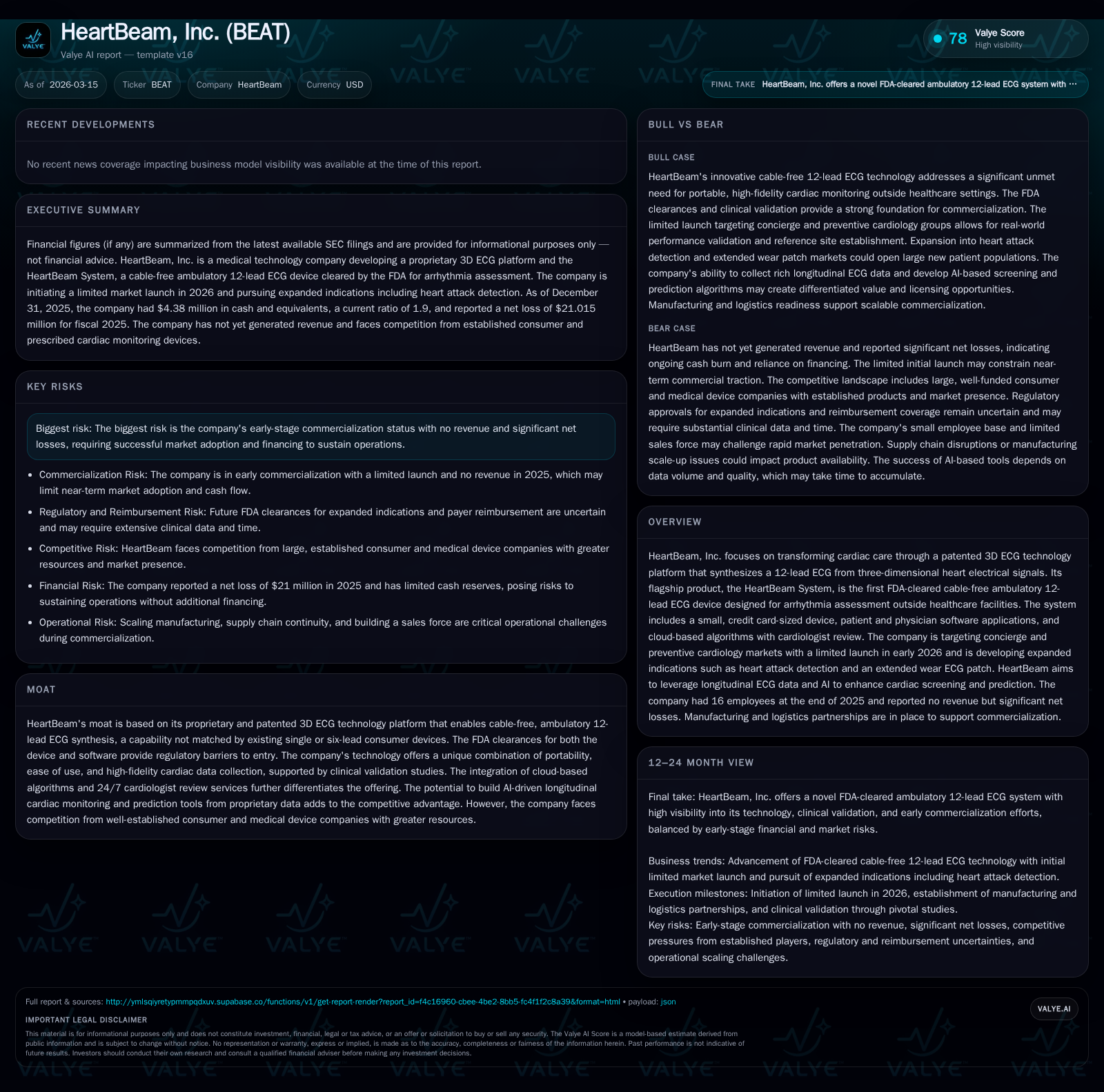
HeartBeam, Inc. is at a critical inflection point, launching its FDA-cleared cable-free ambulatory 12-lead ECG device following years of R&D investment but reporting no revenue as of 2025. The company hinges its growth on limited 2026 market entry focused on concierge and preventive cardiology practices, with expansion planned into heart attack detection and extended wear patches. Despite robust clinical validation and patent protections underlying its unique technology, HeartBeam operates with continued losses and negative cash flows, needing successful adoption and further financing to sustain its operations. Key value drivers include future AI-based longitudinal cardiac monitoring capabilities expected to differentiate it from competitors in telehealth and cardiac diagnostics.
Company Overview
HeartBeam, Inc. is pioneering a transformative approach to cardiac care by delivering higher-resolution ambulatory cardiac monitoring through a patented three-dimensional (3D) electrocardiogram (ECG) platform. This technology uniquely synthesizes a standard 12-lead (12L) ECG from electrical signals captured in three non-coplanar dimensions — an advancement that removes the cumbersome cables typical of traditional ECG machines. By condensing the device into a credit card-sized wearable, HeartBeam enables patients to capture clinically actionable cardiac data conveniently anywhere outside conventional healthcare settings.
The company’s flagship offering, the HeartBeam System, comprises this hardware alongside patient and physician software applications and cloud-based algorithmic analytics which include on-demand board-certified cardiologist review. The system garnered FDA clearance for the device in December 2024, followed by FDA clearance for its software interpretation in December 2025. However, as of the end of fiscal year 2025, HeartBeam reported no revenue generation while continuing significant operating losses [F1][S1][S16].
Historical Performance
HeartBeam represents a quintessential early-stage medtech company transitioning from development to commercialization. Its financial trajectory reflects heavy R&D investment offset by yet unmaterialized commercial revenues:
Historical performance (annual)
| FY | Net ($mm) | CFO ($mm) | OpInc ($mm) | Capex ($) | Net YoY |
|---|---|---|---|---|---|
| 2025 | -21 | -14 | -21 | 600000 | -8.1% |
| 2024 | -19 | -14 | -20 | 201000 | -32.9% |
| 2023 | -15 | -12 | -15 | 256000 | -12.9% |
| 2022 | -13 | -10 | -13 |
Source: SEC companyfacts cache [F1].
Capital returns and efficiency (annual)
| FY | FCF ($mm) | ROE% |
|---|---|---|
| 2025 | -15 | -807.3 |
| 2024 | -15 | -1175.8 |
| 2023 | -12 | -91.9 |
| 2022 | -546.0 |
Source: SEC companyfacts cache [F1].
(Figures represent U.S. dollars; parentheses denote losses) [F1]
The company's operating loss increased approximately 6% year-over-year in FY25 while net losses rose about 8%. Operating cash flow remained negative at nearly $14 million but showed slight improvement compared to FY24 (-3.3% YoY). Capital expenditures increased markedly by nearly triple year-over-year to $600k as the company scaled manufacturing readiness ahead of commercialization [F1].
Equity levels fluctuated due to financing activities not detailed here but remained positive. The approximate return on equity based on annual net loss over shareholders' equity was highly negative at about -807%, reflecting ongoing investment phase status without profitability.
Technology and Clinical Validation
HeartBeam’s patented cable-free technology distinguishes it within the connected cardiac device space by offering comprehensive high-fidelity diagnostics enabled through:
- Integrated electrodes capturing multi-dimensional cardiac signals;
- Proprietary signal processing algorithms synthesizing a physician-familiar full standard 12L ECG;
- A personalized baseline concept comparing symptomatic readings against asymptomatic baselines for improved diagnostic accuracy.
Clinical data underpinning the technology’s promise include the VALID-ECG pivotal study which enrolled nearly two hundred patients across multiple U.S. sites demonstrating a diagnostic agreement rate exceeding 93% between HeartBeam’s synthesized ECGs and standard devices for arrhythmia detection [S22]. Published research also shows parity with standard equipment for coronary occlusion detection—the primary cause of heart attacks—highlighting potential expansion into acute ischemia detection applications previously underserved by portable tools [S22].
This combination offers a new paradigm: patients can self-record a medically rigorous equivalent of hospital-grade ECG remotely with rapid expert interpretation.
Market Strategy and Commercialization
With dual FDA clearances secured covering both hardware and software components for arrhythmia assessment indications,[S16][S20] HeartBeam launched a limited market introduction beginning early 2026 focused on select concierge internal medicine and preventive cardiology practices that have expressed adoptive interest.[S16] This measured rollout intends to establish clinical evidence in real-world use cases while building reference sites conducive to broader scaling.
Initial sales efforts are expected to be lean—reflecting only a few experienced professionals targeting sophisticated physician customers aware of novel ECG benefits.[S24] Over time HeartBeam plans to expand into hospital-at-home programs and clinical trial applications before targeting insurance payers for reimbursement coverage based on demonstrated cost-effectiveness.[S10]
Innovation pipelines include development of an extended-wear patch capable of delivering continuous synthesized 12L ECG monitoring providing convenience advantage over single-lead patches dominating existing multi-billion-dollar detection markets.[S25][S27] Ambitions towards integrating similar technology into smartwatch platforms suggest longer-term diversification aimed at higher-volume consumer accessibility.[S25][S27]
AI-powered analytical capabilities are central: leveraging longitudinal datasets derived from repeated patient recordings HeartBeam seeks to develop screening and predictive algorithms surpassing current episodic or consumer-level wearables’ diagnostic utility.[S16][S21] Early data on AI classification of atrial arrhythmias have been presented at major specialty conferences signaling active development momentum.[S22][S27]
Competitive Landscape
Competition bifurcates into:
- Consumer single-lead devices like Apple Watch’s ECG app or AliveCor’s Kardia products which detect common arrhythmias but lack ischemia or full diagnostic breadth,
- Prescribed medical devices typically tethered or single-indication with limited portability.
HeartBeam uniquely addresses this gap combining portability with full synthetic standard-of-care quality enabling complex arrhythmia assessments and prospective ischemia detection aided by proprietary cloud analytics backed by board-certified cardiologist oversight.[S18]
However well-resourced incumbents dominate adjacent wearable and medical hardware markets making customer acquisition challenging especially amidst evolving payer reimbursement landscapes.[S18]
Risks & Challenges
Key challenges include transitioning from an R&D focus to sustainable commercial operations amid zero current revenues requiring material financing support.[S14][S21] Absence of established recurrent sales or payer reimbursement contracts increases operational risks including dependence on successful adoption within niche customer segments initially targeted.
Stringent regulatory requirements persist post-FDA clearance necessitating ongoing compliance across manufacturing quality systems and marketing claims which may impact timelines or cost structures.[S8][S14] Supply chain dependencies mitigated somewhat by usage of off-the-shelf components still warrant vigilant management given global fluctuations recorded broadly across medtech industries.[S6]
Demand generation depends critically on educating conservative medical purchasers to adopt novel diagnostic tools replacing entrenched workflows—confirmed by company focus on clinical trials publishing peer-reviewed evidence supporting cost-effectiveness and utility.[S10][S20]
Capital Allocation & Liquidity Position
As of December 31st 2025 the company held approximately $4.4 million in cash equivalents against current liabilities near $2.5 million yielding a healthy current ratio (~1.9), indicating near-term liquidity adequacy though runway depends heavily on expense controls.[F1][S12]
Negative operating cash flows persist consistent with expansion investments while capital expenditures increased significantly reflecting preparation for scaled manufacturing and logistics infrastructure.[F1][S6]
No dividends or share repurchases have been declared or reported given ongoing capital formation priority.[F1] Equity levels remain volatile likely reflecting recent financings consistent with early-stage medtech capitalization patterns.
What To Watch: Analysis Perspective
Key indicators signaling progress will include:
- Initial commercial traction metrics from the selective concierge/preventive cardiology launch,
- Achievement of subsequent regulatory clearances expanding indications including heart attack detection,
- Progress towards reimbursement partnerships validating cost-effectiveness relative to existing modalities,
- Advancement towards launch readiness for extended wear patch product,
- Milestones in AI algorithm validation demonstrating incremental diagnostic performance,
- Capital raises or strategic partnerships ensuring operational liquidity beyond initial commercialization phases.
Deployment success depends critically on physician adoption comfortable prescribing new diagnostics alongside proven clinical benefits vis-à-vis comparative standards.
Conclusion
HeartBeam stands as a compelling innovator addressing critical gaps in ambulatory cardiac diagnostics via unique patented electrocardiographic technology absent direct competitive parallels in mobile synthesized full-lead sector. Extensive multi-site clinical validation bolsters prospects yet actual value realization depends on overcoming considerable hurdles endemic to medtech startups—early stage commercialization efforts without revenues necessitate careful execution amidst financial constraints. Longer horizon differentiation rests heavily upon AI-enabled transformation leveraging proprietary longitudinal data streams captured via their platform. Though the company's prospects remain promising technically and clinically it currently operates under significant financial stress typical for companies bridging foundational innovation toward scalable market penetration. Continued scrutiny over execution cadence against milestones noted above will be essential for contextual valuation support.
Disclaimer: This report is prepared solely for informational purposes without making any recommendation regarding any securities mentioned herein. It does not constitute investment advice or an offer or solicitation to buy or sell any securities.
Disclaimer: This is research-only, informational analysis and not investment advice. It may include AI-generated interpretation and general industry context. Always verify important details using primary sources.

Comments