
Bitwise Ethereum ETF Navigates Volatility and Strategic Capital Deployment Amid Regulatory and Operational Challenges
An in-depth review of Bitwise Ethereum ETF's financial swings, capital allocation, and risk landscape highlights key factors shaping its outlook.
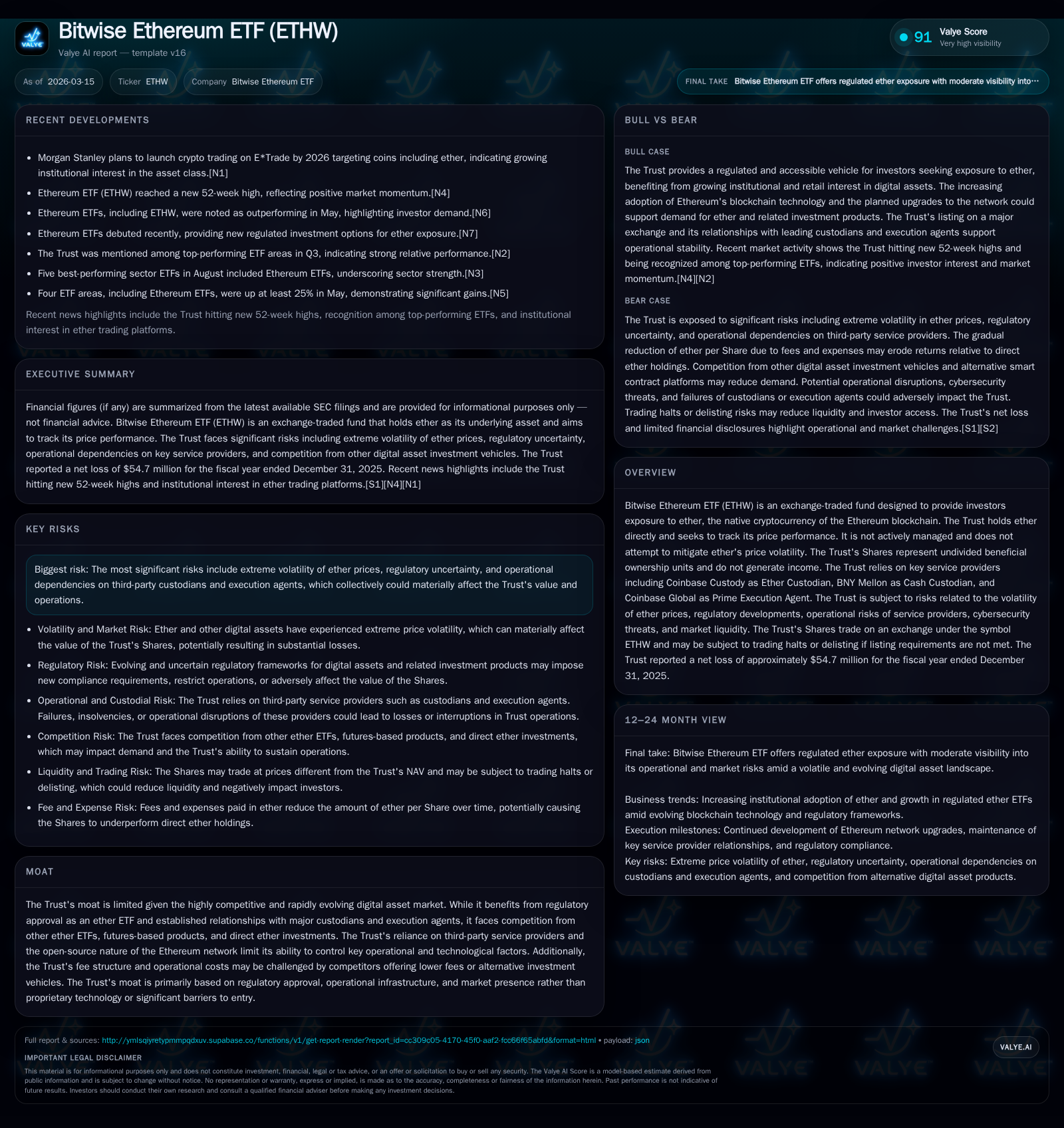
Bitwise Ethereum ETF (ETHW) reported a sharp net loss reversal in 2025 following a modest profit in 2024, reflecting the volatility of ether markets. Operating cash flow improved significantly, supporting substantial share repurchases during the year. The Trust remains exposed to regulatory developments, operational dependencies on key custodians, and technological uncertainties within the Ethereum network, all influencing its future performance and growth prospects.
Financial Performance Overview: Sharp Net Income Reversal during Improved Cash Flow
Bitwise Ethereum ETF (ETHW) experienced a pronounced financial shift between fiscal years 2024 and 2025. The Trust posted a net income of approximately $815,000 in 2024 but incurred a net loss of $54.7 million in 2025, marking an extreme year-over-year change reflective of underlying ether market volatility [F1].
Despite this net loss, operating cash flow improved substantially from negative $403.7 million in 2024 to positive $6.1 million in 2025 [F1]. This improvement suggests effective liquidity management or changes in working capital that positively impacted cash operations independent of accounting losses.
Correspondingly, the Trust executed significant share buybacks totaling $585.4 million in 2025—over ten times the $49.8 million repurchased in the prior year—signaling an assertive capital deployment approach despite adverse earnings [F1]. This activity may reflect management’s valuation perspective or structural features inherent to trust share dynamics.
Historical performance (annual)
| FY | Net ($mm) | CFO ($mm) | Net YoY |
|---|---|---|---|
| 2025 | -55 | 6 | -6816.1% |
| 2024 | 1 | -404 |
Source: SEC companyfacts cache [F1].
Capital returns and efficiency (annual)
| FY | Buybacks ($mm) |
|---|---|
| 2025 | 585 |
| 2024 | 50 |
Source: SEC companyfacts cache [F1].
Source: SEC company facts filing as of March 15, 2026 [F1]
Ether Market Dynamics Impacting Trust Valuation
ETHW’s performance is closely tied to ether price fluctuations due to its direct holdings designed to track ether’s market value [S1]. Ether has exhibited extreme volatility driven by speculative demand and momentum pricing inherent to digital assets.
Ethereum’s transition to a proof-of-stake consensus mechanism introduces supply-side dynamics such as staking penalties and fee-burning deflationary effects that influence ether’s market value and thereby the Trust’s NAV [S1]. Additionally, scalability challenges remain unresolved risks that could affect ether adoption within decentralized finance (DeFi) platforms and smart contract ecosystems—key drivers of intrinsic token demand [S1].
Blockchain events such as forks or governance decisions may also impact shareholder interests if benefits like forks or "airdrops" are not passed through proportionally [S1].
Regulatory Environment and Operational Dependencies
The Trust operates amid an evolving regulatory framework involving multiple federal and state agencies including the SEC and CFTC . While recent enforcement litigation involving Coinbase Global—the Trust’s primary custodian and execution agent—has been resolved [S7], regulatory uncertainty persists with ongoing scrutiny over classification of digital assets as securities or commodities [S21].
Operationally, ETHW relies heavily on Coinbase Custody for ether safekeeping and BNY Mellon for cash custody services. This concentration poses counterparty risk; service disruptions or insolvency could materially affect asset security given limited indemnification provisions favoring custodians over shareholders [S13], [S16].
Further risk arises from use of Trade Credits via prime brokers which expose Trust assets to potential seizure if obligations are unmet—potentially necessitating forced asset liquidation at unfavorable prices impacting NAV [S4], [S19]. These factors underscore the importance of monitoring custodian stability and regulatory compliance.
Outlook: Navigating Blockchain Transition Risks and Competitive Pressures
Future growth depends on ether price appreciation alongside successful navigation of Ethereum network upgrades whose delays or failures could undermine confidence in both ether and ETHW product performance.
Competition from futures-based ether ETFs offering potentially lower fees or enhanced liquidity represents a challenge for physical-asset products like ETHW amid volatile market conditions [S1].
Heightened regulatory scrutiny raises compliance costs that may pressure fee structures industry-wide while constraining product economics.
ETHW’s competitive advantage primarily derives from regulatory approval status and established service infrastructure rather than proprietary technology or high entry barriers.
Capital Allocation Strategy Amid Earnings Volatility
The juxtaposition of significant net losses against massive share buybacks reflects an unconventional capital allocation approach by ETHW management supported by positive operating cash flow [F1]. This may indicate confidence in intrinsic asset value recovery or structural incentives related to trust share creation/redemption mechanisms.
Investors should evaluate whether this strategy persists alongside evolving market dynamics as it may signal prioritization of market presence or price support over near-term profitability.
Investment Considerations: Critical Risks and Monitoring Points
Investment exposure via ETHW entails notable risks including:
- High volatility linked to ether price fluctuations affecting NAV stability [S1]
- Counterparty concentration risks tied to key custodians with limited recourse protections [S13], [S16]
- Regulatory ambiguity regarding digital asset classification with potential compliance cost implications [S21]
- Dependency on successful implementation of Ethereum protocol upgrades impacting tokenomics and utility
- Competitive pressures from derivatives-based ETFs altering investor preferences
- Market liquidity conditions influencing arbitrage between trust shares trading prices versus NAV per share valuations
Investors should closely monitor these factors alongside developments in blockchain technology adoption and regulatory landscape shifts that will shape ETHW's medium-term prospects.
This analysis is based on publicly available SEC filings as of March 15, 2026. It is provided solely for informational purposes and does not constitute investment advice.
Disclaimer: This is research-only, informational analysis and not investment advice. It may include AI-generated interpretation and general industry context. Always verify important details using primary sources.

Comments