
Village Farms International Sees Profit Turnaround Amid Revenue Contraction
The company delivered a significant net income swing in 2025 despite a sharp drop in top-line revenue, supported by its diversified cannabis and produce operations.
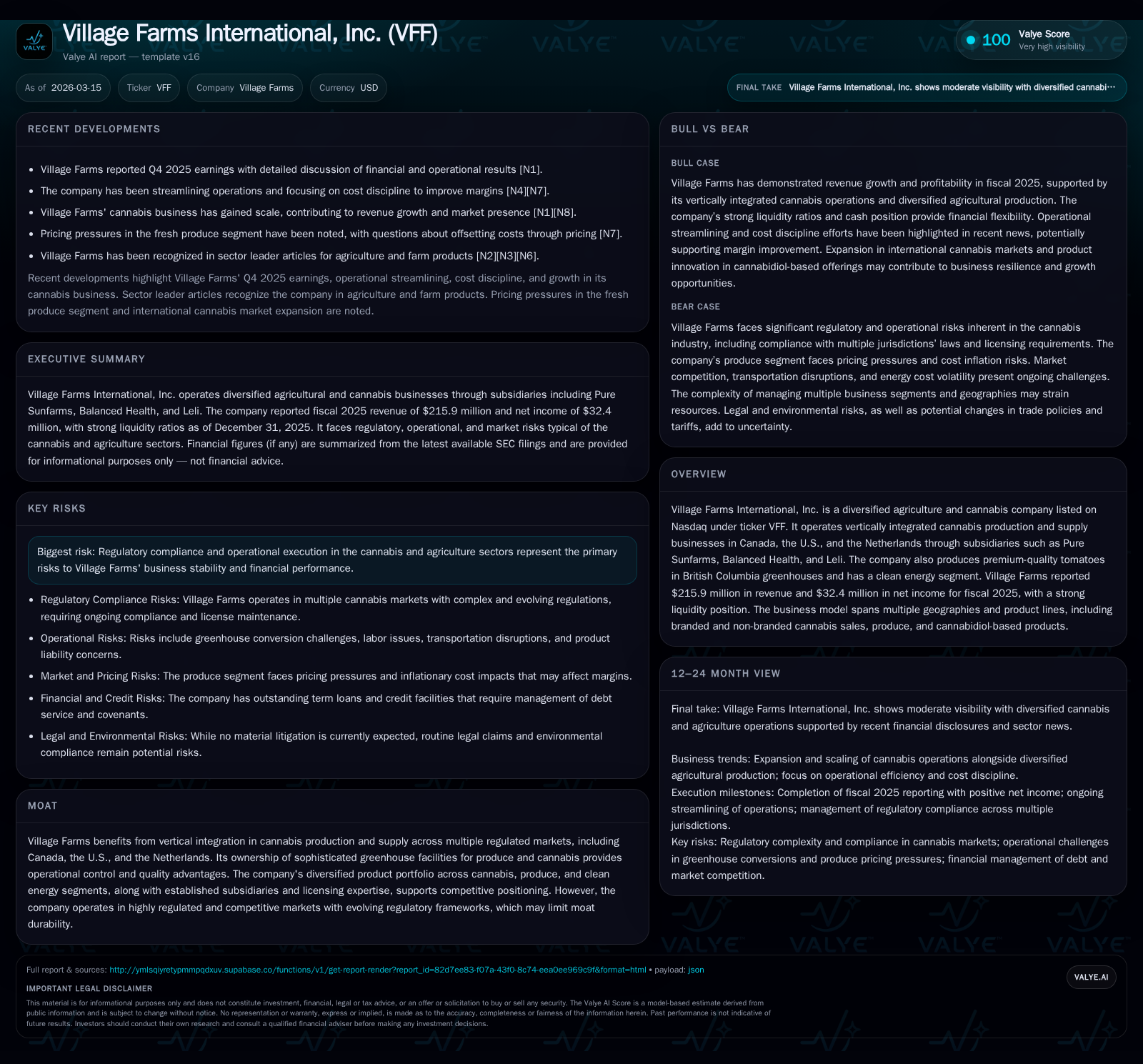
Village Farms International posted $215.9 million in revenue for fiscal 2025, down nearly 36% year-over-year, yet generated $32.4 million in net income compared to a loss the previous year [F1]. This turnaround is attributable to tighter cost controls and operational efficiencies across its vertically integrated cannabis businesses and premium greenhouse produce segment. Capital structure improvements and a strong liquidity buffer underpin the company’s strategic flexibility as regulatory complexity persists across multiple jurisdictions [N1][S4][S5].
Financial Performance in Fiscal 2025: Profit Growth Despite Revenue Decline
Village Farms International recorded fiscal year 2025 revenue of $215.9 million, marking a substantial 35.8% decrease from $336.2 million in 2024 [F1]. This contraction aligns with intensified competition in the cannabis sector and shifts in branded product sales volumes reported during recent earnings calls [N1]. Despite this top-line decline, the company achieved a remarkable net income turnaround of $32.4 million versus a $35.9 million net loss the prior year—equating to a positive swing of over 190% year-over-year profit improvement [F1]. Operating income trajectories had slowed by Q3 2024 but recovered through disciplined cost management initiatives and an optimized product mix favoring higher-margin segments [N1][F1]. This financial reversal underscores Village Farms' capacity to navigate adverse revenue conditions while controlling expenditures effectively.
Historical performance (annual)
| FY | Rev ($mm) | Net ($mm) | CFO ($mm) | Capex ($mm) | Rev YoY | Net YoY |
|---|---|---|---|---|---|---|
| 2025 | 216 | 32 | 18 | -35.8% | +190.5% | |
| 2024 | 336 | -36 | 10 | 10 | +17.7% | -12.7% |
| 2023 | 286 | -32 | 5 | 7 | ||
| 2021 | 294 | -101 | -20 | 14 |
Source: SEC companyfacts cache [F1].
Capital returns and efficiency (annual)
| FY | Buybacks ($mm) | FCF ($mm) | ROE% |
|---|---|---|---|
| 2025 | 3 | ||
| 2024 | 0 | -14.1 | |
| 2023 | 5 | -1 | -10.5 |
| 2021 | 5 | -34 | -33.4 |
Source: SEC companyfacts cache [F1].
Table Note: Operating income quarterly data available for Q3 FY2024 only; other operating income data not provided.
Segment Overview: Cannabis Leadership Integrated with Protected Greenhouse Produce
Village Farms operates an integrated cannabis business across Canada (via Pure Sunfarms), the United States (Balanced Health), and the Netherlands (Leli), complemented by its premium tomato cultivation under proprietary greenhouse facilities in British Columbia [S7]. Pure Sunfarms stands as a licensed producer with substantial national presence leveraging sophisticated greenhouse canopy management technologies that allow precise environmental controls—critical for both plant health and production scalability.
Within cannabis operations, the company navigates branding strategies distinguishing between branded and non-branded sales channels—key for market segmentation strategy—while international sales contribute incremental revenue streams [S29]. Balanced Health targets the burgeoning U.S. CBD market with ingestible and topical cannabidiol products benefiting from vertical integration that spans cultivation through consumer packaging.
The integration of agricultural produce with cannabis allows operational synergies such as shared facility management expertise and energy-efficient greenhouse utilization while mitigating risks inherent to regulatory turbulence typical of cannabis markets worldwide [S7]. This multi-pronged portfolio affords Village Farms greater stability amidst sector volatilities.
Capital Structure Refinements and Liquidity Position Strengthening
In April 2025, Village Farms refinanced its debt by terminating multiple legacy credit lines—including Pure Sunfarms Term Loan and BDC Facilities—and entering into consolidated secured credit facilities totaling C$37.4 million consisting of revolving credit ($10M) plus term loans ($27.4M) secured primarily by its Delta greenhouse assets [S4][S5]. These amendments introduced more favorable covenants enhancing financial flexibility amid ongoing capital deployment needs.
At December 31, 2025, cash and cash equivalents surged to approximately $81.2 million from $24.6 million at the prior year-end—a liquidity cushion supplemented by a current ratio above 2.6 demonstrates robust short-term solvency [F1]. Total long-term debt stood near $32.4 million backed by secured interests over accounts receivable and inventory assets valued above $98 million as collateral—a prudent structural safeguard reducing creditor risk exposure [S4].
Such deleveraging alongside significant cash reserves highlight deliberate balance sheet optimization intended to support ongoing capex commitments without constraining operational agility.
Analyzing Earnings Quality: Cash Flow and Return on Equity Trends
Operating cash flow exhibited pronounced strength in fiscal 2024 rising nearly double year-over-year to $10.3 million from $5.3 million; however full fiscal year operating cash flow for calendar year-end wasn’t disclosed explicitly for FY2025 [F1]. Meanwhile, capital expenditures escalated substantially (+80.7%) to $18.2 million in FY2025 as the company accelerated investments into advanced greenhouse infrastructure upgrading—with implications of heightened capital intensity typical for controlled environment agriculture businesses pushing production boundaries [F1][S13].
Despite negative free cash flow estimated at approximately -$7.9 million (operating cash flow minus capex), profitability gains translated into an estimated ROE of roughly 12.8%, signaling improving shareholder returns following years of losses [F1]. This evolution suggests that though reinvestment demands weigh on liquidity generation short-term, underlying earnings improvements exhibit enhanced quality grounded in actual cash profitability rather than purely accounting gains.
Strategic Growth Drivers and Regulatory Headwinds Ahead
Village Farms’ strategy focuses on expanding footprint within internationally regulated cannabis markets while innovating cannabidiol-derived consumer products targeting evolving wellness trends especially within the U.S.[N1]. Cross-border commercialization expertise via subsidiaries like Rose LifeScience further anchors presence particularly within Quebec’s licensed adult-use framework—critical given Canada’s stringent Cannabis Act restrictions [S15][N1]. Expansion into Europe via Leli introduces exposure to developing regulatory regimes demanding rigorous compliance but promising access to emerging demand centers.
At the same time regulatory headwinds remain significant risks including federal/state mismatches in the U.S., license renewals under changing Cannabis Act provisions in Canada, plus evolving environmental/health safety legislation impacting greenhouse operations broadly [S15][S20]. Managing complex compliance coupled with operational execution amidst these shifting frameworks remains central to sustaining competitive moat advantages derived from vertical integration.
Capital Allocation Priorities: Share Repurchases and Reinvestment
In September 2025 the Village Farms board authorized a $10 million share buyback program aimed at repurchasing up to approximately five million shares—a measured expression of confidence given concurrent heavy capital expenditure requirements on greenhouse upgrades [N1][S10][F1]. Buyback execution has been moderate thus far reflecting balanced priorities between returning capital to shareholders versus supporting long asset life cycle reinvestments that underpin scalable growing operations.
This cautious approach underscores recognition that long-term agricultural infrastructure demands steady reinvestment even amid improving profitability metrics—a hallmark challenge encountered by industry peers operating intensive indoor cultivation environments requiring ongoing capital refresh cycles.
Outlook: Key Milestones and Metrics to Monitor
Looking forward stakeholders should watch upcoming quarterly earnings not only for financial momentum but also for progress reports on amortization of credit facilities maturing principally through early-to-mid next decade horizons [N1]. Given market sensitivities around regulatory shifts especially related to licensing approvals or revisions across Canada/U.S./European jurisdictions monitoring compliance outcomes will be crucial.
Additional markers include tracking capex efficiency improvements translating into operating leverage gains—a primary value driver within greenhouse canopy-managed crop production.
Given absence of explicit forward guidance from management calls attention toward reading near-term results as barometers for strategic execution fidelity amidst evolving macro industry conditions.
Disclaimer: This analysis is based solely on publicly available information sourced from Village Farms International’s SEC filings such as Form 10-K/Q reports [F1],[S#] and verified news transcripts without incorporating non-public data or offering investment advice.
Disclaimer: This is research-only, informational analysis and not investment advice. It may include AI-generated interpretation and general industry context. Always verify important details using primary sources.

Comments