
W&T Offshore’s Gulf of America Focus Tests Resilience Amid Deepwater Challenges and Capital Strains
The company’s specialized offshore asset base drives operational scale but faces profitability pressure from market volatility and debt constraints.
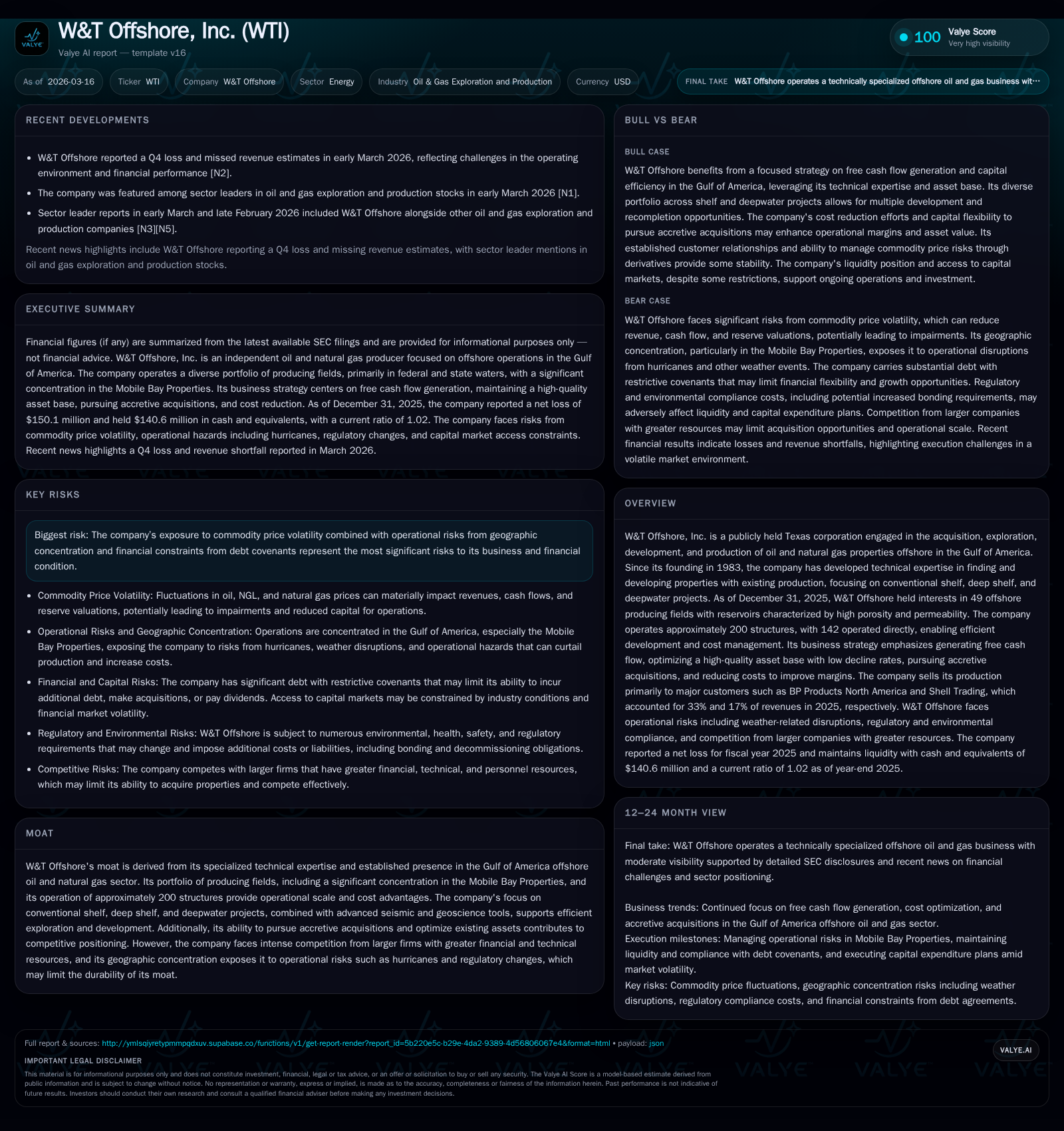
W&T Offshore, Inc. remains a focused independent oil and gas producer in the Gulf of America with a portfolio of conventional shelf and deepwater assets emphasizing stable production and accretive acquisitions. Despite significant technical expertise and operational scale with 142 operated structures, the company has struggled with sharp declines in profitability over recent years, culminating in a substantial net loss in 2025. The concentrated geographic exposure to Gulf of America risks—including hurricanes and regulatory challenges—combined with commodity price volatility and restrictive debt covenants, have tempered growth prospects. While generating positive operating cash flow, capital allocation is constrained by high leverage and regulatory uncertainties, limiting flexibility for expansion or shareholder returns.
Company Overview
Founded in 1983, W&T Offshore, Inc. (WTI) operates as an independent oil and natural gas producer wholly focused on offshore assets in the Gulf of America [S1][S24]. The company specializes in acquisition, exploration, development, and production across conventional shelf, deep shelf, and deepwater environments. As of December 31, 2025, WTI held working interests in 49 producing fields managed through about 200 structures—with operator control over approximately 142—allowing for effective cost management and operational scale [S1]. This portfolio includes a significant concentration in Mobile Bay Properties [S1][S7]. The reservoirs typically exhibit high porosity and permeability characteristics underpinning relatively higher initial production rates.
Historical Performance
Financial data availability beyond 2018 is limited for revenue; the latest full-year reported top-line was $143 million at FY2018 [F1]. However, more recent filings portray a marked deterioration in operating income and net earnings. Operating income swung negative starting after FY2023, reaching approximately -$52.8 million by FY2025 [F1]. Net losses deepened substantially to around -$150 million in FY2025 from a loss of -$87 million the prior year [F1]. These results reflect prevailing macroeconomic pressures, notably volatile oil prices combined with elevated operating costs attributable partly to complex deepwater operations and legacy asset devaluation exposures.
Notwithstanding challenges in profitability metrics, WTI maintained positive operating cash flow through this turbulent period—cashing $77 million in CFO during FY2025 [F1]. This positive cash generation points to solid underlying asset productivity despite margin compression. Yet capex demands remain substantial given offshore development costs coupled with requirements for well repairs and facility maintenance.
Historical performance (annual)
| FY | Net ($mm) | CFO ($mm) | OpInc ($mm) | Net YoY |
|---|---|---|---|---|
| 2025 | -150 | 77 | -53 | -72.2% |
| 2024 | -87 | 60 | -42 | -658.7% |
| 2023 | 16 | 115 | 29 | -93.3% |
| 2022 | 231 | 340 | 454 |
Source: SEC companyfacts cache [F1].
Capital returns and efficiency (annual)
| FY | ROE% |
|---|---|
| 2025 | 75.1 |
| 2024 | 165.7 |
| 2023 | 50.0 |
| 2022 | 3027.9 |
Source: SEC companyfacts cache [F1].
Numbers are based on latest company financial filings from SEC XBRL data [F1].
Future Growth Prospects
WTI plans to leverage its technical specialization with efforts to optimize the existing high-quality asset base characterized by low decline rates. This involves pursuing accretive acquisitions within its core Gulf operating area that complement existing operations through increased scale or resource diversification [S1]. Advanced seismic imaging and geoscience tools underpin exploration success especially for stacked pay developments which enhance resource recovery without the need for entirely new acreage acquisition.
However, growth is circumscribed by several factors:
- Commodity price volatility: Pricing fluctuations impose limits on viable capital deployment and may force conservative reserve booking or impairments [S1].
- Regulatory environment: Increasingly stringent environmental regulations raise compliance costs and potential liabilities linked to decommissioning obligations [S5][S9][S16].
- Geographic concentration risks: The company’s reliance on a few key areas like Mobile Bay renders it vulnerable to hurricane impacts leading to shut-ins or evacuations [S1][S7].
- Debt-related restrictions: Covenants embedded within the company's $358.8 million long-term debt constrain financial maneuvering including dividend deferral or limited ability to incur additional borrowings [S4][S13][F1].
- Climate Transition Pressures: The Inflation Reduction Act incentives for clean energy plus shifts among lenders pose strategic headwinds for fossil-fuel-centric companies like WTI [S15][S21][S25].
Forecasts / Milestones / Expectations
No explicit forward-looking guidance for revenue or earnings was provided as per filings up to March 2026 [N1][S3]. Market observers should monitor:
- Operational uptime recovery post-hurricane seasons impacting Gulf production availability.
- Management capital allocation decisions relating to acquisitions or divestitures announced via subsequent SEC filings.
- Evolution of regulatory policies affecting offshore activities that might impact cost structures.
- Debt covenant compliance status particularly relating to refinancing efforts around maturity periods.
Given current trends, free cash flow optimization remains critical as capital restrictions may limit production growth or exploration aggressiveness.
Returns / Capital Allocation
Capital structure is notably leveraged; total principal amount of long-term debt stands near $359 million at fiscal year-end 2025 [F1][S18], accompanied by restrictive covenants limiting dividend payments, asset sales without consent, incurrence of additional debt, or certain mergers [S4][S8][S13]. Negative shareholders’ equity at -$200 million as of end-2025 reflects cumulative earnings shortfalls exceeding capital contributions [F1]. Prior dividends were paid up until at least FY2016 but none reported recently amid financial tightening [F1].
Operating cash flow remained positive at $77 million in FY2025 against persistent net losses evidencing continued profitability challenges alongside good operational cash management [F1]. Free cash flow has hovered near $60 million after adjustments for capital expenditures though precise details require cautious interpretation due to changing capex patterns [F1] .
The company’s capital allocation strategy is prudently cautious: prioritizing maintaining liquidity amidst uncertain commodity prices while seeking accretive acquisitions that can improve margins or extend reservoir life without undue leverage expansion [S1][S20]. This emphasis aligns with a broader industry shift toward disciplined spending post-cyclical downturns.
Industry Context and Strategic Positioning (Analysis)
W&T Offshore occupies a distinct niche as an independent operator heavily invested in shallow water shelf alongside increasing exposure into deeper water formations within the Gulf region—a segment known for steep technical demands but historically rewarding discovery economics given proximity to infrastructure. Their focus on high-quality reservoirs with favorable permeability allows relatively higher initial production compared to many onshore plays where tight formations prevail.
Nonetheless, WTI faces intense competition from larger integrated oil majors capable of absorbing regulatory costs more readily while aggressively pursuing new technologies such as subsea processing or digital twin simulations which could eclipse older development approaches if not matched.
Moreover, the cyclical nature of offshore infrastructure utilization means rig availability fluctuations coupled with heightened hurricane season severity introduce operational unpredictability. Insurance market constraints further complicate risk management budgets.
Lastly, evolving investor sentiment increasingly favors companies with defined carbon transition strategies—areas where pure fossil fuel producers must gradually adapt or confront constrained access to low-cost capital.
Conclusion
W&T Offshore remains a technically adept offshore producer concentrating within the Gulf of America offering operational scale through its large portfolio but endures significant financial pressure highlighted by sustained net losses and negative equity at year-end fiscal 2025. Positive operating cash flow indicates core asset productivity yet high leverage coupled with debt covenants imposes strategic limits on growth investments or shareholder return policies. Market challenges arising from commodity volatility, environmental regulation evolution, geographic risk concentration, litigation over surety collateral demands, and transitioning capital market dynamics together constrain future outlooks. Stakeholders should keep close watch on capital structure shifts alongside operational milestones related to drilling success and regulatory compliance adaption going forward.
This memorandum is intended solely for informational purposes based on publicly available data as of March 16, 2026. It does not constitute investment advice or recommendations.
Disclaimer: This is research-only, informational analysis and not investment advice. It may include AI-generated interpretation and general industry context. Always verify important details using primary sources.

Comments