
Bank7 Corp. Delivers Steady Returns Amid Regional Competition
Bank7 Corp.'s consistent profitability and capital allocation discipline underscore its operational resilience within a competitive regional banking landscape.
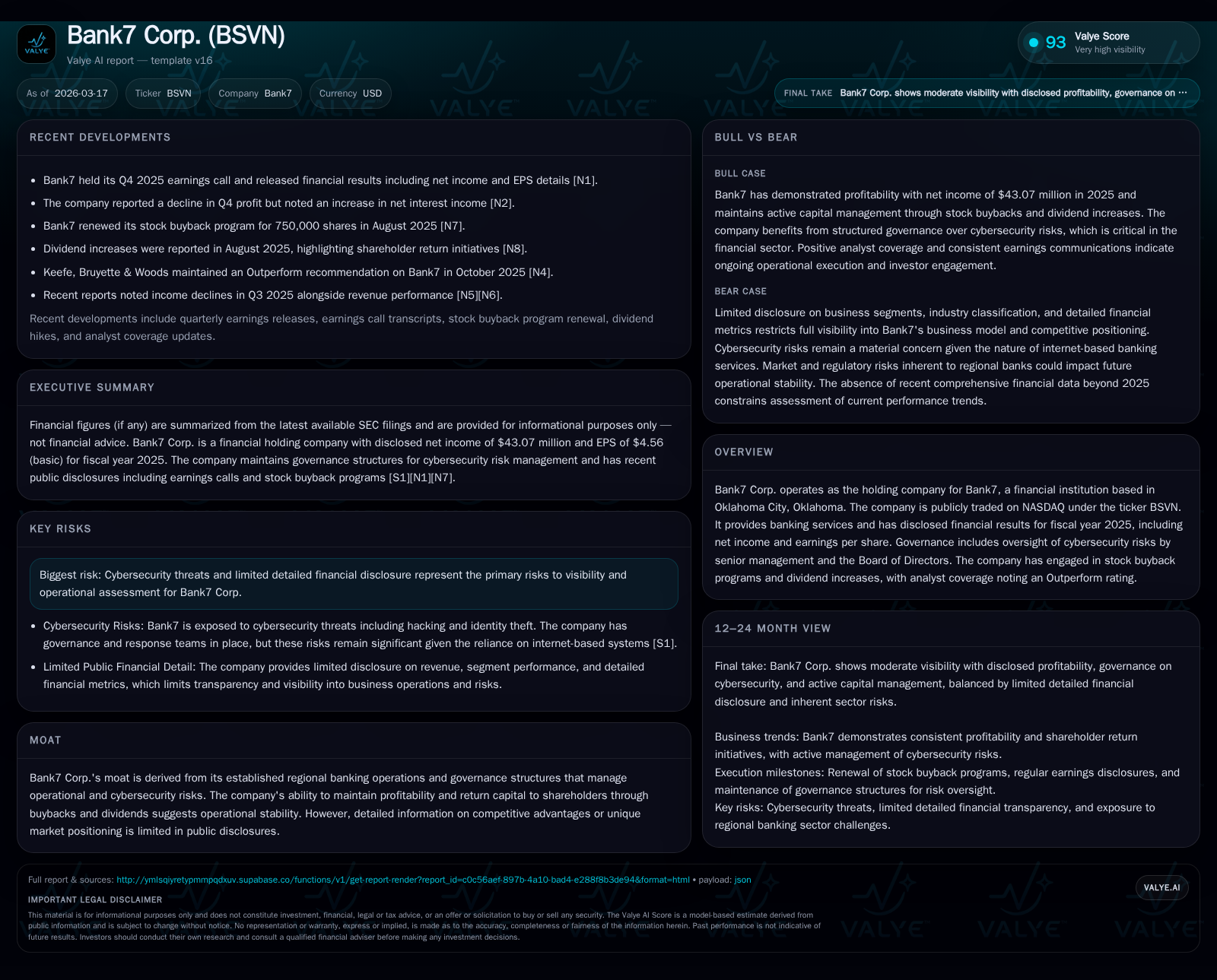
Bank7 Corp. has demonstrated stable net income growth over recent years, with a modest decline in 2025 reflecting typical regional banking cyclicality. Its measured increase in capital expenditures alongside prudent dividend hikes evidences a balanced reinvestment and shareholder return strategy. The company's governance structures, particularly its comprehensive cybersecurity oversight, fortify operational stability—a critical factor in the evolving threat environment for regional banks. While explicit growth guidance remains limited, Bank7's strong capitalization and disciplined capital deployment position it well amid market constraints.
Consistent Profitability Trends Shape Historical Growth
Bank7 Corp., headquartered in Oklahoma City, has sustained a trajectory of profitability growth over the past four fiscal years [F1]. Net income rose from $29.6 million in FY2022 to $45.7 million by FY2024 before experiencing a modest contraction to $43.1 million in FY2025, representing a -5.8% year-over-year decline [F1]. This variation aligns with common ebbs in regional banking profits influenced by interest rate cycles and economic conditions.
Operating cash flow (CFO) similarly peaked at $55 million in FY2024 but receded by 16.2% to $46.1 million in FY2025 [F1]. Concurrently, capital expenditures (Capex) increased by approximately 13%, rising from $4.2 million to $4.74 million year-over-year [F1], signaling targeted reinvestment efforts such as branch upgrades or IT infrastructure enhancement—typical for banks aiming to maintain contemporary service platforms and regulatory compliance.
The company’s approximate return on equity (ROE), calculated by dividing net income by equity for FY2025, stood at a robust 17.2%, indicating effective deployment of shareholder funds amidst an evolving regional banking environment [F1]. This ROE compares favorably with many midsize peers where mid-teens percentages are considered solid returns when coupled with conservative risk profiles.
Historical performance (annual)
| FY | Net ($mm) | CFO ($mm) | Capex ($mm) | Net YoY |
|---|---|---|---|---|
| 2025 | 43 | 46 | 5 | -5.8% |
| 2024 | 46 | 55 | 4 | +61.6% |
| 2023 | 28 | 49 | 3 | -4.6% |
| 2022 | 30 | 40 | 0 |
Source: SEC companyfacts cache [F1].
Capital returns and efficiency (annual)
| FY | Div ($mm) | FCF ($mm) | ROE% |
|---|---|---|---|
| 2025 | 9 | 41 | 17.2 |
| 2024 | 8 | 51 | 21.4 |
| 2023 | 6 | 46 | 16.6 |
| 2022 | 4 | 39 | 20.6 |
Source: SEC companyfacts cache [F1].
Table: Bank7 Corp. Historical Financial Performance Summary (FY2022-FY2025) [F1]
Capital Deployment Drives Shareholder Value Creation
Capital allocation reflects Bank7’s focus on balancing shareholder returns with financial strength preservation. Dividend payments steadily escalated from $4.4 million in FY2022 to $9.3 million in FY2025—more than doubling over this span—highlighting a commitment to rewarding investors through increasing distributions [F1]. This progressive dividend policy is notable given the modest net income dip seen most recently.
Share repurchase programs have contributed historically to capital returns; however recent filings do not detail significant buyback activity beyond earlier years [F1][S19]. This absence could indicate temporary suspension or scaling back that often occurs as firms prioritize liquidity or face market uncertainties.
Meanwhile equity expanded markedly—from $144 million at end-2022 to nearly $251 million at end-2025—demonstrating internal capital generation exceeding dividend outflows and supporting regulatory requirements [F1]. The company’s sound capitalization underpins lending capacity and risk tolerance within its regional footprint.
Cybersecurity Governance as a Pillar of Operational Stability
Bank7’s governance framework accords cybersecurity paramount importance amidst widespread internet-based threats prevalent across the banking sector [S1][S13]. Oversight cascades from the Chief Operating Officer (COO)/IT Manager—with over a decade of experience—to a dedicated IT Committee composed of senior executives and operating under the COO’s chairmanship.
Operational execution is supplemented by a Cyber Incident Response Team featuring both board representation and executive officers tasked with detailed preparedness planning and incident management protocols [S1][S13]. The Board of Directors periodically receives comprehensive network health reports each meeting cycle detailing current threat landscapes and incidents encountered.
This layered and proactive cyber risk governance serves as a competitive requisite rather than just compliance formality within regional banks that increasingly rely on digital channels yet face outsized attack vectors relative to resource scale.
Future Trajectory: Growth Prospects Within Regional Banking Constraints
Public disclosures provide limited direct commentary on explicit growth strategies beyond maintaining steady regional operations [N1][S1]. The company operates primarily within Oklahoma and surrounding areas where entrenched client relationships foster retention but where population growth rates may constrain rapid expansion.
Organic growth avenues likely center around selective loan portfolio enhancements and incremental deposit base increases coupled with technology-driven service improvements based on internal reinvestment trends indicated by capex rises [F1]. However competitive pressures from larger banks and fintech entrants remain challenges typical for regionally focused institutions.
Absent explicit forward-looking guidance or analyst forecasts due to limited recent disclosures [N1], tracking quarterly earnings changes along with any disclosed plans for strategic initiatives will be critical analysis angles going forward.
Monitoring Key Milestones and Financial Health Indicators
As direct forecast data or milestones lack prominence in filings [N1][S3], observers should emphasize upcoming quarterly earnings reports for signals on profit stabilization or recovery beyond the noted net income dip below FY2024 peak levels.
Additionally monitoring dividend consistency or any changes to share repurchase policies could illuminate shifts in cash flow priorities or confidence levels among management teams [S19]. Movements in operating cash flow trends relative to reinvestment intensity also provide early indicators of operational efficiency adjustments or strategic pivots.
Assessing Risks: Cybersecurity and Disclosure Transparency
The primary operational risks outlined pertain heavily to cybersecurity vulnerabilities inherent in internet-based system usage and online commerce handling [S4][S6][S13]. Despite no material incident reports publicly filed recently and robust governance structures maintained [S13], potential breaches remain existential threats echoing industry-wide concerns.
Moreover limited disclosure transparency constrains comprehensive visibility into detailed business segment performance or granular competitive advantages beyond financial aggregates provided [S4][S6]. This opacity imposes challenges for fully discerning sustainability of margins or client concentration risks common among small-to-mid sized bank holding companies.
This analysis aims solely to present an evidence-based overview of Bank7 Corp.’s recent financial performance and organizational practices without issuing investment recommendations or forecasts not supported explicitly by source data.
Disclaimer: This is research-only, informational analysis and not investment advice. It may include AI-generated interpretation and general industry context. Always verify important details using primary sources.

Comments