
Playboy, Inc.: Shifting from Legacy Media to Licensing Growth Engines
Playboy’s strategic pivot to a capital-light licensing model in 2025 is reshaping its brand monetization and financial profile after years of operating losses.
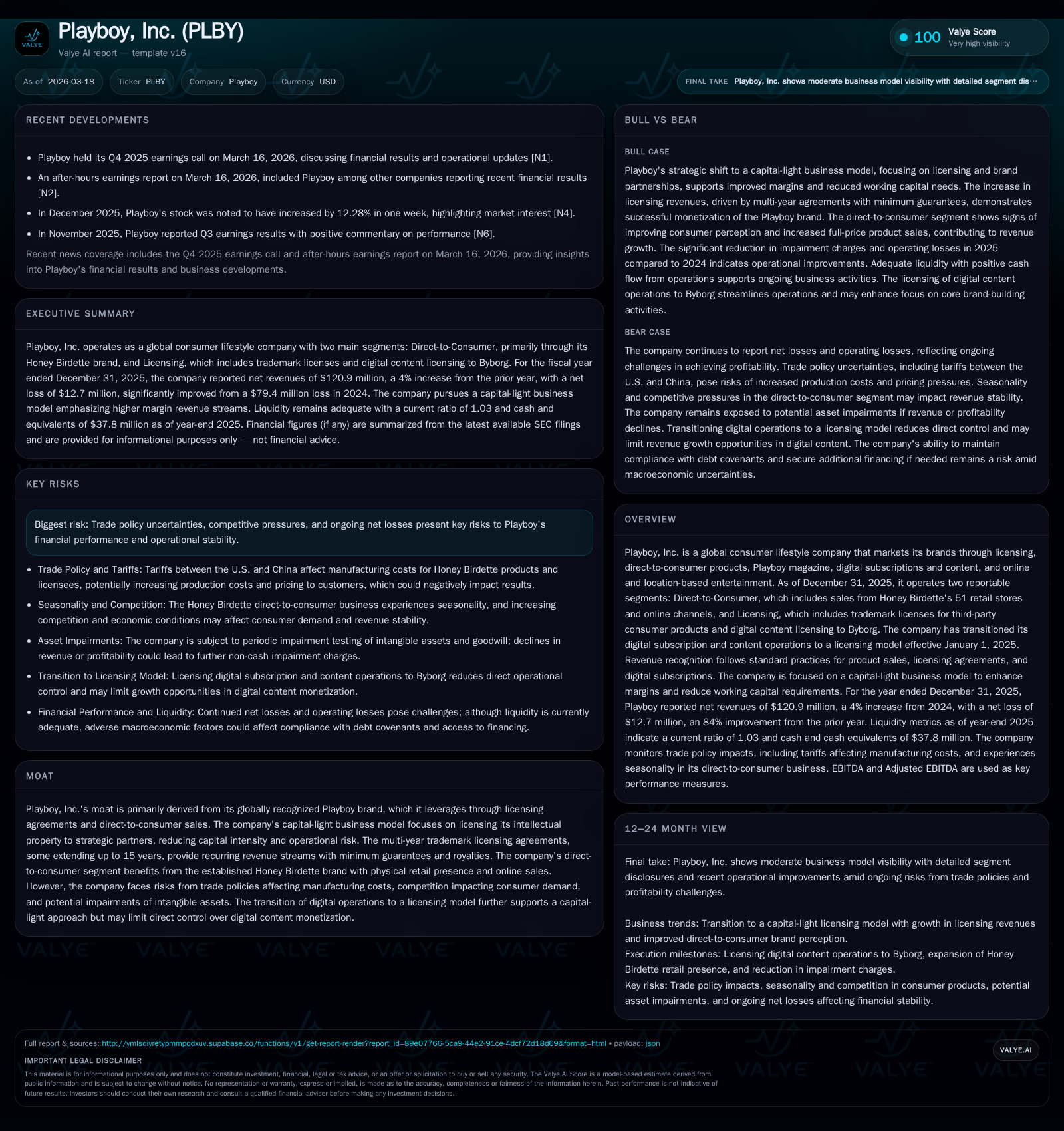
Playboy, Inc. has transitioned from traditional digital content ownership to licensing its intellectual property, notably through a landmark $300 million deal with Byborg beginning January 2025. This shift supports a capital-light business model emphasizing recurring revenue streams with minimum guarantees and high-margin royalties. Despite continued operating losses, the company has materially reduced net losses by over 80% year over year and stabilized cash flows. Key growth levers include the expansion of trademark licensing globally, the direct-to-consumer Honey Birdette retail presence, and a restructured China joint venture expected to sustain approximately 10% revenue contribution. Market challenges remain in trade policy uncertainties, competitive pressures, and potential asset impairments.
Transitioning Business Model: From Publishing to Licensing Revenue
Playboy, Inc.’s defining strategic move took effect January 1, 2025, when it licensed its digital subscription and content operations—including Playboy Plus and Playboy TV—to Byborg under a License & Management Agreement (LMA). This deal commits Byborg for an initial term of 15 years with minimum guaranteed payments totaling $300 million over that period [S1]. The agreement also envisages multiple renewal terms extending up to nine decades beyond the initial term.
This transition markedly shifts Playboy's revenue recognition from operating digital media directly to receiving royalty streams and minimum guarantees via licensing fees. From a capital allocation perspective, this lowers working capital demands associated with running digital platforms and reduces operational risk since Byborg assumes the day-to-day business risks while Playboy focuses on IP monetization [S1]. This licensing cadence brings enhanced recurring revenue visibility tied closely to long-term trademark license agreements.
Examining Historical Performance: Operating Losses and Cash Flow Trends
Financially, Playboy remains unprofitable but showcases marked improvements across key profit metrics. Operating income loss narrowed significantly from -$50.8 million in FY2024 to -$8.0 million in FY2025—an 84.2% improvement [F1]. Similarly, net income losses shrank by approximately the same magnitude from -$79.4 million to -$12.7 million year over year [F1].
Operating cash flow recovered impressively: generating mere $18 thousand positive CFO in FY2025 after negative $19.1 million cash consumption in FY2024. Capital expenditures reverted sharply downward as well—from $2.26 million in FY2024 down to about $1.02 million in FY2025—a reduction of nearly 55% [F1]. These trends underscore a leaner operating model aligned with the capital-light focus.
Seasonality factors affect Honey Birdette’s direct-to-consumer sales performance, historically peaking during holiday periods but subject more recently to competition and economic headwinds influencing consumer discretionary spending [S1].
Historical performance (annual)
| FY | Net ($mm) | CFO ($mm) | OpInc ($mm) | Capex ($mm) | Net YoY |
|---|---|---|---|---|---|
| 2025 | -13 | 0 | -8 | 1 | +84.0% |
| 2024 | -79 | -19 | -51 | 2 | +56.0% |
| 2023 | -180 | -43 | -190 | 4 | +35.0% |
| 2022 | -278 | -60 | -326 | 8 |
Source: SEC companyfacts cache [F1].
Capital returns and efficiency (annual)
| FY | Buybacks ($) | FCF ($mm) | ROE% |
|---|---|---|---|
| 2025 | -1 | -69.0 | |
| 2024 | 0 | -21 | 1027.0 |
| 2023 | 1000000 | -47 | -393.1 |
| 2022 | -68 | -178.9 |
Source: SEC companyfacts cache [F1].
*Table shows steady financial improvement while remaining loss-making *
Capital-Light Model Dynamics: Licensing Agreements and Brand Partnerships
Playboy’s LMA with Byborg exemplifies sector-standard licensing agreements featuring minimum royalty guarantees designed to assure baseline revenues independent of actual sales performance [S1]. The deal includes upfront prepayment benefits for portions of the latter term's minimum guarantees—enhancing Playboy’s short-term liquidity visibility.
Additional brand partnerships extend into hospitality services and digital gaming verticals under trademark licenses managed in-house or via joint ventures [S1]. The company strategically positions new categories leveraging brand extension synergies that capitalize on Playboy's iconic IP cachet globally.
Such arrangements protect against volatility inherent in direct operations by securing stable royalty streams while allowing partners operational autonomy; this aligns incentives for brand promotion without requiring capital-intensive ownership.
Direct-to-Consumer Segment: Honey Birdette Retail and Online Integration
The Direct-to-Consumer division centers primarily on Honey Birdette—a premium intimate apparel retailer operating 51 stores across three countries along with online channels as of December 31, 2025 [S1]. In this segment, margin improvement stemmed largely from elevated full-price product sales driving higher gross margin percentages (~60%) compared to prior periods marked by discounted product inventory clearance [S15].
However competitive pressure remains significant given the proliferation of boutique intimates brands and shifting consumer tastes exacerbated by macroeconomic factors affecting discretionary spending patterns [S1]. Seasonality effects persist but may moderate under evolving sales models emphasizing e-commerce.
China Licensing Joint Venture: Strategic Expansion and Market Importance
After stabilizing its China operations under a joint venture with CTL during 2024-25 phases [S1], Playboy amicably exited that arrangement late Q4 2025 and established a new joint venture operated by UTG owning a controlling interest effective March 31, 2026 [S1]. This move is intended to provide fresh operational agility aligned with localized market strategies amid ongoing geopolitical tensions.
China remains materially relevant comprising approximately 10% of total revenue consistently over the past two years—a sizable contributor within global licensing revenues [S1]. Geopolitical risks create headwinds affecting manufacturing sourcing costs especially for Honey Birdette products which have Chinese supply chain inputs; tariff unpredictability could compress margins or necessitate pricing adjustments [S1][S19].
Financial Positioning: Liquidity, Debt Structure, and Covenant Management
As of December 31, 2025 Playboy had unrestricted cash balances of approximately $37.8 million giving ample near-term liquidity coverage for operating needs despite ongoing negative earnings [F1][S10]. This is complemented by an amended credit facility termed A&R Credit Agreement facilitating senior secured term loans totaling roughly $160 million face value due May 25, 2028 [S9][S10].
Covenant relief provisions suspend net leverage ratio testing until Q2-2026 with step-down provisions thereafter—providing temporary covenant breathing room during business transition phases [S4][S6][S14][S17]. Interest rates on term loans reset based on SOFR plus credit spreads currently targeting amortization commencing Q4-2025 with approximately a nominal annual principal amortization rate of ~1% [S6][S7].
The Company completed full conversion of Series B convertible preferred stock into common shares by August 22nd, 2025 eliminating preferred dividend burdens but retaining optional redemption/convertibility features initially deployed as debt-equity hybrids [S6][S9]. Minimum liquidity covenants require maintaining no less than $7.5 million unrestricted cash balance subject to cure rights through first quarter of fiscal year ending March 31st , 2026 [S7][S8][S16].
Capital Allocation Review: ROE, Cash Flow Generation, Dividends, and Buybacks
Playboy's trailing twelve-month return on equity remains deeply negative at about -69%, reflecting net losses relative to modest shareholder equity of approximately $18.4 million as of December ’25 end [F1]. The company essentially generated breakeven operating cash flow but suffered minor negative free cash flow after capex deductions (~$-1 million) indicative of disciplined spending consistent with brand pivot strategy.
Notably management has not returned capital via dividends or share buybacks recently; only minimal share repurchases occurred historically ($1 million buyback recorded in FY23) reflecting cautious stewardship amid yet unresolved profitability challenges and credit obligations [F1][S16]. Thus far capital discipline favors reinvestment into licensing expansion initiatives rather than shareholder distributions.
Forward Outlook: Growth Drivers, Risks, and Key Milestones to Monitor
Looking ahead Playboy aims growth by broadening its licensing footprint into additional product categories beyond core apparel/accessories—including lifestyle merchandise—as well as extending geographic reach especially leveraging stable China JV arrangements post-March ’26 close [N1][S1]. Part of brand rejuvenation includes relaunching Playboy magazine editorial content supporting marketing efforts for licensees worldwide.
Risks include tariffs potentially increasing production costs particularly for Asian-sourced goods impacting pricing elasticity [S19]; intensified competition among premium lifestyle brands limiting consumer wallet share; and looming impairment risks related to intangible assets if brand valuation softens or profitability falters again needing non-cash write-downs as seen previously though none were recorded for FY25 unlike prior years’ asset impairments [S1].
Operational milestones warrant monitoring include ramp-up pace for excess royalties beyond minimum guarantees under Byborg agreement; adherence to resumed leverage covenant testing starting Q2-26; resolution progress on ongoing litigation cases involving licensees such as AVS Products LLC scheduled for trial mid-2026; and sustained stabilization/improvement trends in direct-to-consumer unit economics at Honey Birdette inclusive of ecommerce penetration gains.
This report synthesizes publicly filed data sourced primarily from Playboy’s latest SEC filings dated March 16th , 2026 alongside recent earnings call disclosures without forward-looking speculation beyond documented guidance or management commentary. It does not constitute investment advice or recommendations.
Disclaimer: This is research-only, informational analysis and not investment advice. It may include AI-generated interpretation and general industry context. Always verify important details using primary sources.

Comments