
Lightwave Logic's Transition to Commercialization Hinges on Electro-Optic Polymer Integration and Market Adoption
The company’s proprietary electro-optic polymer materials target silicon photonics applications but face financial losses and scaling challenges.
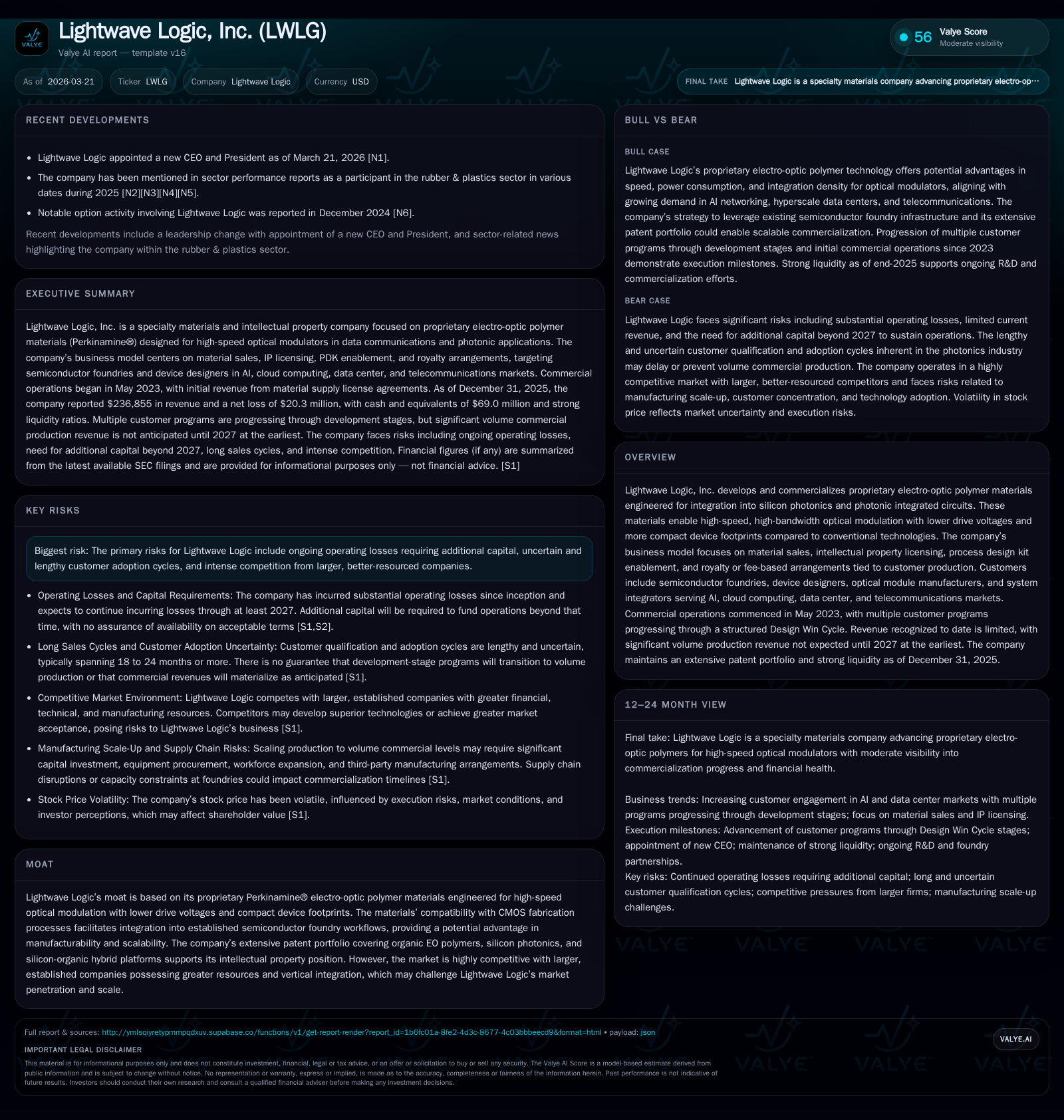
Lightwave Logic, Inc. is advancing proprietary electro-optic polymer materials designed for integration into silicon photonics to enable high-speed optical modulation with lower power requirements and compact device footprints. Since commercial operations began in mid-2023, revenue remains limited as multiple customer programs progress through an 18-24 month design cycle. The firm has incurred substantial operating losses since inception and expects continued negative cash flows through at least 2027, funded by existing cash reserves and potential future capital raises. Key risks include lengthy customer adoption cycles, competitive pressures from established chipmakers, and the challenge of scaling manufacturing within foundry ecosystems.
Historical Performance
Lightwave Logic’s financial history has been characterized by substantial operating losses as it advances its core technology. Its fiscal year revenues climbed from $40.5K in 2023 to $95.6K in 2024, reaching $236.9K in 2025, indicating early signs of commercialization but still negligible in absolute terms [F1]. Operating losses have remained significant though slightly improved: from approximately -$21.2M in 2023 to -$23.1M in 2024 before narrowing to about -$20.8M in 2025 [F1]. Net losses follow a similar pattern.
Operating cash flow has consistently been negative due to heavy R&D investments and limited revenue generation, with a CFO of -$13.7M in 2025 compared to -$15.6M the prior year [F1]. Capital expenditures have declined over the past two years—from $3.3M in 2023 to $1.3M in 2025—likely reflecting initial build-out phases tapering off as the company transitions toward commercialization [F1].
Equity surged significantly from $33.4M at end-2024 to $74.6M by the end of 2025 as the company raised capital through financings [F1], building a strong balance sheet to fund near-term operations.
Historical performance (annual)
| FY | Rev ($) | Net ($mm) | CFO ($mm) | OpInc ($mm) | Rev YoY | Net YoY |
|---|---|---|---|---|---|---|
| 2025 | 236855 | -20 | -14 | -21 | +147.7% | +9.9% |
| 2024 | 95605 | -23 | -16 | -23 | +136.1% | -7.1% |
| 2023 | 40502 | -21 | -12 | -21 | -22.1% | |
| 2022 | -17 | -10 | -17 |
Source: SEC companyfacts cache [F1].
Capital returns and efficiency (annual)
| FY | FCF ($mm) | ROE% |
|---|---|---|
| 2025 | -15 | -27.2 |
| 2024 | -18 | -67.4 |
| 2023 | -16 | -57.7 |
| 2022 | -12 | -62.5 |
Source: SEC companyfacts cache [F1].
*Approximate since FY23 data precedes FY24.
Business Model and Technology Overview
Lightwave Logic focuses on developing and licensing proprietary electro-optic polymer materials under its Perkinamine® brand for integration into silicon photonics (SiPh) platforms [S1][S27]. Unlike traditional silicon or III-V compound semiconductor modulators which often exhibit higher drive voltages or larger footprints, these organic EO polymers aim to provide:
- High-speed optical modulation suitable for modern data rates.
- Low-voltage operation reducing power consumption and simplifying driver electronics.
- Compact modulator footprints enabling higher integration density.
- CMOS compatibility facilitating fabrication within existing semiconductor foundry BEOL (back-end-of-line) process flows.
The company does not manufacture finished devices but supplies materials along with intellectual property licenses and process design kits (PDKs) that support material integration into customers’ fabrication flows [S1][S15]. Revenue streams include material sales (primarily for prototyping and initial production stages), royalty or fee-based licensing arrangements tied to production volumes by customers such as semiconductor foundries and module manufacturers [S15].
Industry Landscape and Future Growth Drivers
Targeted end markets encompass AI networking clusters, hyperscale cloud data centers, and telecommunications domains demanding ever-increasing bandwidths and energy-efficient interconnects [S5][S6]. Industry analysts forecast that the optical transceiver market serving these applications could reach up to $24 billion annually by the late-2020s with high-speed modulators accounting for a $1–2.5 billion niche segment [S5].
Growth prospects hinge on several factors:
- Successful qualification of polymer-based modulators within demanding telecom-grade reliability standards.
- Achievement of competitive cost structures against incumbent solutions including silicon photonics (SiPh) and Indium Phosphide platforms.
- Partnership progression through Lightwave Logic’s Design Win Cycle — an approximately two-year customer engagement covering evaluation through production readiness [S15][S25].
- Expansion of wafer manufacturing capacity among preferred foundries enabling volume deployment [S9][S27].
Risks include potential market resistance due to historical rejection of polymer modulators in telecom despite meeting Telcordia certifications [S21], technical hurdles related to yield improvements and environmental robustness at scale [S14], as well as competitive pressure from vertically integrated incumbents with advanced PIC platforms [S21].
Commercialization Milestones & Guidance
As of January 2026 multiple customers were reported actively progressing through development stages under Lightwave Logic’s structured commercialization framework [S27][N1]. Specifically:
- Three customer programs entered prototype-to-final product phases requiring custom material tuning and iterative design validation.
- Approximately fifteen additional engagements were earlier stages focused on initial evaluation or preliminary integration efforts.
Revenues recognized during calendar year 2026 are expected primarily from material sales for evaluation or prototyping as well as non-recurring engineering (NRE) fees associated with development support [S6][S15][S25]. The company does not anticipate meaningful revenue contribution from high-volume commercial production until at least calendar year 2027 due to the intrinsic length of the Design Win Cycle and required qualification milestones against yield and cost targets [S6][S25].
Potential delays may occur if allocation at semiconductor foundries becomes constrained or if technical validation encounters setbacks [S9][S22]. Hence timelines remain subject to substantial external dependencies including customer roadmap alignment and broader industry conditions.
Financial Returns & Capital Allocation
Lightwave Logic continues operating with negative returns so far given ongoing R&D spending combined with nascent revenue generation. Return on equity stood near negative ~27% in FY25 based on net loss relative to equity base of approximately $74.6 million at year-end [F1].
Free cash flow also remains negative around -$15 million driven by persistent operating cash flow deficits partially offset by relatively modest capital expenditures trending downward from prior years [F1].
The firm’s current liquidity position is supported by roughly $69 million in cash and equivalents sufficient under current budget plans through at least December 2027 absent unforeseen operational shifts or accelerated growth investments [S8][F1]. Capital allocation has prioritized sustaining R&D efforts targeted at material optimization—including electro-optic efficiency enhancements—and scale-up capabilities for pilot-level commercial supply [S12][S14][S27].
Capital raises have been executed previously including a Roth Sales Agreement facility providing up to $35 million from late-2022 with approximately $12 million remaining available as of early 2026 [S8]. Management acknowledges potential need for future financings depending on execution progress as they approach volume ramp milestones.
There are no declared dividends or share repurchase programs reflecting reinvestment focus at this developmental stage when net losses persist [F1][S8].
Key Risks & Operational Challenges
Several risk factors merit careful consideration given Lightwave Logic's current status:
- Sustained operating losses: Net losses exceeding $20 million annually require consistent access to capital markets or alternative funding sources beyond existing cash resources through at least late-2027 [F1][S16].
- Customer adoption uncertainties: Lengthy qualification cycles averaging approximately two years delay revenue recognition; transition from evaluation to production remains uncertain per individual customer outcomes [S15][S25][N1].
- Manufacturing scale-up: Material demand scale depends on successful transfer of back-end deposition processes into high-volume foundry environments; availability of wafer runs subject to external foundry scheduling constraints beyond direct control [S9][S18].
- Competitive environment: Adoption challenges arise amid competition by entrenched silicon photonics providers as well as compound semiconductor technologies potentially achieving cost-performance parity first at relevant speeds (~800 Gbps+) [S21][S26].
- Regulatory exposure: Operations involve hazardous chemical handling regulated under U.S. environmental law posing liability risks; also export controls may restrict sales/technology transfer internationally affecting commercial reach [S13][S14].
- Intellectual property litigation risk: Despite an extensive patent portfolio around EO polymers and hybrid photonic integration platforms supporting competitive moat claims there exists risk of third-party infringement claims imposing costly legal exposure or injunctions [S10][S19].
- Cybersecurity threats: Potential breaches exposing proprietary research or confidential business information could disrupt operations or damage reputation given reliance on digital systems [S19].
Operational Footprint & Human Capital
Research & development activities are centralized in Lightwave Logic’s Englewood Colorado facility supporting polymer synthesis, device integration support including back-end-of-line process development aligned with foundry workflows plus limited commercial material supply activities reflective of early stage deployment plans [S11][S23]. As of end-2025 workforce comprised around 34 full-time employees largely technical personnel specialized across chemistry, photonics engineering, device physics, process integration plus SG&A roles underpinning commercialization efforts [S22].[N1]
The company emphasizes cross-functional collaboration needed to navigate complex interdisciplinary challenges associated with organic EO polymer innovation embedded within silicon photonics ecosystems.
Sector Context Analysis
The broader silicon photonics market is witnessing rapid evolution catalyzed by exponential demands arising from AI compute clustering driving hyperscale data center expansion globally. Optical interconnects underpin energy-efficient high-bandwidth links essential to minimizing overall system power consumption while maximizing link density — precisely where polymer-based EO modulators aim to stake out differentiation via their lower voltage operation combined with compact form factors compatible with CMOS processes.
However adoption inertia favors incumbent waveguide materials like silicon itself or III-V compounds used widely today notwithstanding their higher drive voltages or footprint disadvantages because mature supply chains exist delivering economies of scale unmatched by newer entrants such as Lightwave Logic attempting disruptive organic polymer alternatives.
Given these factors success requires demonstrating unequivocal performance benefits combined with manufacturability scalability — bridging innovation cycles including intellectual property protection plus rigorous qualification testing meeting telecom standards — all within tight cost envelopes demanded by hyperscale buyers focused intensely on total cost of ownership metrics per gigabit per second bandwidth delivered.
Conclusion & Monitoring Points
Lightwave Logic is navigating an inherently challenging transition phase moving from research-centric operations toward eventual commercial supply within cutting-edge photonic device space leveraging unique electro-optic polymer technology. Revenue growth remains embryonic but shows signs advancing through structured Design Win Cycles with multiple customers engaged across various stages.
Outstanding considerations for further surveillance include pace of customer program transitions into prototype finalization stages advancing toward production ramp starting earliest in calendar year 2027; progress made embedding EO polymer deposition steps within preferred third-party foundry back-end integrations; achievement of reliability standards aligning with telecom-grade certifications; competitive developments within silicon photonics achieving cost-performance milestones impacting market receptivity toward polymers; judicious capital management maintaining runway amid significant operating deficits.
Investors should note that sizable negative returns likely will persist short term while operating expenses dominate; successful conversion of pipeline engagements into scalable royalties or material supply revenue critical for demonstrating viability beyond experimental deployments.
This analysis is based exclusively on publicly available information including SEC filings up to March 20th, 2026 ([F1],[S#]) and credible news releases ([N#]). No forecasts herein constitute investment advice but seek only to summarize company fundamentals and contextual industry dynamics objectively.
Disclaimer: This is research-only, informational analysis and not investment advice. It may include AI-generated interpretation and general industry context. Always verify important details using primary sources.

Comments