
Cardinal Infrastructure Group’s Post-IPO Expansion and Capital Structure Underpin Regional Growth
Cardinal Infrastructure leverages recent acquisitions and a strengthened balance sheet to advance its land and site preparation business in the Carolinas.
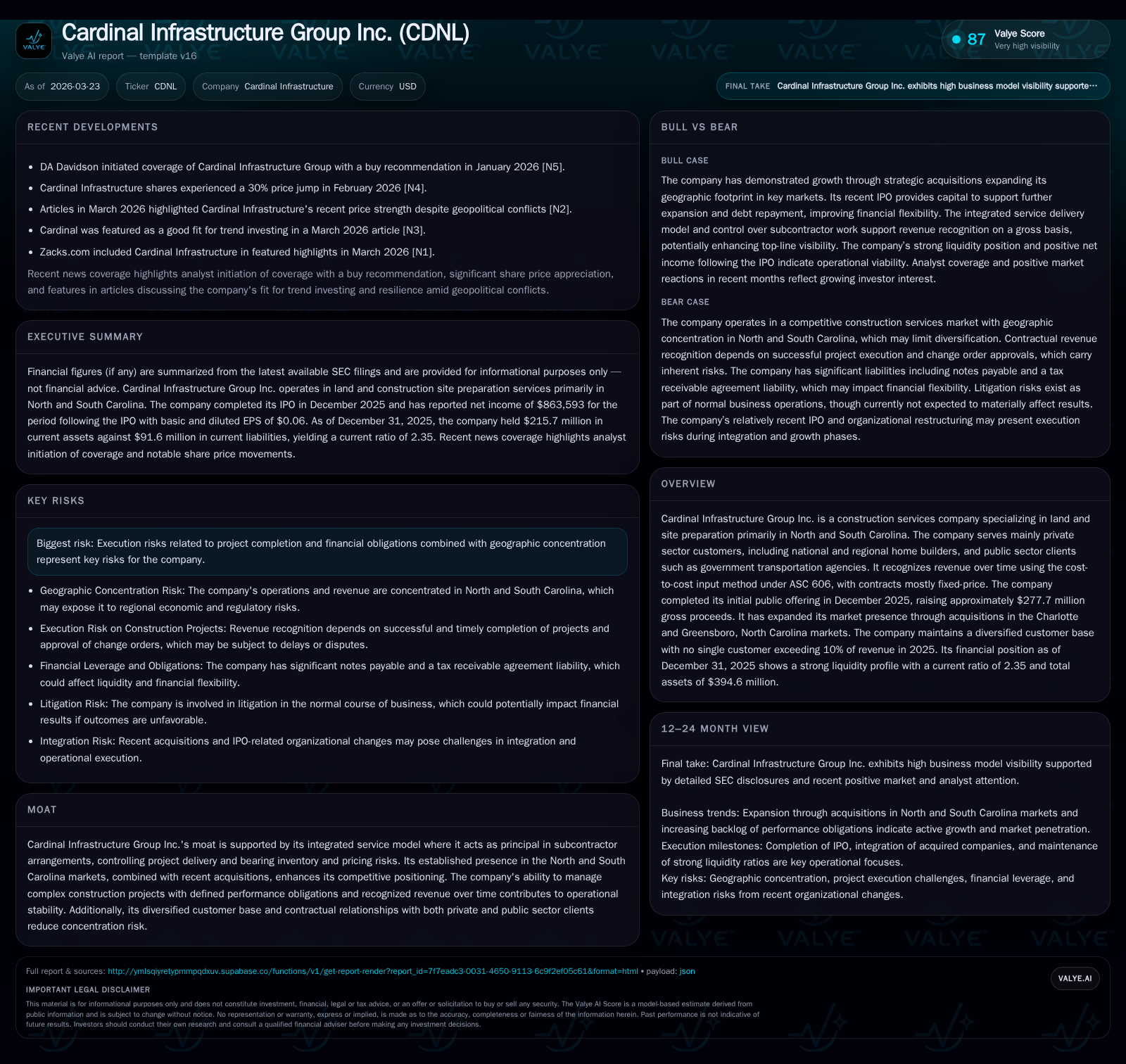
Cardinal Infrastructure Group Inc. entered public markets in late 2025, raising significant capital to fuel acquisition-led growth primarily focused on North and South Carolina. The company’s revenue expanded substantially from 2023 to 2025, driven by strategic purchases of regional competitors and a growing project backlog. Operating income reached $40.4 million in 2025, while net income remained modest at $0.9 million, reflecting investments and financing costs. Cardinal maintains strong liquidity with a current ratio of 2.35 and cash near $97 million at year-end 2025. The company’s capital structure features a $120 million senior secured term loan facility with scheduled amortization and favorable covenant compliance. Backlog growth to approximately $517 million supports continued expansion, balanced against execution risks in fixed-price contracts concentrated geographically.
Company Background and IPO
Cardinal Infrastructure Group Inc., publicly listed since December 2025, operates primarily in land development and site preparation services focused on residential homebuilding projects across North and South Carolina [S1]. Its customer base consists mainly of private national and regional homebuilders supplemented by public sector contracts such as government transportation agencies [S12]. Revenue recognition follows fixed-price contract accounting under ASC 606 using the cost-to-cost method [S6].
The company's initial public offering generated gross proceeds of approximately $277.7 million in December 2025 [S22], enabling significant capital deployment toward strategic acquisitions including Purcell, Red Clay, Roadways, and Page in Charlotte and Greensboro metropolitan areas [S12]. These acquisitions have expanded Cardinal's regional presence while materially increasing backlog.
Historical Financial Performance
From fiscal years ending December 31, 2023 through December 31, 2025, Cardinal experienced rapid revenue growth accompanied by scaling operations. Key financial metrics are summarized below:
Historical performance (annual)
| FY |
|---|
| 2025 |
Source: SEC companyfacts cache [F1].
Revenue estimates for earlier years derive from disclosed backlog expansions and segment disclosures [S12]. Operating income of $40.4 million for the latest period indicates effective operational leverage despite significant investments [F1]. Net income remains modest at approximately $0.9 million, resulting in an estimated ROE of about 0.6%, reflecting higher interest expenses exceeding $7 million annually due to recent debt issuances [F1][S27].
Capital expenditures surged from $20.8 million in 2024 to $43.8 million in 2025 as the company commenced construction of its own asphalt manufacturing plant alongside fleet modernization efforts [S14].
Cash flow from operations is positive at roughly $37 million; however, free cash flow is negative reflecting elevated capital spending [F1]. Liquidity remains strong with current assets more than double current liabilities yielding a current ratio of approximately 2.35 at year-end [F1].
Capital Structure & Liquidity
Post-IPO refinancing established a robust capital structure featuring a senior secured credit facility with a revolving component up to $75 million plus a term loan facility totaling $120 million maturing October 2030 [S8]. Interest rates are tied to SOFR plus margins ranging between approximately 0.875% to over 2%, dependent on leverage ratios, resulting in an effective interest rate near mid-6% as of December 31, 2025 [S17]. Scheduled principal amortization begins Q1 2026 initially at five percent annually rising over five years.
The credit facilities are secured by substantially all company assets including newly acquired equipment refinanced via IPO proceeds [S26][S9]. Total notes payable stood at around $121 million net of amortized issuance costs as of year-end [S9][S22].
Cash reserves increased markedly post-IPO reaching approximately $97 million at year-end versus roughly $21 million previously providing ample liquidity for operational contingencies and capital investment demands [F1][S20].
Market Position & Backlog Growth
Cardinal maintains leadership in its core regional market through integrated service delivery acting as principal subcontractor managing project execution end-to-end which controls procurement timing, mitigates price volatility risks, and optimizes inventory levels.
Contract backlog representing performance obligations yet to be completed expanded substantially to roughly $517 million as of December 31, 2025 compared with about half that two years prior [S12]. Nearly all contracts are located within North and South Carolina confirming geographic concentration but diversified across multiple customers with no single client exceeding ten percent of total revenues mitigating concentration risk meaningfully [S23][S12]. Private sector customers accounted for over ninety-five percent of revenue while public sector contracts provide stable governmental revenue streams offering counter-cyclical protection.
Recent acquisitions notably enhanced presence in Charlotte—a high-growth residential construction market—and Greensboro expanding scale benefits alongside network reach within these important metropolitan areas [N4][S12].
Growth Drivers & Risks
Key drivers supporting growth include:
- Strong regional housing demand: Population inflows into the Carolinas sustain robust land development activity.
- Operational enhancements: Asphalt plant construction reduces reliance on third-party suppliers improving cost control.
- Acquisition strategy: Targeted bolt-on acquisitions broaden geographic footprint and service capabilities.
- Backlog strength: Large contracted work pipeline supports revenue visibility over the near term.
Principal risks involve execution challenges inherent to fixed-price contracts where cost overruns or scheduling delays could impact margins adversely; geographic concentration also exposes the company to regional economic cycles [S19]. Debt service obligations require careful leverage management especially amid interest rate fluctuations given elevated borrowing costs [F1].
Outlook Considerations
While explicit forward guidance is not provided, investors should monitor:
- Progress toward profitability improvements as asphalt plant becomes fully operational.
- Conversion rates from backlog into recognized revenue indicating sustained contract awards.
- Integration effectiveness of recent acquisitions influencing synergies.
- Capital expenditure trends affecting free cash flow generation.
- Compliance with debt covenants alongside scheduled amortization adherence.
- Changes in customer or geographic diversification strategies impacting risk profile.
Overall, Cardinal Infrastructure Group’s post-IPO transformation underscores ambitions to consolidate fragmented regional infrastructure services fueled by substantial capital investment balanced against operational execution risks typical within fixed-price construction sectors.
Disclaimer: This analysis is based solely on reviewed SEC filings, news releases, and publicly available data without offering investment advice or recommendations.
Disclaimer: This is research-only, informational analysis and not investment advice. It may include AI-generated interpretation and general industry context. Always verify important details using primary sources.

Comments