
Cadeler A/S Drives Offshore Wind Growth with Specialized Fleet and Financial Discipline
Cadeler leverages its specialized jack-up vessels, recent upgrades, and disciplined capital structure to capitalize on rising offshore wind installation demand.
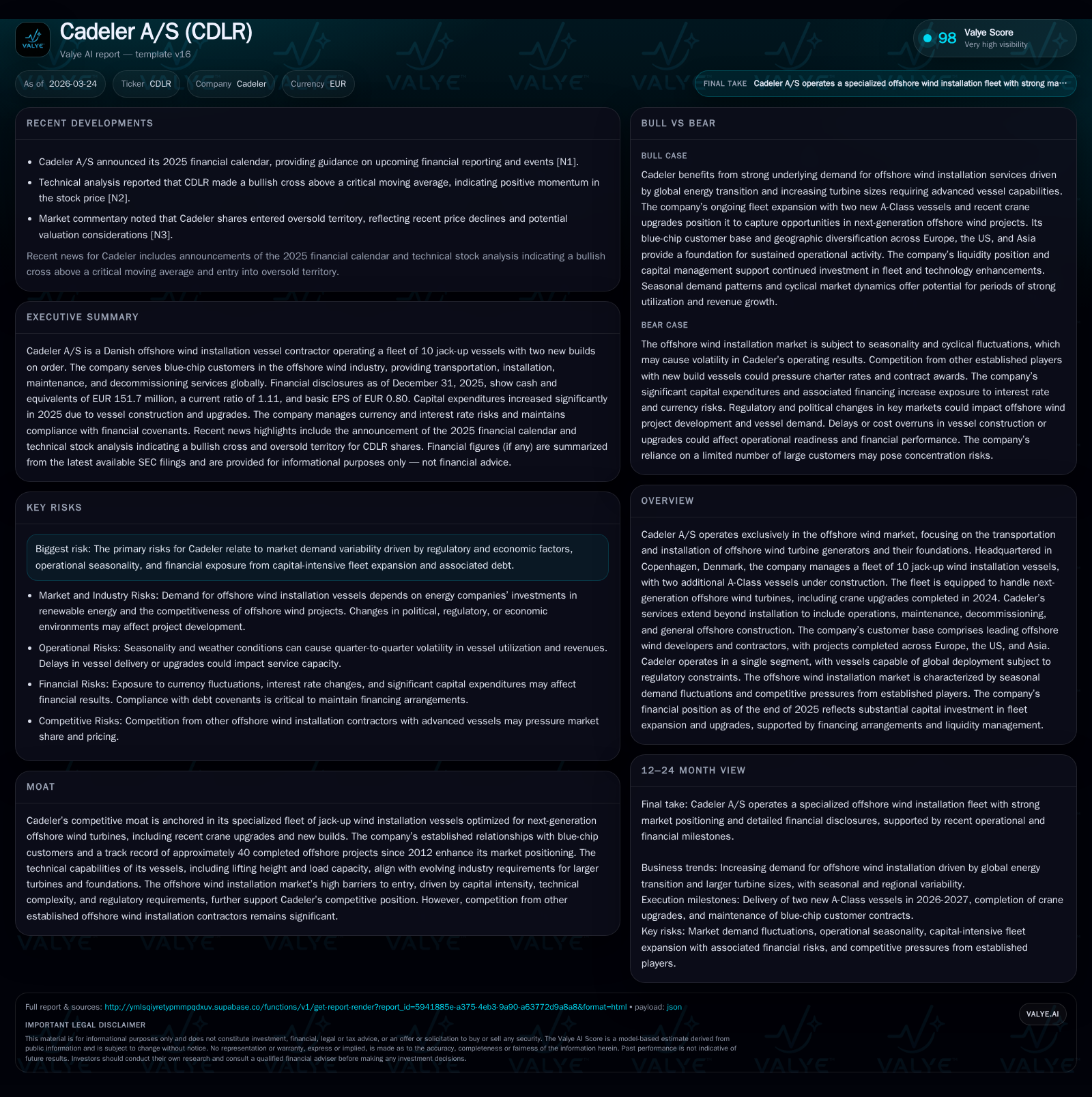
Cadeler A/S has demonstrated strong historical growth anchored by its specialized fleet of ten jack-up wind installation vessels, complemented by recent crane upgrades and two new A-Class vessels under construction. The company reported sharp profit and adjusted EBITDA improvements in 2025, supported by increasing vessel utilization and expanded fleet capabilities. While its capital-intensive expansion has raised leverage and finance costs, Cadeler maintains covenant compliance through refinancing and access to green financing facilities. Looking ahead, vessel deliveries scheduled through early 2026 and a robust order book underpin growth prospects amid global offshore wind market tailwinds. Currency exposure and regulatory dynamics pose notable risks that management actively mitigates.
Evolution of Cadeler’s Growth: Scale, Capability, and Project Milestones
Cadeler A/S was founded in Denmark in early 2008 focusing solely on the offshore wind sector. Over nearly two decades, it has built a specialized fleet currently comprising ten jack-up wind installation vessels tailored to the transportation and installation of offshore WTGs (wind turbine generators) and their foundations. Since 2012, Cadeler has completed approximately 40 projects across key markets including Europe, the US, and Asia [S1].
The company's growth trajectory is closely linked to strategic fleet expansion combined with capability enhancements — notably the completion of major crane upgrades in 2024 designed to accommodate next-generation turbines featuring higher lifting requirements [S1]. This improved lifting height and load capacity enables Cadeler's vessels to meet evolving technical specifications.
Alongside this organic growth, Cadeler secured multiple vessel newbuild contracts with prominent shipyards such as COSCO for P-Class and A-Class vessels as well as Hanwha Ocean for M-Class vessels [S12]. Deliveries commenced in mid-2024 with Wind Peak (P-Class) followed by Wind Pace (P-Class) in early 2025; two M-Class vessels were delivered in January and November 2025 [S5][S21].
The fleet expansion culminated recently with the delivery of Wind Ally (A-Class) ahead of schedule in September 2025, while the second A-Class vessel Wind Ace is scheduled for Q1 2026 [S5]. These additions increase operational scale and serve as critical revenue drivers validated by signed contracts.
Fleet Specialization and Technical Enhancements Driving Market Leadership
Cadeler maintains a technically differentiated fleet primarily consisting of jack-up wind installation vessels. Jack-up vessels provide a stable platform offshore by jacking their legs down onto the seabed allowing precision operations required for installing heavy WTGs and foundations under challenging marine conditions [S28].
The company’s recent crane upgrade initiative completed in 2024 increased lifting heights beyond previous limits to handle larger turbines now common in the offshore market. This technical moat ensures compliance with industry demands where turbine size growth requires greater lifting capacities [S1][S28].
Moreover, the construction of new A-Class vessels extends Cadeler’s capabilities. These state-of-the-art ships boast enhanced payloads and improved fuel efficiency relative to older classes, positioning Cadeler favorably against peers. The ability of these vessels to operate globally but constrained by regulations highlights operational flexibility within strict safety frameworks [S1].
Navigating Financial Structure: Capital Allocation, Debt Facilities, and Covenant Discipline
Cadeler’s capital structure reflects its asset-backed business model reliant on substantial external funding for newbuild acquisitions and fleet upgrades.
At year-end December 31, 2025, total interest-bearing debt was approximately EUR 1.7 billion — a marked increase due primarily to financing agreements linked to newbuild deliveries [F1][S10][S17]. Key debt facilities include:
- Green Corporate Facility with revolving credit lines totaling up to EUR 550 million,
- P-Class Facility financing two P-class vessels,
- M-Class Facilities I & II refinancing senior secured loans for two M-class vessels,
- A-Class Facility arranging funds for ongoing A-class shipbuilding,
- HoldCo unsecured facilities providing general corporate liquidity [S4][S5][S14][S17].
All credit facilities include customary covenants such as minimum freely available cash thresholds (e.g., €35–50 million), equity ratios (≥35%), positive working capital requirements (>0), dividend restrictions limiting payouts to no more than fifty percent of consolidated net profit without lender approval, change-of-control clauses protecting lender interests, and debt service coverage ratios requiring at least a 2:1 ratio over HoldCo Facility debt service obligations [S4][S6][S14].
As of December 31, 2025, Cadeler reported full compliance with all covenants; leverage metrics will be closely monitored as the company executes further capital expenditures on existing ordered ships [S4][S6]. Dividend distributions remain controlled pending achievement of vessel delivery milestones.
Unpacking 2025 Performance: Revenue, Profitability, and Cash Flow Trends
Fiscal year-end December 31, 2025 marked a significant inflection reflecting operational leverage from fleet expansion and project execution efficiencies.
| Metric | 2024 (EUR million) | % Change YoY | 2025 (EUR million) | Notes |
|---|---|---|---|---|
| Profit for the Period | 65.1 | +330% | 280.2 | Net income surged driven by higher utilization [S1] |
| Income Tax Expense/(Credit) | 2.4 | N/A | 7.7 | Increase aligned with rising profits [S1] |
| Finance Costs | 7.2 | N/A | 37.4 | Higher interest reflecting debt-funded expansion [S1] |
| Depreciation & Amortization | 56.5 | N/A | 107.6 | Reflects capitalization of newbuilds [S1] |
| Adjusted EBITDA | 126 | +237% | 425.4 | Key underlying performance indicator [S1] |
| Cash & Cash Equivalents End Period | N/A | N/A | 151.7 | Solid liquidity position [F1] |
| Current Ratio (Current Assets / Liabilities) | N/A | N/A | 1.11 | Stable short-term liquidity [F1] |
Cash generated from operations reached approximately EUR 394 million compared with about EUR 93 million prior year reflecting project delivery timing coupled with increased vessel utilization [F1][S20]. Financing activities included strategic drawdowns to meet installment payments on shipbuilding commitments amounting to roughly USD 496 million over coming periods [S7][S8].
Emerging Opportunities and Potential Headwinds in Global Offshore Wind Markets
Offshore wind markets worldwide continue dynamic growth driven by aggressive renewable energy targets across Europe, North America, and parts of Asia-Pacific where Cadeler operates.
Key opportunities include:
- Increasing scale of offshore projects requiring larger WTGs demanding sophisticated installation assets,
- Limited supply pipeline for highly specialized jack-up vessels constraining competition,
- Expansion into operations & maintenance services broadening revenue streams beyond installation alone.
Challenges comprise:
- Execution delays owing to weather seasonality impacting offshore windows,
- Regulatory uncertainties affecting project timing or permitting,
- Capital intensity amplifying financial risk through leveraged expansions [S1].
Given international deployment ability subject to permitting constraints alongside stringent safety regulations governing jack-up operations, Cadeler must maintain operational agility allied with meticulous project scheduling coordination.
Investment Signals: Order Book, New Builds, and Customer Contracts to Monitor
Critical value inflection points revolve around cadence in delivering contracted orders tied mostly to newly commissioned vessels:
- Delivery of second A-Class vessel (Wind Ace) expected Q1 2026;
- Ongoing construction milestones for third A-Class ship with contract values aggregating near EUR ~1 billion overall;
- Contract awards from blue-chip developers providing multi-year revenue visibility.
Monitoring contract backlog replenishment post these milestone deliveries will be pivotal given continued capex-driven financing needs [S5][N1]. Any acceleration or delay will influence both revenue streams and liquidity profiles materially.
Balancing Risk with Reward: Currency Exposure, Interest Rates, and Operational Cyclicality
Financial risk oversight remains key given exposure primarily via:
- Currency Risks: Functional currency is EUR but significant payment obligations denominated in USD (~USD 496 million related to newbuild installments) necessitate active hedging programs reducing earnings volatility impacts; cash holdings also maintained largely in USD and GBP enabling partial natural hedges [S22];
- Interest Rate Risk: Most debt facilities indexed to three-month EURIBOR plus margin; rate rises increased interest expense by about EUR 15.6 million annually if fully drawn but partly mitigated via capitalization treatments under IFRS standards on borrowing costs [S11];
- Operational Seasonality: Offshore installation works face weather window constraints limiting quarter-to-quarter revenue consistency requiring prudent working capital planning.
Outlook Analysis: Strategic Priorities for Sustainable Profitability and Expansion
Management emphasizes sustaining momentum through accelerated vessel capability investments balanced against rigorous debt servicing discipline ensuring covenant compliance going forward [N1]. Strategic priorities include:
- Completion and onboarding of remaining A-Class vessels expanding premium asset base,
- Pursuit of contract awards aligned with large-scale offshore projects geared toward advanced WTGs implying ongoing demand for technically capable platforms,
- Navigating complex regulatory environments coupled with economic variables affecting project pipelines globally.
In absence of explicit forward guidance beyond public milestone notifications [N1], key performance indicators aligning capital expenditure schedules against cash flow generation will serve as barometers for long-term financial health.
This analysis synthesizes publicly available data from SEC filings (20-F), Nasdaq news releases referencing Cadeler’s FY25 results dated March 24, 2026, and company disclosures without providing investment advice.
Disclaimer: This is research-only, informational analysis and not investment advice. It may include AI-generated interpretation and general industry context. Always verify important details using primary sources.

Comments