
Willamette Valley Vineyards Reports Revenue Decline and Operating Loss in 2025 Amid Elevated Debt
The Oregon-based winery faces challenges from declining sales volumes and competitive pressures while managing increased financial leverage and cautious capital expenditures.
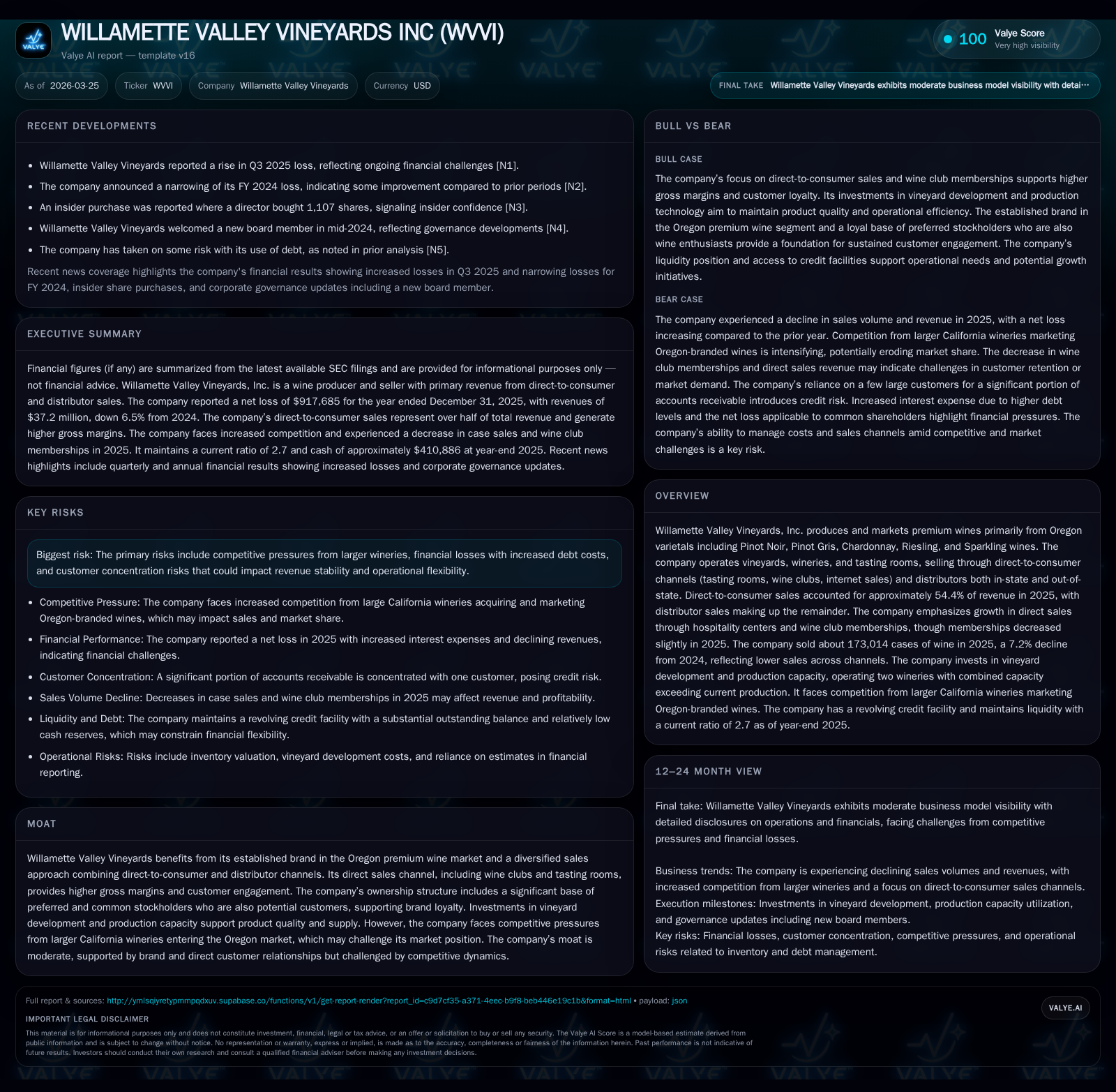
Willamette Valley Vineyards, Inc. recorded a 6.5% revenue decline to $37.2 million in fiscal 2025 with an operating loss of $1.4 million after a positive operating income in the prior year. Case shipments fell 7.2% to approximately 173,000 units, reflecting softness across direct-to-consumer and distributor channels. The company’s capital structure includes over $15 million in long-term debt at an average interest rate of roughly 6.3%, alongside a $3.1 million line of credit balance with a covenant waiver in place. While preferred stock issuances continue to support operations, no common stock dividends are planned. Capital expenditures moderated sharply to $444K, and the company maintains capacity to scale production if demand improves. Competitive pressures from larger California wineries encroaching on Oregon-branded wines add further challenges.
Company Overview and Market Position
Willamette Valley Vineyards, Inc., based in Oregon, operates vineyards, wineries, and tasting rooms producing premium wines focused on varietals such as Pinot Noir and Pinot Gris [S1]. The company sells through two primary channels: direct-to-consumer (DTC) including tasting rooms, wine clubs, and online sales representing just over half (54.4%) of total revenue in fiscal 2025; and national distributor sales accounting for the remainder [S7][S10]. This dual approach balances scale with higher-margin consumer engagement.
The brand benefits from its association with the Willamette Valley AVA designation and has built a loyal customer base supported by approximately 14,800 preferred stockholders who are often wine enthusiasts [S14]. However, competition has increased as large California wineries enter the Oregon-branded wine segment, creating pressure on market share and pricing [S8].
Historical Financial Performance
The following table summarizes key financial metrics for the fiscal years ending December 31:
Historical performance (annual)
| FY | Rev ($mm) | Net ($) | CFO ($mm) | OpInc ($) | Rev YoY | Net YoY |
|---|---|---|---|---|---|---|
| 2025 | 37 | -917685 | -2 | -1436172 | -6.5% | -678.4% |
| 2024 | 40 | -117894 | -3 | 571858 | +1.7% | +90.2% |
| 2023 | 39 | -1198593 | -2 | -1207202 | +15.3% | -85.4% |
| 2022 | 34 | -646492 | -3 | -546418 |
Source: SEC companyfacts cache [F1].
Capital returns and efficiency (annual)
| FY | FCF ($mm) | ROE% |
|---|---|---|
| 2025 | -2 | -1.4 |
| 2024 | -5 | -0.2 |
| 2023 | -6 | -1.7 |
| 2022 | -17 | -0.9 |
Source: SEC companyfacts cache [F1].
Revenue peaked around FY2023 before declining notably in FY2024-25. Operating income shifted from a modest profit in FY2024 back into loss territory in FY2025 due largely to lower sales volumes coupled with sustained selling expenses [F1]. Net losses have persisted but increased significantly last year.
Operating cash flows remain negative reflecting working capital demands despite reductions in capital spending which tapered sharply following substantial investments earlier in the period [F1].
Sales Volumes and Channel Dynamics
Total cases sold declined by approximately 7.2% year-over-year to roughly 173,014 cases in calendar year 2025 from about 186,419 cases previously [S14]. Both direct-to-consumer sales volume and distributor sales contributed to this decline.
Direct-to-consumer sales provide higher gross margins due to pricing closer to retail levels but experienced a decline in wine club memberships by around 700 members during the year [S14]. The distributor channel remains critical for broader reach but exhibits thinner margins and concentration risk with one distributor accounting for about one-sixth of revenues [S15].
Operational Capacity and Vineyard Development
The winery's annual production capacity comfortably exceeds current output levels; estate winery capacity is approximately 275,000 cases with additional storage at Tualatin Winery supporting up to about another 28,000 cases [S10]. Capital expenditures declined substantially to $444K in FY2025 from over $1.8 million the prior year indicating cautious investment amid uncertain demand trends [F1][S23].
Approximately three-quarters of grapes used are grown internally on company-owned vineyards providing vertical integration benefits but exposing the business to agricultural risks such as phylloxera infestations present at some sites along with weather-related risks like early autumn rains or wildfire smoke impacting grape quality .
Profitability and Margins
Gross profit contracted last year driven by reduced sales volumes combined with relatively stable or increasing selling expenses which include hospitality center operations that contribute to fixed costs [S13][F1]. Direct-to-consumer sales command higher gross margins than distributor sales but overall margin pressures persist due to volume declines.
Interest expense increased approximately fifteen percent year-over-year due to higher average debt balances amid rising interest rates totaling over $1.12 million paid during FY2025 [F1][S11]. These factors compounded EBITDA compression resulting from both revenue decreases and cost pressures.
Capital Structure and Liquidity
As of December 31, 2025 Willamette Valley Vineyards held long-term debt totaling approximately $15.18 million up from about $14 million the prior year consisting primarily of four AgWest loans bearing fixed interest rates ranging roughly between 4.75% and 6.66%, secured against vineyard properties [F1][S9][S18]. The weighted average borrowing cost was near six-point-three percent.
A revolving line of credit renewed mid-2025 allows borrowings up to $5 million; outstanding balance was approximately $3.14 million at year-end bearing interest at seven percent [S5][F1]. A covenant breach related to debt was waived until December 31st, 2026 providing temporary relief on financial flexibility [S5][S15].
Cash reserves were limited at roughly $410K at fiscal year-end underscoring liquidity constraints given ongoing negative operating cash flows primarily influenced by working capital fluctuations including receivables concentration where one customer represented about forty-five percent of accounts receivable balances at year-end [F1][S15].
Preferred equity remains a key funding source with recent continuous offerings raising net proceeds near $6 million supporting operations without diluting common shareholders; preferred dividends accrue annually while no dividends have been declared or planned for common stock holders [F1][S6][S12]. No share repurchases occurred recently.
Outlook and Risks
While explicit forward guidance is not provided within filings reviewed there is emphasis on stabilizing or growing direct-to-consumer sales through hospitality initiatives and wine club engagement which are critical for margin expansion given their higher profitability relative to wholesale distribution channels [S14]. Existing production capacity supports potential growth if demand rebounds.
Risks include agricultural vulnerabilities such as pest infestations (phylloxera), unpredictable weather impacting grape quality or yields (e.g., smoke exposure), plus intensifying competition from large California wineries expanding Oregon-branded portfolios which could erode pricing power and brand distinctiveness historically associated with Willamette Valley wines [S8][S25].
Financially elevated leverage exposes the firm to interest rate risk and covenant compliance scrutiny necessitating prudent balance sheet management alongside efforts to improve operational cash flows.
Conclusion
Willamette Valley Vineyards operates within a niche premium wine segment characterized by strong regional identity yet faces multiple headwinds including declining case volumes impacting revenues and profitability; elevated fixed costs compressing margins; rising debt levels constraining liquidity; plus external competitive forces challenging market positioning.
The company's strategy centers on enhancing direct consumer relationships while cautiously managing capital investments aligned with demand conditions. Maintaining financial discipline particularly around debt covenants will be crucial as it navigates these challenges.
This analysis is based exclusively on publicly available SEC filings as of March 25th, 2026 ([F1],[S#]) without any speculative information or forward-looking statements beyond disclosed content.
Disclaimer: This is research-only, informational analysis and not investment advice. It may include AI-generated interpretation and general industry context. Always verify important details using primary sources.

Comments