
Brazil Potash Corp. Advances Autazes Project with Strategic Partnerships and Rigorous Indigenous Engagement
Brazil Potash Corp. progresses development of its Autazes potash project through robust permitting, community collaboration, and capital initiatives.
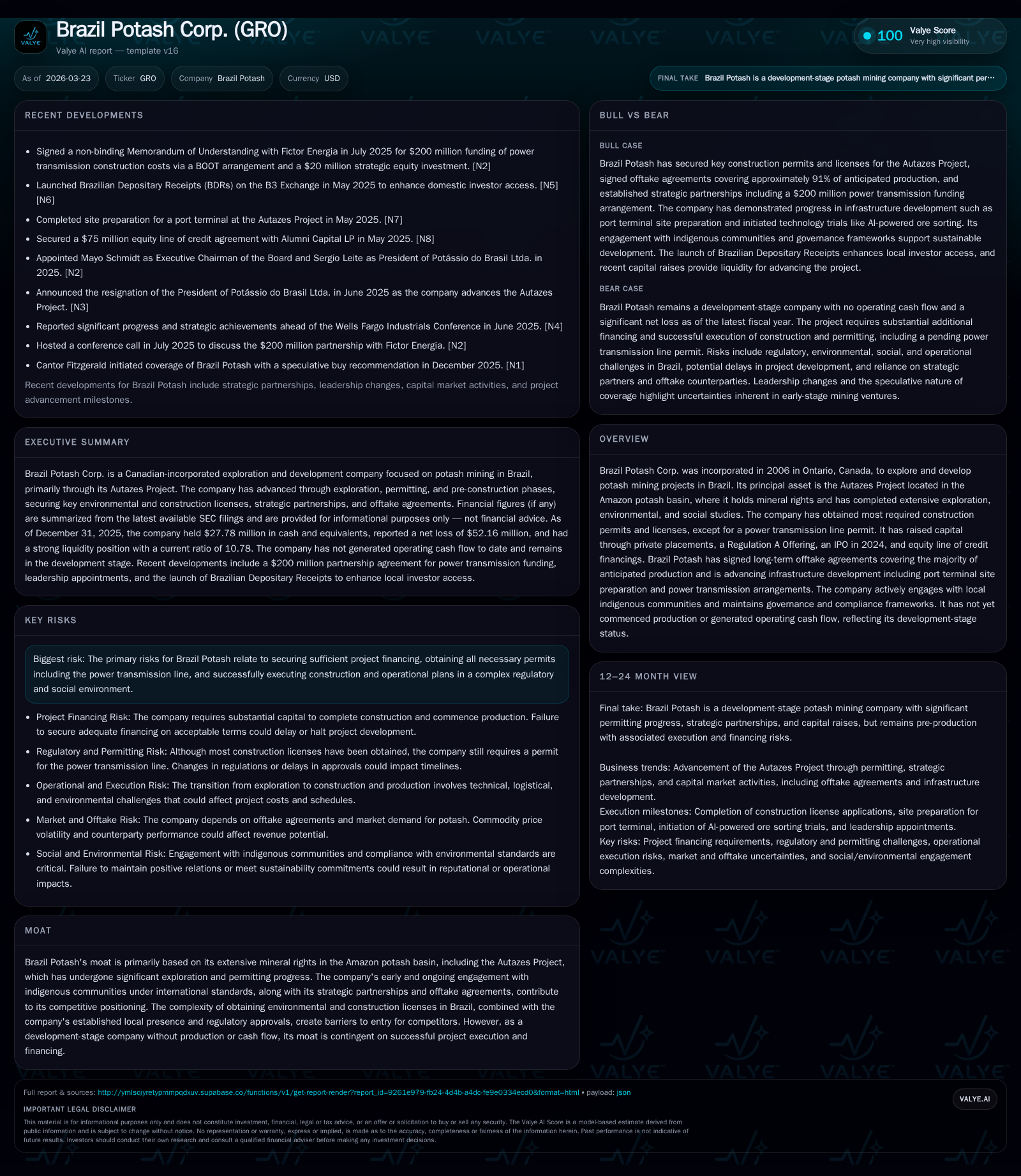
Brazil Potash Corp., established in 2006 to unlock potash potential in Brazil’s Amazon basin, has steadily expanded its mineral rights and completed key environmental and social permitting milestones at the Autazes Project. The company’s strategic partnerships, including long-term offtake agreements and infrastructure collaborations, complement its pioneering adherence to ILO Convention 169 for indigenous consultations. Despite successful equity raises and solid current liquidity, Brazil Potash faces critical permitting hurdles—particularly a pending power transmission line permit—and project execution risks in a complex regulatory environment. Returns remain negative as expected for a development-stage miner, with management compensation aligned towards long-term value creation.
From Exploration to Development: Historical Growth and Exploration Milestones
Brazil Potash Corp., incorporated in Ontario in October 2006, embarked on a focused mission to explore potash deposits within Brazil’s Amazon basin. Early progress was marked by the establishment of its wholly owned Brazilian subsidiary, Potássio do Brasil Ltda., which initiated regulatory filings for mineral exploration at the Autazes Property as early as 2008 [S1][S2].
Between 2009 and 2014, incremental private placements cumulatively raised over $140 million (including $25.4 million in 2009, $8.6 million in 2011, $43.8 million in 2012, among others) enabling the company to advance drilling campaigns and expand mineral rights [S1][S16]. During this period, the Brazilian National Mining Agency granted a series of five exploration permits from 2009 through 2011, establishing critical tenure over Autazes [S1]. The company concurrently secured environmental exploration licenses from the Amazonas Environmental Protection Institute (IPAAM).
This foundational period culminated in initiating social and environmental studies essential for construction permitting stages. Canada-based ERCOSPLAN completed a preliminary economic assessment that underpinned financing efforts in subsequent years [S16]. These milestones attracted further capital through warrant exercises and private placements through to early 2015.
Historical performance (annual)
| FY | Net ($mm) | Net YoY |
|---|---|---|
| 2025 | -52 | -12.4% |
| 2024 | -46 |
Source: SEC companyfacts cache [F1].
Capital returns and efficiency (annual)
| FY | ROE% |
|---|---|
| 2025 | -33.0 |
| 2024 | -34.3 |
Source: SEC companyfacts cache [F1].
Net losses deepened slightly year-over-year, reflective of ongoing developmental investment without operational cash inflows ([F1]).
Project Architecture: Key Drivers Behind Autazes’ Advancement
The Autazes Project remains Brazil Potash’s cornerstone asset covering roughly 680 square miles within one of the world’s largest untapped potash basins [S25]. Securing the mineral rights via successive exploration permits allowed the company exclusive access to multiple ore bodies near communities including Autazes itself.
Critical infrastructure inputs are advancing: port terminal site preparation activities near Urucurituba are underway to facilitate mine-to-port logistics essential for bulk export operations [S1][S14]. Further upstream is the pending federal licensing for a dedicated power transmission line crucial for connecting the mine facility to Brazil's national electricity grid — the sole major outstanding construction permit delaying full-scale project execution [S8][S14].
Offtake visibility is robust with signed long-term agreements covering about 91% of projected production volumes spanning contracts from ten up to seventeen years with regional buyers such as Keytrade, Kimia, and Amaggi [S14]. Such arrangements mitigate market risk exposure during ramp-up phases.
Environmental Approvals and Regulatory Risks Unique to Brazilian Mining
Autazes’ progress illustrates Brazil's complex permitting landscape where overlapping federal, state (Amazonas Environmental Protection Institute), and local agency jurisdictions interlock tightly [S3][S20]. The company has obtained the necessary environmental permits for construction stages but faces persistent legal challenges initiated by Brazil’s federal prosecutor office (Ministério Público Federal).
A notable example includes the May 2024 Civil Lawsuit aimed at suspending environmental licensing based on procedural claims regarding indigenous consultation compliance under ILO Convention 169 [S4]. The Lower Court posed several suspensions between 2023-2024 but appellate courts repeatedly reinstated licenses ([S12],[S20]). However, any adverse appellate decision could halt construction temporarily while contested at higher courts.
The Licenses governing water withdrawal involve deep wells authorized by IPAAM providing potable water supply commitments aligning with sustainable water stewardship principles [S17]. Tailings management plans envision natural dissolution stockpiles redirecting brine solutions underground into aquifers—a common regulatory-sensitive mechanism within potash mining.
The Indigenous Collaboration Model: A Strategic Moat and Social License
Brazil Potash is recognized as one of the first companies in Brazil practicing indigenous consultation rigorously following International Labour Organization Convention 169 standards instead of more general FUNAI directives [S3][S12][S19]. This protocol accords full autonomy to indigenous communities — primarily the Mura people — on how consultations proceed.
In January 2025, the company’s subsidiary formalized a cooperation agreement with the Mura Indigenous Council establishing frameworks such as 'Plano Bem Viver Mura,' emphasizing sustainable socio-economic development initiatives directly proposed by indigenous representatives [S19]. This holistic engagement extends beyond customary CSR programs by embedding direct employment of local indigenous workers and preferential supply contracts to indigenous-owned companies.
The initiative aims not only to uphold legal permitting robustness but builds a lasting reputational moat difficult for competitors lacking such embedded community relationships to replicate.
Capital Structure, Equity Raises, and Liquidity Post-IPO
Brazil Potash transitioned from private financing rounds to public markets successfully completing its IPO on November 27, 2024 raising $30 million gross proceeds on NYSE American under ticker "GRO" [S14]. Since then it supplemented capital through an equity line of credit facility and private placements tallying approximately $32.5 million net proceeds during FY2025 [S14][S18][S23]. Cumulatively since inception including Regulation A offerings and prior private placements roughly $202.5 million has been raised supporting sustained pre-production expenditures ([F1],[S14]).
Key liquidity metrics as of year-end FY2025 include cash & equivalents totaling approximately $27.8 million against current liabilities of roughly $2.7 million yielding a strong current ratio near 10.78 — underscoring solid short-term financial flexibility uncommon for junior mining developers at similar phases ([F1]).
Recent strategic equity investments also include Fictor Energia's announced $20 million stake coupled with funding commitments exceeding $200 million towards power infrastructure under BOOT arrangements providing non-dilutive capital pathways [S14]. BTIG acts as lead financial advisor targeting project-level equity midstream financing requisite for full-scale construction commencement.
Despite these advances no debt financing is currently reported reflecting cautious leveraging given early-stage operational uncertainty alongside volatile regulatory dynamics.
Forecasting Construction Milestones and Infrastructure Dependencies
While explicit forward-looking timelines are not formally published beyond filing disclosures, near-term milestones pivot around obtaining the remaining construction permit required for the new power transmission line — a gating item given energy demands anticipated during full processing plant operation [S13][S14].
Port site foundation work is reportedly progressing reflecting readiness for ore export logistics integration consistent with mine-to-port workflows critical in commodities supply chains where river transport capacity reconciliation often constrains throughput volumes.
The strategic partnership landscape—including long-term off-take clients committing >90% production—provides commercial underpinning supporting construction start decisions contingent on financing closure and permit receipt [S14]. Thus project timelines will likely hinge materially on navigating remaining legal proceedings effectively alongside external market variables impacting capital availability.
Return Metrics with Emphasis on Capital Allocation Strategy
As expected during exploration and pre-production phases average returns are negative reflecting heavy upfront investments without operating revenues ([F1]). FY2025 net loss expanded modestly by approximately 12% YoY reaching -$52.2 million compared against an equity base of nearly $158 million yielding an indicative negative ROE near -33% ([F1]). No dividends or share repurchase programs have been implemented given this developmental context [S5][S7][F1].
Management compensation incorporates consulting agreements providing fixed base fees supplemented by deferred share units (DSUs) vesting over time designed to align incentives with long-term shareholder value appreciation rather than short-run financial targets [S1][S10]. Executive compensation plans also aim to introduce pay-for-performance elements empowering prudent risk-taking balancing growth ambitions against capital discipline constraints.
Cash burn dynamics remain consistent with typical junior resource developers where sustained equity raises fund activities including drilling expansions, feasibility engineering costs, social/environmental program execution, permitting endeavors, and preparatory infrastructure expenditures until commercial production initiates generating operational cash flows.
Risks on the Horizon: Financing, Permits, and Operational Execution
Brazil Potash’s foremost risks remain tethered to securing sufficient project-level financing aligned with cost expectations coupled with successful timely issuance of outstanding permits specifically concerning power transmission licensing that directly impacts plant energization capabilities ([S3],[S4],[S15],[S19],[S22],[S25]). Recurrent litigation actions targeting environmental licenses underscore ongoing judicial uncertainty despite prior appellate victories ([S6],[S12],[S20]). Failure or delays here may cascade into cost overruns disrupting schedules negatively impacting planned delivery milestones.
Foreign investment considerations impose additional administrative burdens including compliance with outdoor rural property ownership restrictions governed by INCRA norms requiring formal authorizations upon changes involving foreign majority control representing a regulatory nuance specific to Brazilian mining ventures [S22].
Operationally executing complex multi-year construction projects within remote tropical environments imposes logistical challenges around labor availability requiring proactive workforce training programs recently initiated near Autazes consistent with industry best practices aiming to develop local talent pipelines ahead of peak hiring demands [S19]. Supply chain dependencies related to river navigation volumes add another dimension needing continual coordination amongst stakeholders.
Moreover sociopolitical dynamics influenced by indigenous relations mandate continued dialogue maintaining social license conditions integral to avoiding disruptions tied to community opposition. The company’s progressive indigenous engagement framework thus constitutes both a risk mitigation tool and competitive differentiation factor enhancing sustainability credentials applauded via external ESG ratings achieved recently such as an "A" score from MSCI [S9],,.
Disclaimer: This is research-only, informational analysis and not investment advice. It may include AI-generated interpretation and general industry context. Always verify important details using primary sources.

Comments