
Leatt Corp: Rebounding with Innovation and Market Penetration in Protective Gear
Leatt Corp's recent financial turnaround is driven by its patented safety technology and expanding global distribution networks.
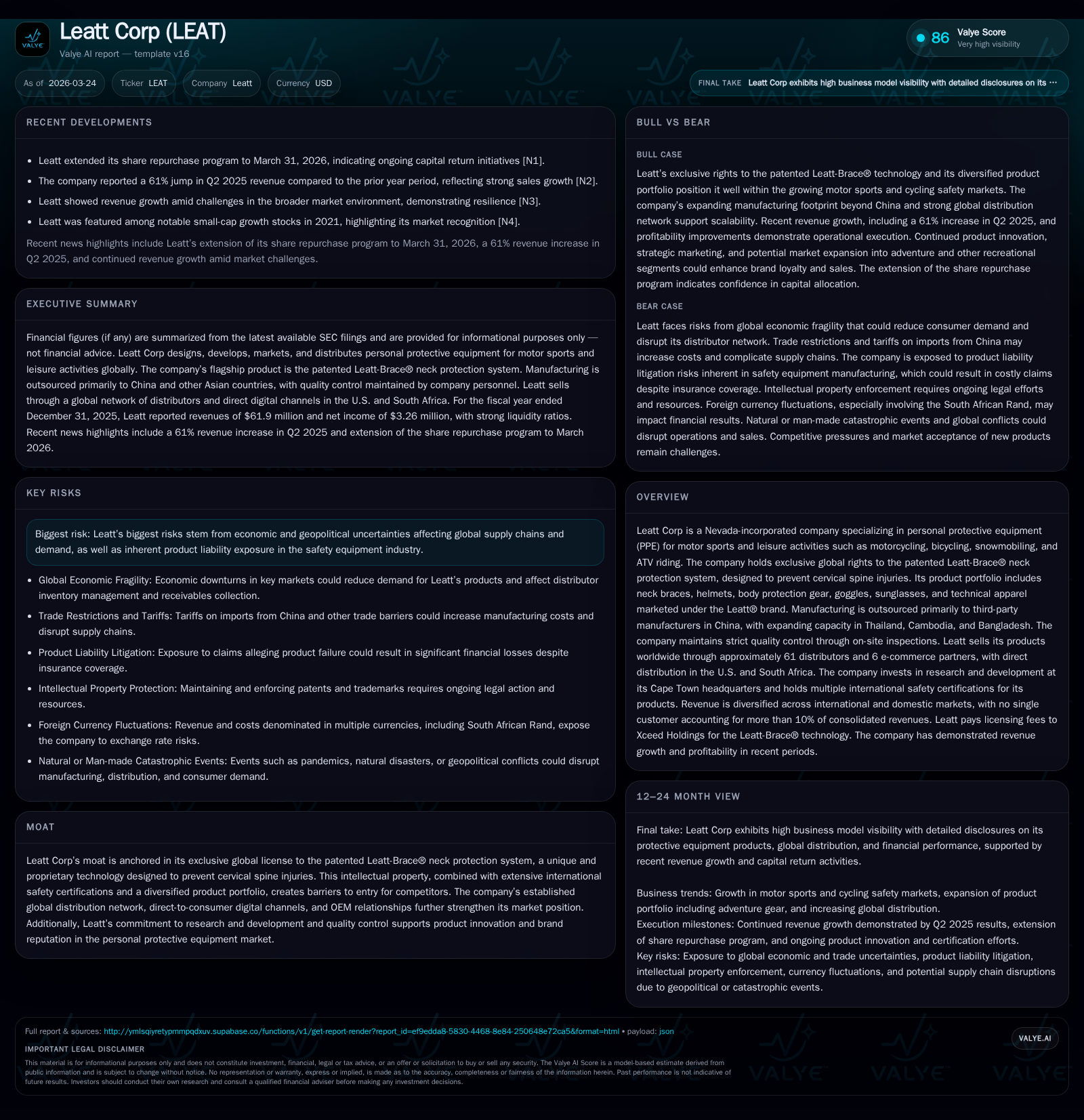
Leatt Corp returned to profitability in FY2025 after prior years of operating losses, supported by a 40.6% revenue surge and a 234.6% rebound in operating income. This recovery is anchored by its exclusive rights to the patented Leatt-Brace® neck protection system, which benefits from extensive international safety certifications. The company operates a diversified global supply chain with manufacturing primarily in China alongside growing capacity in Southeast Asia, enabling responsive expansion and risk mitigation. Despite a decline in operating cash flow in 2025 compared with 2024, the firm maintains a strong liquidity position and prudent capital expenditure approach. Looking forward, Leatt faces opportunities for growth via direct-to-consumer digital channels and OEM partnerships but must navigate ongoing geopolitical supply risks and patent litigation.
From Volatility to Growth: Historical Financial Performance Overview
Leatt Corp demonstrated pronounced financial recovery in FY2025, rebounding from headwinds that led to operating losses in FY2024 [F1]. Revenue advanced by 40.6% year-over-year to nearly $61.9 million, underscoring renewed demand momentum after prior declines [F1]. Operating income turned positive at roughly $4.01 million for FY2025, reflecting a substantial rebound of 234.6% relative to the previous year [F1]. Net income also improved sharply from a net loss of approximately $2.20 million in FY2024 to a net profit exceeding $3.26 million [F1], translating into an approximate ROE of 7.7% based on FY2025 equity near $42.23 million [F1].
However, operating cash flow softened by about 35.3% from $2.79 million in FY2024 down to just over $1.81 million despite improving profitability—likely influenced by working capital shifts amid expanding operations [F1]. Capital expenditures moderated slightly to approximately $1.08 million in FY2025 from nearly $1.23 million the prior year, aligning with targeted investments mainly supporting research & development and e-commerce capabilities [F1],[S14].
Historical performance (annual)
| FY | Rev ($mm) | Net ($mm) | CFO ($mm) | OpInc ($mm) | Rev YoY | Net YoY |
|---|---|---|---|---|---|---|
| 2025 | 62 | 3 | 2 | 4 | +40.6% | +248.0% |
| 2024 | 44 | -2 | 3 | -3 | -6.8% | -374.5% |
| 2023 | 47 | 1 | 7 | 1 | -38.1% | -91.9% |
| 2022 | 76 | 10 | 3 | 13 |
Source: SEC companyfacts cache [F1].
Capital returns and efficiency (annual)
| FY | FCF ($mm) | ROE% |
|---|---|---|
| 2025 | 1 | 7.7 |
| 2024 | 2 | -5.8 |
| 2023 | 5 | 2.0 |
| 2022 | 2 | 25.1 |
Source: SEC companyfacts cache [F1].
Table: Leatt Corp Historical Financial Highlights showing recovery trend in FY2025 [F1]
The Pillar of Innovation: The Leatt-Brace® Franchise and Technology Edge
Central to Leatt’s competitive advantage is its exclusive global license for the patented Leatt-Brace® neck protection system—a pioneering injection-molded cervical spine protective technology engineered to prevent catastrophic injuries during motor sports activities [S1]. This intellectual property is held through Xceed Holdings under a licensing agreement controlled by founder Dr. Christopher Leatt [S1].
The Leatt-Brace® system holds extensive international safety certifications including Economic Commission for Europe (ECE) UN Regulation No.22 r06 for motorcycle helmets; US Department of Transportation (DOT) FMVSS218; North American ASTM F1952 for downhill bicycle racing; Australian/New Zealand AS/NZS2063; UK Auto Cycle Union Gold Standard; Japanese JSA JIS T8133; Brazilian ABNT NBR7471; Chinese CCC certifications; Dutch NTA8776 e-bike helmet standard; and FIM homologation for sanctioned off-road events [S1],[S26]. These certifications underpin market credibility where regulatory approval serves as both technical validation and marketing leverage.
Beyond the flagship brace technology offering mechanical load distribution across the cervical region during crashes [S26], Leatt has developed an expanding portfolio including helmets integrated with this technology alongside body protection gear such as chest protectors marketed under its brand [S22]. This vertical integration reinforces barriers to entry given R&D complexity and certification lead times.
Global Footprint and Manufacturing Evolution: Supply Chain Nuances
Leatt relies predominantly on third-party manufacturers based mainly in China—leveraging scale efficiencies critical for cost competitiveness—but recognizes supply chain risks amid geopolitical tensions affecting tariffs and logistics [S1],[S20]. To mitigate these risks and diversify manufacturing exposure [S18],[S19], the company is scaling supplemental production capacities across Thailand, Cambodia and Bangladesh.
Quality assurance includes internal inspections supported by external consultants conducting on-site audits at manufacturing facilities ensuring adherence to strict production specifications vital for safety compliance [S1],[S13]. Products are typically shipped from consolidated or manufacturer warehouses directly to distributors or import agents worldwide—streamlining delivery while managing inventory costs [S5],[S11].
Market Dynamics: Demand Drivers, Competitive Positioning & Risk Factors
Demand drivers include heightened consumer safety awareness across motor sports such as motocross racing—as well as urban cycling trends boosted by e-bike adoption necessitating advanced helmet certifications like NTA8776—and broader leisure participation emphasizing injury prevention gear effectiveness [S2]. The Leatt-Brace® technology addresses cervical spine injuries that are difficult to mitigate via conventional helmets alone.
Competitive advantages stem from proprietary licensed IP combined with an extensive distributor network comprising approximately 61 distributors plus six e-commerce partners enabling broad retail reach globally [S13],[S22]. Direct distribution subsidiaries Two Eleven (U.S.) and Leatt SA (South Africa) bolster digital storefronts facilitating direct-to-consumer sales growth.
Risks include cybersecurity threats linked to IT systems used for order processing and customer data—with limited redundancy potentially heightening vulnerability—and ongoing geopolitical instability impacting raw material procurement plus shipping costs affected by fuel price volatility [S20],[S9]. Product liability exposure remains inherent given potential claims despite comprehensive insurance coverage; historically the Company has prevailed or settled lawsuits related to product performance claims but vigilance continues given industry hazards [S20],[S15].
Financial Health & Capital Allocation: Cash Flows & Profitability
Leatt shows solid liquidity with current assets around $47.6 million against current liabilities near $9.78 million at FY2025 year-end yielding a conservative current ratio near 4.87—providing substantial short-term financial flexibility [F1],[S23]. Profitability improved markedly returning positive operating earnings after consecutive prior year losses.
Return on equity approximates about 7.7%, indicating moderate efficiency generating shareholder value within this niche PPE sector that demands sustained innovation investment overseen through dedicated R&D teams based at Cape Town headquarters collaborating with external engineering partners for certification rigor [F1],[S1],[S14]. Free cash flow was positive at roughly $725k—operating cash flow less capex—reflecting cautious but strategic investment priorities without dividends or buybacks signaled currently favoring organic growth reinvestment [F1],[S7],[S14].
Future Outlook: Growth Catalysts & Constraints Ahead
Management expresses optimism centered on motor sports market growth particularly within bicycles driven by enhanced safety regulations plus consumer trends favoring outdoor recreation alongside global digital channel expansions that lift direct sales volumes beyond wholesale models enabling improved profitability leverage contingent on scaling unit economics realization [S2]. OEM partnerships offer incremental upside embedding products within motorcycle manufacturers’ ecosystems enhancing brand visibility.
Constraints include persistent supply chain fragility exacerbated by tariffs or customs restrictions potentially elevating input costs or delaying inventory replenishment affecting fulfillment speed plus ongoing patent infringement litigation initiated mid-2025 within South Africa which could materially impact IP enforcement depending on legal outcomes pending without scheduled hearings yet designated—a legal risk requiring close monitoring given competitive moat reliance [S25].
Maintaining quality production flow amid volume acceleration while navigating geopolitical headwinds will be essential for sustaining momentum beyond the near term.
Investor Focus: Operational Milestones & Benchmarks
In absence of explicit guidance on revenue or margins corporate observers should track indicators like order backlog evolution and distributor inventory turnover as early signs of demand trends or channel health—especially relevant following prior industry-wide elevated stockpiling phases impacting ordering patterns [S3]. Key R&D milestones including new product certifications will reflect innovation execution sustaining differentiation within PPE markets.
Operational priorities encompass advancing geographic manufacturing diversification beyond China toward Southeast Asia corridors critical for reducing geopolitical risk while enhancing agility plus closely observing developments around South African patent litigation given strategic implications on IP portfolio integrity foundational to competitive positioning. Enhancements within digital commerce platforms supporting Two Eleven U.S./Leatt SA South Africa channels may signal emerging return pathways from direct-to-consumer models driving long-term growth scalability.
This analysis is informational only and does not constitute investment advice regarding securities of Leatt Corp or any other mentioned entities.
Disclaimer: This is research-only, informational analysis and not investment advice. It may include AI-generated interpretation and general industry context. Always verify important details using primary sources.

Comments