
Perma-Fix Environmental Services' Shifting Revenue Mix and Regulatory Dependencies Pressure Margins
The company leverages specialized nuclear waste treatment licenses and emerging PFAS technology amidst federal budget uncertainties.
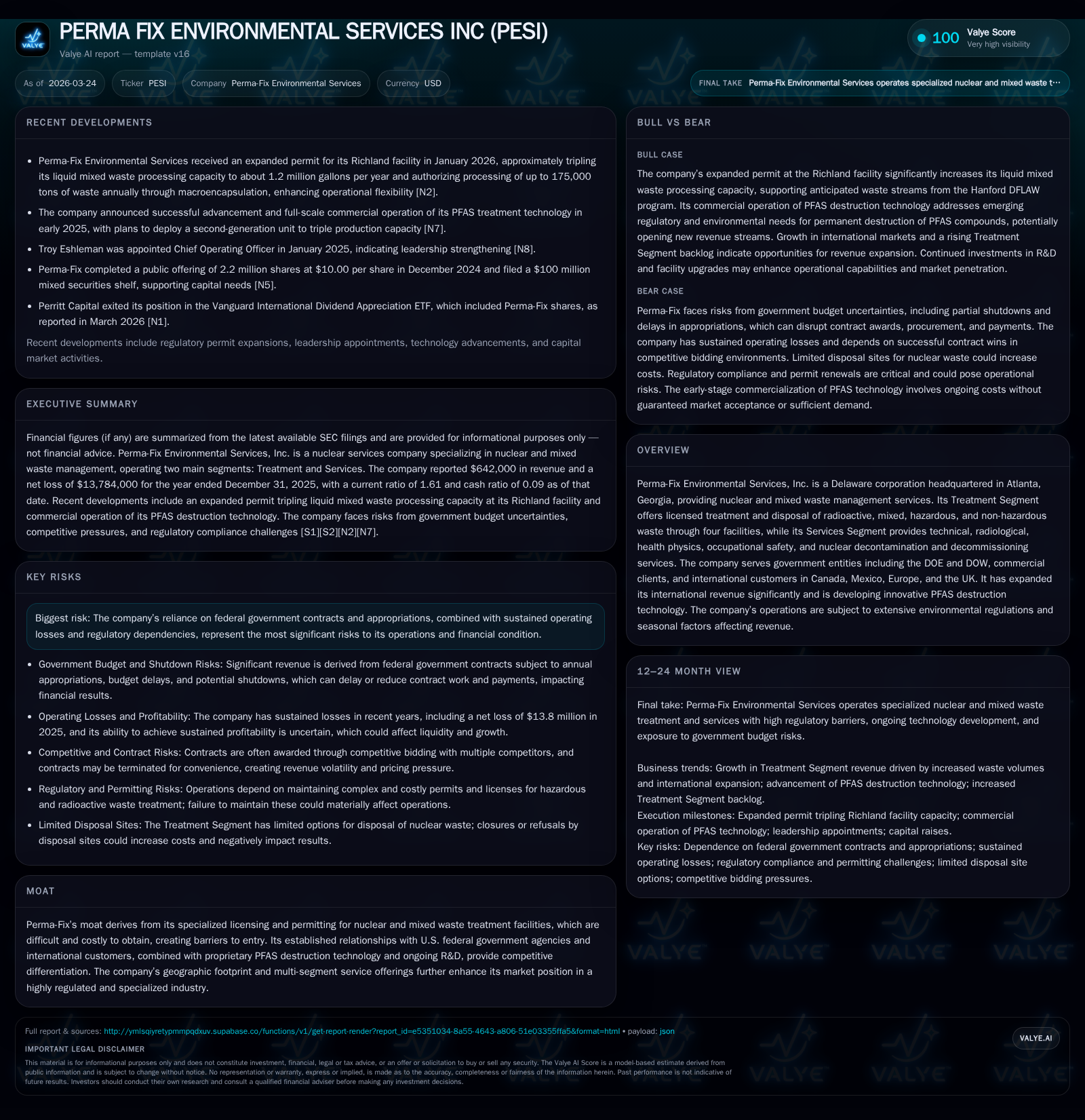
Perma-Fix Environmental Services Inc (PESI) operates in a highly regulated niche of nuclear and mixed waste management, serving predominantly U.S. government clients alongside growing international business. While 2025 revenue plunged dramatically due to the divestiture of legacy operations, improvements in treatment segment backlog and international contracts provide potential growth avenues. Significant risks remain from regulatory dependencies, government funding delays, and sustained operating losses with negative cash flow trends. The company is advancing its proprietary PFAS destruction technology as a strategic growth initiative within its broader remediation portfolio.
Company Overview and Industry Position
Perma-Fix Environmental Services Inc (NASDAQ: PESI), incorporated in Delaware and headquartered in Atlanta, Georgia, is a leading niche provider focused on treatment and management of radioactive and mixed hazardous waste. Its core competencies span licensed treatment facilities enabling disposal of nuclear and mixed wastes, paired with a technical services segment that offers radiological protection, decommissioning (D&D), health physics, occupational safety, and consulting services primarily to U.S. government entities such as the Department of Energy (DOE) and Department of Defense (DOD), commercial clients, and an expanding international customer base across Canada, Mexico, Europe, and the UK [S1][S4][S8][S16].
Key competitive advantages stem from the extensive regulatory licensing required to operate nuclear waste treatment facilities under Nuclear Regulatory Commission (NRC) or equivalent state authorities, creating high barriers to entry for new players. The company’s diversified geographic presence combined with ongoing R&D investments into novel waste processing methods like PFAS destruction technology support differentiation within this specialized industry [S1][S12][S20].
Historical Performance and Revenue Dynamics
Perma-Fix's historical financial trajectory has seen significant volatility influenced by regulatory cycles, government budget fluctuations, and portfolio restructuring efforts.
Historical performance (annual)
| FY | Rev ($mm) | Net ($mm) | CFO ($mm) | OpInc ($mm) | Rev YoY | Net YoY |
|---|---|---|---|---|---|---|
| 2025 | 1 | -14 | -11 | -12 | +31.0% | |
| 2024 | -20 | -15 | -16 | -4219.4% | ||
| 2023 | 0 | 6 | 1 | +112.7% | ||
| 2022 | 60 | -4 | -1 | -5 | -1.3% |
Source: SEC companyfacts cache [F1].
Capital returns and efficiency (annual)
| FY | FCF ($mm) | ROE% |
|---|---|---|
| 2025 | -15 | -27.5 |
| 2024 | -18 | -32.0 |
| 2023 | 4 | |
| 2022 | -2 |
Source: SEC companyfacts cache [F1].
Note: Revenue for years prior to 2025 are not reported explicitly here post-asset sale; reported drop in FY25 reflects strategic divestitures rather than pure operational decline [F1].
The dramatic collapse in top-line revenue recorded at $642K for FY2025—down almost 99% year-over-year—stems chiefly from strategic asset sales linked with discontinued operations divested around late-2024/early-2025 which removed substantial legacy revenue streams [F1][S1][S17]. This shift materially distorts direct comparability with prior years but refocuses Perma-Fix towards core profitable operations.
Within this reshaped business model:
- The Treatment Segment bounced back strongly during the year driven by higher radioactive waste volumes including growing revenue contribution from international commercial clients realizing nearly double-digit volume growth; it represented approximately 73% of consolidated revenue in 2025 up from about 59% in the previous period [S4][S16].
- Conversely the Services Segment saw a significant revenue contraction (~31%) due to delayed project mobilization and procurement disruptions linked to shifts in federal administration policies earlier in the year along with impacts from the partial federal shutdown starting October 1st of that year [S1][S2][S16].
Though there are clear signs of operational improvement within the Treatment business line through backlog expansion—rising about +51% to approximately $11.9 million—the actual conversion timing into revenue remains variable given complexities with waste types and customer-specific requirements [S1].
Forward-Looking Growth Drivers and Challenges
Growth Prospects:
- The ramp-up associated with planned activities tied to the DOE’s Direct-Feed Low-Activity Waste program at Hanford is expected to drive volume increases in nuclear waste treatment capacity [S1].
- International expansion initiatives targeting Canada, Mexico & European markets aim to mitigate domestic government dependence by leveraging Perma-Fix’s unique treatment capabilities including volume reduction via incineration for returns back to generators [S4][S8].
- Research & Development focused on PFAS (per- and polyfluoroalkyl substances) destruction technology appears promising as one of very few options facilitating permanent elimination versus containment—currently moving from bench scale towards pilot scale applications with deployment plans for enhanced second-generation systems increasing capacity potentially threefold by late-2026 [S20][S24]. A joint U.S. distribution agreement entered in late-2025 with a fluorine-free firefighting agent manufacturer indicates early commercial traction efforts [S24].
Constraints:
- The core dependency on U.S. federal government contracts remains a major risk factor; about two-thirds (~64%) of total revenue originates either as prime or subcontract work from federal agencies like DOE/DOD whose budgets face unpredictability amid frequent continuing resolutions or shutdowns that disrupt revenue recognition timing or lead to outright cancellations [S1][S2][S4][S17]. A partial federal shutdown beginning October 1st 2025 negatively impacted project activity and payment schedules [S2].
- The company continues to incur losses at the operating level with negative EBITDA trends aggravated by elevated capital expenditures aimed at upgrading facilities and scaling R&D efforts which limits positive free cash flow generation until operations sustainably improve [F1].
- Heavy regulation introduces operational risks including permitting challenges for facilities under EPA/RCRA/TSCA frameworks; loss or tightening of permits could materially hamper facility operations given few alternatives exist for disposal sites [S6][S10][S25].
- Environmental liability potential remains substantial due to exposure from historical contaminated sites remediation obligations totaling nearly $3.5 million reserves as of end-of-year reflecting increased estimates largely at Perma-Fix South Georgia operations related to soil and groundwater cleanup costs [S13].
Financial Condition and Capital Allocation
Despite recent asset sales that have restructured company scale,
- Operating income stood at a loss of approximately $11.7 million in FY25 representing modest improvement relative to prior year ($15.7 million loss) [F1].
- Net loss was $13.8 million; trailing twelve months ROE is negative around -27.5% based on net loss relative to shareholders' equity near $50 million at year-end [F1].
- Operating cash flows were deeply negative at roughly minus $10.7 million against capital expenditures exceeding $4.7 million resulting in an approximate free cash flow deficit close to -$15.5 million underscoring ongoing liquidity strain [F1].
- The company holds current assets well above current liabilities yielding a current ratio near 1.6x providing some short-term liquidity cushion; however debt covenants related to borrowing base tied to accounts receivable quality impose restrictions that could limit financing flexibility if profitability does not recover sufficiently soon [F1][S7][S9].
- No dividend payments or share repurchases were reported consistent with preservation of capital during continued losses.
Competitive Landscape Details
Major competitors include EnergySolutions and Waste Control Specialists which operate multiple licensed treatment/disposal centers offering overlapping low-level radioactive waste handling capabilities creating pricing competition on disposal sites that Perma-Fix relies upon post-treatment segments' processing efforts [S4]. Differentiators rely heavily on licensing breadth/complexity along with integrated service offerings including radiological engineering support personnel embedded within Services Segment engagements [S14]. Internally developed PFAS destruction technology adds an innovative layer distinguishing Perma-Fix's value proposition above standard containment methods increasingly favored amidst tightening regulatory scrutiny on PFAS contamination liabilities [S20][S24]. Nonetheless competitive tender environments especially in government procurement necessitate consistent safety records and cost rationalization measures given concentration on large fixed-price contracts shielded from inflationary pass-throughs limiting pricing power despite rising input costs [S15].
Risk Profile Summary
Regulatory compliance burden continues to shape operational risk profiles: numerous environmental laws such as RCRA and CERCLA impose strict permitting requirements coupled with joint liability exposure for past contamination events extending even to third-party activities complicating risk management efforts [S6][S11][S22]. Failure or delays in obtaining/maintaining permits could result in abrupt stoppage or suspension orders severely impacting financial stability.
Political uncertainties bear heavily through exposure to U.S federal funding mechanisms prone to impasses disrupting contract award cycles plus pandemic-like macro shocks causing supply chain delays that hamper mobilization timelines further exacerbating Services Segment inconsistencies evidenced over recent years [S2][S19]. Litigation risk related to toxic tort claims is heightened given historical exposure footprint requiring diligent risk mitigation strategies supported by insurance programs though residual risks linger towards financial outcomes.
Cybersecurity vulnerabilities could impact sensitive data retention especially tied to government projects requiring rigorous controls maintained within ongoing IT investments.
Conclusion: Monitoring Indicators Ahead
Key variables warranting vigilant observation over forthcoming quarters:
- Realization rate of Treatment Segment backlog translating into top-line recovery vis-à-vis Services Segment procurement pipeline stability.
- Commercial adoption velocity & scalability success for PFAS destruction capabilities.
- Resolution dynamics around U.S federal budget appropriations cycles alleviating shutdown duration risks impacting order flow timing.
- Trends in operating margin contraction/expansion aligned with capacity utilization changes after recent capex outlays.
- Environmental remediation cost developments influencing contingency reserves adjustments.
Perma-Fix’s ability to leverage its specialized operational footprint combined with technological innovation amid lingering fiscal headwinds will dictate its near-to-medium term financial rehabilitation path alongside ongoing compliance vigilance required by this intensely circumscribed industrial niche.
This report synthesizes currently available information as of March 24th, 2026 without providing investment advice or price guidance. All numeric figures are cited explicitly from company filings or confirmed sources.
Disclaimer: This is research-only, informational analysis and not investment advice. It may include AI-generated interpretation and general industry context. Always verify important details using primary sources.

Comments