
Sparta Commercial Services: Specializing in Niche Financing Amid Capital Strains
Sparta’s multi-sector niche strategy combines blockchain innovation with municipal equipment financing but faces critical liquidity challenges.
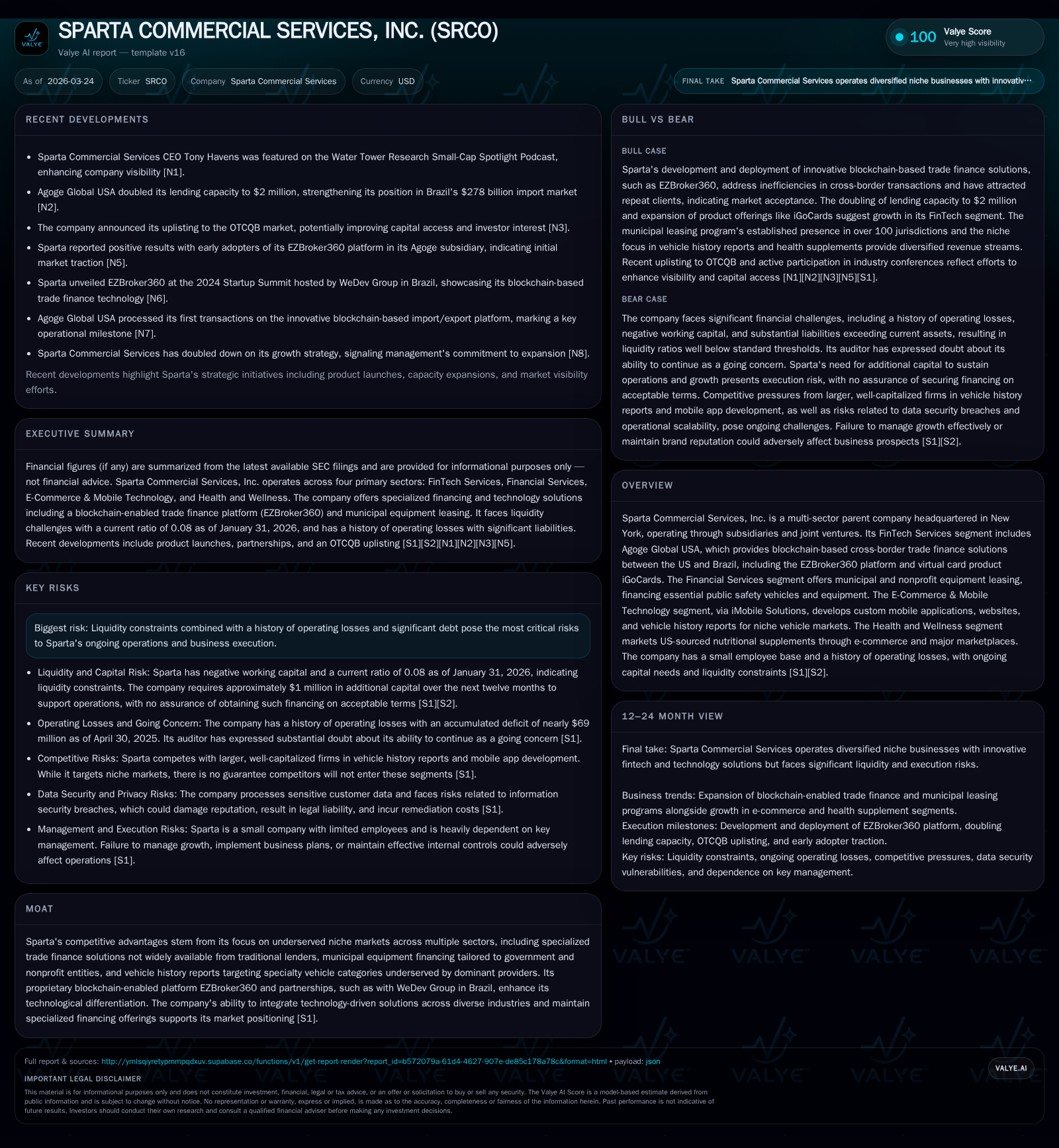
Sparta Commercial Services operates uniquely across fintech, municipal leasing, mobile technology, and health sectors, targeting underserved niche markets with proprietary offerings like the EZBroker360 blockchain platform. Despite technological differentiation and innovative finance solutions, the company endures a history of significant operating losses, a debilitated balance sheet with a current ratio near 0.08, and mounting debt obligations totaling over $11 million. Sparta requires approximately $1 million in capital within the next year to sustain operations amid ongoing negative cash flows and dilution risks. Forward growth depends on scaling fintech products, expanding joint ventures, and resolving liquidity constraints while regulatory scrutiny poses added uncertainty.
Evolution of Sparta’s Revenue Streams and Historical Profitability
Sparta Commercial Services operates four primary business segments: FinTech services specializing in cross-border trade finance; financial services focusing on municipal and nonprofit leasing of essential equipment; e-commerce and mobile technology offering custom applications and vehicle history reports; and health and wellness marketing US-sourced nutritional supplements [S1][S5][S9]. Despite this diversification, Sparta has persistently struggled with profitability.
Annual revenues have hovered around the $600,000 mark most recently ($601,832 at FY2025 end), reflecting relatively flat top-line performance without meaningful growth acceleration [F1]. Operating income has consistently been negative throughout recent years, dipping from -$864,493 in FY2024 to -$1,225,083 in FY2025—a 41.7% deeper loss year-over-year [F1]. Net income exhibits even more pronounced deterioration: a loss of approximately $2.11 million in FY2025 compared with a $607K loss the prior year representing a -248.2% swing [F1]. Operating cash flows are also negative at around -$1.23 million for FY2025, underscoring continuing cash burn alongside negligible capital expenditures.
Historical performance (annual)
| FY | Net ($mm) | CFO ($mm) | OpInc ($) | Net YoY |
|---|---|---|---|---|
| 2025 | -2 | -1 | -1225083 | -248.2% |
| 2024 | -1 | -1 | -864493 | -159.5% |
| 2023 | 1 | -3 | -1389655 | +111.3% |
| 2022 | -9 | -1 | -1267246 |
Source: SEC companyfacts cache [F1].
Capital returns and efficiency (annual)
| FY | ROE% |
|---|---|
| 2025 | 18.2 |
| 2024 | 5.7 |
| 2023 | -9.1 |
| 2022 | 43.4 |
Source: SEC companyfacts cache [F1].
Revenue steady around $600K latest; accelerating losses especially FY25; minimal Capex spend.
This trend highlights that despite multiple operational facets and technology-driven business lines spanning FinTech to consumer wellness products[S9], Sparta remains deeply unprofitable with an expanding accumulated deficit exceeding $68 million as of April 30, 2025 [S1].
Innovative Solutions: Blockchain Trade Finance and Municipal Equipment Leasing
Sparta's FinTech arm is driven by Agoge Global USA Inc., formed in late 2022 as a subsidiary dedicated to bridging cross-border trade finance inefficiencies between the United States and Brazil [S1]. A strategic joint venture with WeDev Group Ltda., a Brazilian blockchain-focused tech firm brings technological heft to this initiative.
The flagship product is EZBroker360—an advanced blockchain-enabled platform leveraging stablecoins and distributed ledger technology to accelerate transaction times markedly from days down to mere hours while lowering payment processing costs and boosting security transparency through audit-ready ledgers [S1][S5].
Beyond simple payment facilitation via its underwriting platform supporting staged financing (covering freightage costs through customs duties), EZBroker360 offers compliance assistance tailored to Brazilian tax rules plus import/export documentation support—a distinctive feature not typical among conventional banks involved in international finance [S9]. Additionally, it encompasses industry introductions aiding market entry logistics and coordinates reselling efforts extending beyond primary jurisdictions.
A complementary fintech innovation is iGoCards—a virtual card expense management system designed for globally oriented enterprises allowing USD or stablecoin fund loading alongside multi-user control features intended to streamline both payables and receivables for comprehensive financial ecosystem management around international commerce activities currently under phased rollout [S1][S9].
Parallelly, Sparta’s Financial Services segment provides equipment leasing predominantly for municipalities and nonprofits under IRC §501(c)(3), financing vital assets like police cruisers (including preferred partnerships with BMW Motorrad USA Police Motors), fire trucks, EMS vehicles—areas often underserved by traditional institutional lenders due to regulatory or underwriting constraints unique to public sector clientele [S5][S9]. This segment benefits from direct outreach campaigns combined with recurring referrals from manufacturers and dealerships positioning Sparta as a go-to financing partner for over 100 jurisdictions domestically—again reinforcing Sparta’s niche focus model while maintaining pass-through relationships with banking institutions [S5].
Assessing Financial Health: Liquidity, Debt Burden, and Operating Loss Trends
Financially Sparta faces daunting challenges exacerbating its growth ambitions. As of January 31st, 2026 data reveals a perilous liquidity position:
- Cash & equivalents stand at a minimal $70K against current liabilities exceeding $11.4 million.
- Current assets total less than $925K yielding an abysmal current ratio near 0.08 indicating severe working capital deficiency unable to cover even short-term obligations without external funding injections [F1][S6].
- Total liabilities recorded were $11.35 million as April ended fiscal year 2025 further stressing solvency considerations amidst stagnant revenue inflows.
- Equity remains significantly negative (-$11.6M at FY2025 end), aligning with continued cumulative losses dating back several years indicating deep erosion of net asset base despite incremental capital raises or retained earnings adjustments).
Moreover an independent auditor explicitly raised "substantial doubt" regarding Sparta’s ability to continue as a going concern citing ongoing losses coupled with limited cash flow generation indicating that absence of successful recapitalization or profitable operations may force cease of business activities imminently [S6][S22].
Operating cash flows remain consistently negative with marginal reductions year-over-year (-$1.23M fiscal 2025 vs.-$1.21M fiscal 2024), reflecting persistent cash burn related to operational investments exceeding working capital replenishments or revenue inflows supporting day-to-day expenses without meaningfully reversing core losses [F1].
Debt restructuring conversations loom given the scale of liabilities relative to asset coverage without secured credit facility accessibility detailed as uncertain within filings pointing toward potential negotiation or asset divestiture scenarios should additional funding fall short [S6][S22].
Growth Drivers and Constraints in Diverse Niche Markets
Sparta leverages distinctive market niches characterized by financing needs overlooked by broader banking incumbents requiring specialized underwriting criteria or bespoke product structuring:
- The FinTech trade finance focus between US-Brazil corridors exploits economic friction points where traditional lenders tend not to engage due to complex regulatory frameworks or inefficient manual processes alleviated through blockchain automation benefiting clients such as Patta Brazil who report operational scaling including projected 50% revenue increases attributable directly to improved financing access from Agoge's solutions [S1][S9].
- Municipal leasing secures vital public safety assets supporting agencies nationwide fostering repeat client engagement bolstered by targeted marketing through trade shows plus referrals preserving entrenched client relationships despite competitive pressure from traditional financial institutions reluctant or constrained in servicing this segment effectively [S5][S11].
- Vehicle history reporting under iMobile Solutions addresses specialty vehicle categories like motorcycles or heavy-duty trucks inadequately covered by major providers CARFAX® or AutoCheck®, carving out defensible terrain reinforced by proprietary data sourcing agreements enhancing competitiveness within fragmented automotive data ecosystem niches [S8][S14].
- The Health & Wellness segment markets premium nutritional supplements sourced exclusively from U.S.-based manufacturers underscoring quality focus but faces intense competition within fragmented consumer wellness channels placing growth pressures on brand awareness initiatives amidst shifting e-commerce dynamics [S5][S11].
Constraints primarily revolve around capital scarcity restricting scale momentum—limited liquidity forces prioritization hindering aggressive expansion spending while mounting debt catalyzes cautionary deployment of investment dollars thereby throttling potential uptake velocity in each vertical category within extremely competitive landscaping dominated by better capitalized incumbents possessing established customer bases and marketing budgets [S15][S19].
Capital Allocation Strategy: Funding Needs, Shareholder Dilution, and Returns
To maintain operations amidst continuing losses Sparta anticipates requiring approximately $1 million in additional capital within the next twelve months—a prerequisite stated explicitly within its disclosures intended to fund working capital deficits prior to achieving positive cash flows or profitable status otherwise threatening ongoing viability [S6][F1]. Equity issuances contemplated carry material dilution risks for existing shareholders especially given recent grants of common stock options totaling 3.6 million shares exercisable over three years offered as executive incentives implicating increased share count potentially diluting earnings per share further absent profitability improvements influencing return metrics negatively [F1][S3].
No dividend distribution nor share repurchase program exists reflecting poor free cash flow generation combined with substantial operating deficits underscoring financial scarcity forcing reinvestment prioritization into core business activities rather than capital returns despite an inferred positive ROE metric obscured by highly negative equity balances rendering conventional profitability measures less comparable given net asset depletion histories [F1].
Capex spending remains minimal suggesting conservative investment philosophy possibly driven by urgent liquidity preservation over new fixed asset acquisition though this may also reflect the technology-centric model relying more heavily on intangible software development partnerships than physical infrastructure investment limiting depreciation burdens yet requiring sustained operational funding for platform maintenance.
What to Watch Next: Milestones and Potential Catalysts for Turnaround
While explicit forecasts are not disclosed publicly within filings recent developments warrant monitoring:
- Expansion roadmap for iGoCards will be pivotal; enabling "Receive" feature managing both payables/receivables could broaden platform utility attracting wider clientele stimulating recurring revenue streams complemented by stablecoin transaction processing efficiencies should adoption metrics increase incrementally beyond early traction stages noted by management discussion narratives.
- Further commercialization success of joint ventures such as Agoge's partnership with WeDev Group Ltda., particularly scaling loan deployments beyond initial $2 million marks supported by organic referrals alongside operational efficiency improvements serving as growth engines contingent on favorable regulatory environments sustaining transactional throughput efficiencies.
- Debt restructuring negotiations outcomes will materially affect capital cost structure determining if burden lightening can free up resources for growth investments versus potential liquidation threats
- Profitability inflection points remain aspirational pending combined top line expansion coupled with rigorous cost controls overcoming historically entrenched loss trends without observable margin improvement guidance given
Risks Surrounding Regulation, Compliance, and Going Concern Status
Regulatory environment injects significant uncertainty particularly surrounding fintech operations leveraging blockchain technologies where legal frameworks remain fluid:
- Legal ambiguity around smart contract enforceability coupled with heightened government scrutiny including U.S. federal/state investigations pose execution risks including compliance remediation costs that could materially impair agility needed for scaling product portfolios[S4][S7][S23].
- Crypto-economy regulation increasingly demanding adherence under anti-money laundering laws plus travel rules introduces operational overhead impacting user experience potentially risking customer attrition critical during nascent growth phases[S7][S13][S16].
- Ongoing auditor emphasis on going concern doubts indicates existential threat consistent with substantial indebtedness compounded by capital access uncertainties relevant factors demand vigilance in tracking liquidity measures closely paired with scenario planning for adverse outcomes[S6][F1].
- Cybersecurity risks inherent in digital transaction platforms further threaten reputational damage or interruption exposure due to malicious threat actors exploiting vulnerabilities thereby impacting client confidence essential for retention particularly within specialized trade finance sectors[S21][S28].
This report compiles publicly available SEC filings and company data as of March 24th, 2026 without extrapolation beyond documented evidence. It intends solely to provide detailed operational and financial insights into Sparta Commercial Services' multi-sector business framework relative to contemporaneous market and regulatory conditions without proffering investment advice.
Disclaimer: This is research-only, informational analysis and not investment advice. It may include AI-generated interpretation and general industry context. Always verify important details using primary sources.

Comments