
VenHub Global’s Autonomy Ambitions Tested by Early-Stage Financial Strains and Regulatory Hurdles
VenHub Global, Inc. pioneers fully autonomous retail stores leveraging robotics and AI but faces significant commercialization, financial, and regulatory challenges as it scales.
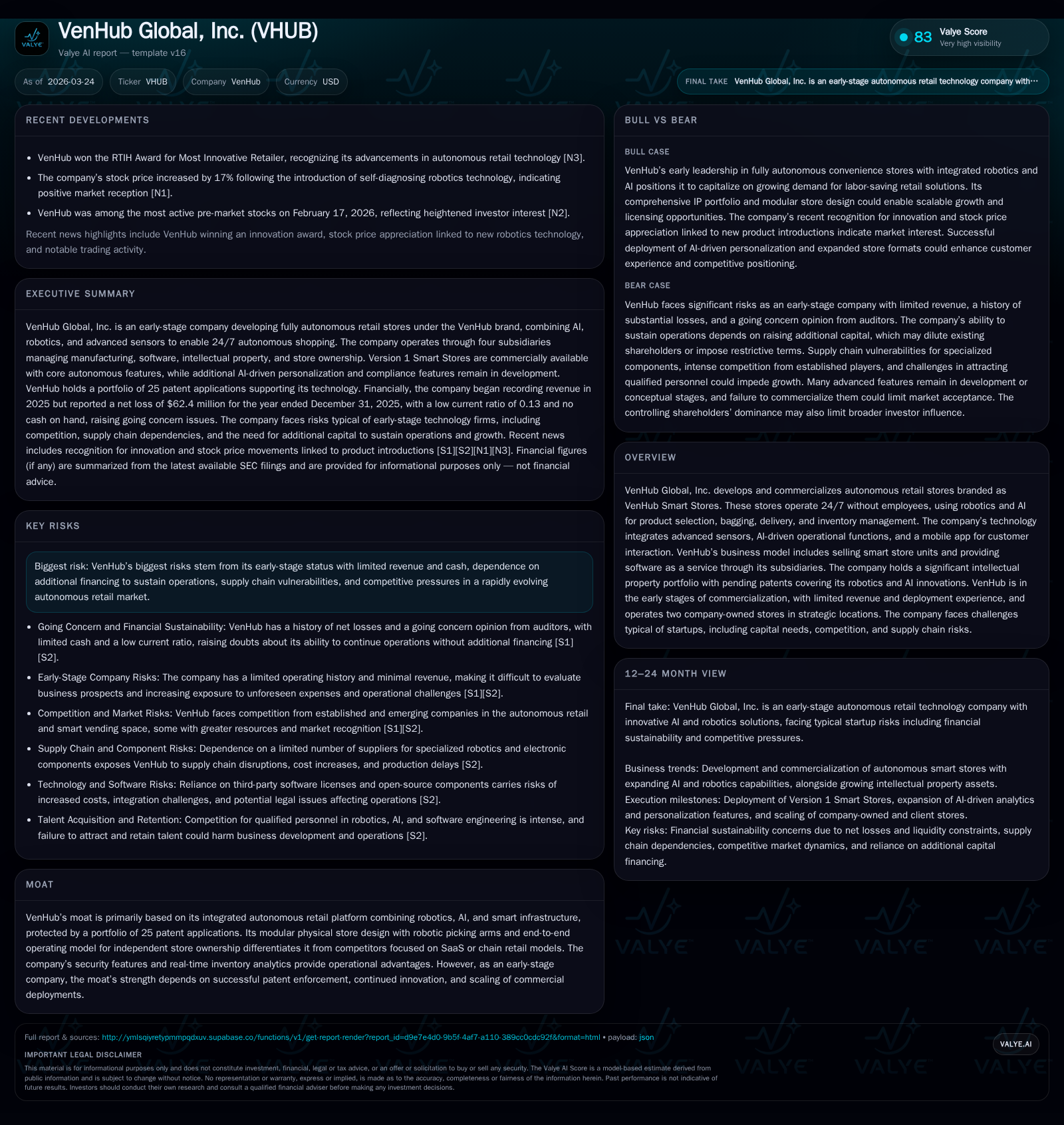
VenHub Global, established in 2023, operates two company-owned autonomous retail stores that integrate robotics and AI for a 24/7 employee-free shopping experience. Despite promising technology and a growing patent portfolio supporting its integrated retail platform, the company remains early-stage with minimal revenue and substantial operating losses. Its future growth hinges on transitioning from prototype to scalable commercial deployments amid intense competition, complex regulatory compliance, and capital constraints. VenHub’s financials reflect steep net losses exceeding $62 million at year-end 2025 on just $864K revenue, highlighting a precarious going concern status. Upcoming milestones include expanding store deployments and advancing AI personalization features, all while defending its brand amidst trademark disputes.
Company Background and Business Model
VenHub Global, Inc., incorporated in Wyoming in early 2023 before redomiciling to Delaware and subsequently Nevada by late 2025, is an autonomous retail technology company aiming to revolutionize convenience shopping through its flagship VenHub Smart Stores brand [S1][S13][S24]. These stores deploy integrated robotics, artificial intelligence (AI), sensors, and mobile applications to deliver a fully autonomous retail experience operating continuously without onsite employees.
The company combines physical modular store infrastructure—approximately 200 square feet per unit—with sophisticated AI-powered backend systems facilitating product selection, robotic bagging and delivery within the store footprint, inventory tracking, customer app ordering, and store performance analytics for owners [S13][S26]. VenHub plans to expand product functionality and store formats including mobile/wheeled smart units adaptable to diverse retail environments.
Currently, two company-owned flagship stores at Los Angeles Airport (LAX) and Union Station serve primarily to seed strategic markets, conduct research & development activities, test new technology features live, and comply with local jurisdictional requirements where direct operation is necessary rather than selling units to third parties [S13]. The broader business model focuses on selling robot-enabled smart store units coupled with Software as a Service (SaaS) solutions through subsidiaries.
Historical Performance: Growth Drivers and Financial Results
As a recent entrant with commercial revenue starting only in 2025, VenHub remains at an early commercialization stage. Recorded revenue for the twelve months ending December 31, 2025 was $864K USD — reflecting limited commercial rollout — while operating income was negative $39.4 million USD with net losses around $62.4 million USD due to significant investments in technology development, manufacturing setup costs, public company expenses following Nasdaq listing (January 30, 2026), general administration, sales efforts and ongoing R&D focused on robotics and AI capabilities [F1][S1][S14].
Cash and equivalents were reported at zero as of September 30, 2025; current liabilities of $10.55 million significantly exceeded current assets of $1.36 million resulting in a current ratio of only 0.13—a clear liquidity pressure requiring near-term financing or equity raises [F1][S10][S27].
Historical performance (annual)
| FY |
|---|
| 2025 |
Source: SEC companyfacts cache [F1].
These metrics illustrate typical startup patterns within capital-intensive sectors such as robotics-enabled retail automation.
Competitive Positioning and Moat Considerations
VenHub emphasizes its integrated end-to-end platform combining robotics hardware with AI operational functions as differentiators from competitors primarily offering SaaS or partial automation without full autonomy or modular ownership models [N1][S13]. Its intellectual property portfolio includes approximately 25 pending patent applications covering robotics navigation systems, AI-powered inventory control algorithms, security mechanisms including bulletproof glass enhancements—and predictive theft prevention leveraging AI analytics [S20].
The strength of this moat depends on successful patent enforcement against incumbents or emerging entrants with deeper capital resources; failure could lead to commoditization risks [S20]. Additionally, the "VenHub" trademark faces formal opposition at the USPTO which may disrupt brand continuity during critical early customer acquisition phases amid competitive industry activity [S22].
Future Growth Prospects: Highlights and Constraints
VenHub plans enhancements beyond current robotic picking/bagging/delivery features:
- Expanded AI-driven analytics improving forecasting accuracy for inventory optimization.
- ID verification modules targeting age-restricted products enhancing compliance.
- Customer personalization via recommender engines analyzing purchase history (currently in testing).
- Biometric authentication technologies aimed at secure transactions.
- Energy infrastructure upgrades including battery backups plus solar power integration projects underway.
- Format expansions into larger footprints partnering potentially with big-box retailers plus mobile/wheeled smart store versions optimizing last-mile deployment flexibility [S13][S26].
Growth bottlenecks include:
- Manufacturing scale challenges intrinsic to complex robotic assembly onsite.
- Complex multi-jurisdictional regulatory compliance involving licenses for robotic equipment operation in public spaces plus stringent data privacy laws affecting user information handling [S4][S15][S17].
- Acute reliance on external financing given limited cash resources; failure to secure funding could stall expansion or cause dilution [F1][S10][S27].
- Competitive pressures from established smart vending players or chain retailers developing autonomous checkouts may erode advantages absent accelerated commercialization.
Key Milestones & What to Watch For
Key milestones going forward include:
- Expanding beyond initial two operated locations via more company-run stores or third-party sales increasing installed base.
- Deployment of advanced AI personalization moving from testing into live environment trials.
- Resolution of trademark opposition supporting brand consolidation.
- Improvement of liquidity profile through financing rounds or partnerships enabling scaled production capacity aligned with sales growth.
- Navigating evolving regulatory approvals without costly delays or product redesigns impacting time-to-market.
Investors should monitor quarterly disclosures for updates on these areas alongside metrics related to active smart store counts and SaaS subscription growth if applicable.
Capital Allocation & Returns Profile
VenHub’s financial profile shows substantial net losses (over $62 million) relative to minimal revenues (~$864K), resulting in distorted return metrics such as an approximate ROE of +604% driven by negative equity positions rather than profitability [F1]. The company does not pay dividends or conduct buybacks nor generate positive operating cash flow due to ongoing cash burn necessitating fresh capital likely from equity or debt financing given near-zero cash balances reported Q3 2025 [F1][S10][S27].
Capital allocation prioritizes R&D investments toward maturing autonomous robotic platforms alongside incremental capex for manufacturing setup—all aimed at scalable commercial rollouts constrained currently by lack of positive free cash flow generation. Returns on invested capital are expected only once higher volumes enable operational leverage benefits complemented by software subscription revenues [S14].
Risks Overview
VenHub faces typical early-stage tech venture risks:
- Auditor issued going concern opinion highlights existential threat absent timely financing arrangements [S1].
- Complex regulations intersecting robotics operation licenses with data privacy laws create compliance burdens possibly causing costly delays or fines if unresolved promptly [S4][S15][S17].
- Intellectual property enforcement risks including patent defenses and trademark opposition consume legal resources diverting management focus [S20].
- Execution risks persist given unproven manufacturing scale capacity plus uncertainties around timing of AI feature deployment impacting competitive position.
- Cybersecurity vulnerabilities threaten proprietary information security requiring sustained investment; failures could harm customer trust during critical growth phase [S16].
- Dependence on continuous funding exposes share price volatility risks coupled with dilution pressures during fundraising detrimental to existing shareholders [F1].
Conclusion
VenHub Global presents an ambitious vision for fully autonomous retail powered by cutting-edge robotics combined with real-time AI analytics aiming to transform consumer shopping outside traditional staffed outlets. While its technology foundation appears promising supported by a broad IP portfolio enabling integrated smart stores operating around the clock without human intervention—the transition from pilot demonstrations to fully scaled profitable business remains challenging.
Severe operating losses reflective of ongoing development stage paired with complex regulatory environments require careful navigation alongside intellectual property defense imperatives already manifesting legal complexities around branding rights. Near-term commercial evidence mainly comprises pilot flagship locations emphasizing demonstration over mature cash flow generation.
Success depends on effective capitalization bridging funding gaps while accelerating production capabilities accompanied by iterative software enhancements crucial for differentiated customer experiences—especially personalization features still maturing post-launch. Monitoring milestone achievements including expanded deployments beyond seeded flagship units alongside resolution of trademark challenges will provide insight into whether VenHub can convert innovative promise into sustainable market penetration amid intensifying competition in autonomous retail.
This report is based solely on publicly available data as of March 24th, 2026. It does not constitute investment advice or recommendations.
Disclaimer: This is research-only, informational analysis and not investment advice. It may include AI-generated interpretation and general industry context. Always verify important details using primary sources.

Comments